My plan for the Franco-Prussian War Prussian Army project is to raise a complete infantry corps and a cavalry division. With much of the infantry corps complete I have started the cavalry.
It is easy to think that cavalry in the Franco-Prussian War was sidelined in a conflict in which tactics were dominated by artillery and small arms fire. Yet in the opening six weeks of the war, from the initial actions on the Frontier to the French surrender at Sedan, the cavalry forces on both sides were numerous and played a significant combat role in three of the eight major battles. At Froeschwiller, on 6 August 1870, Michel’s cuirassiers brigade was sacrificed to allow Lartigue’s infantry division to disengage, while just an hour or so later on the same field another four regiments of cuirassiers from Bonnemains’ Division were sacrificed in a vain attempt to allow the rest of MacMahon’s Corps to escape destruction. Ten days later, at the Battle of Rezonville — Vionville — Mars-la-Tour there were three significant cavalry actions: the unsuccessful attempt by the French cavalry, including the Cuirassiers of the Guard, to recapture the village of Flavigny; von Bredow‘s famous “Todtenritt, or Death Ride” and the great clash of cavalry near near Village sur Yron - the last great mounted cavalry battle on the planet. Finally there was the destruction of Margueritte’s cavalry at the Battle of Sedan on 1 September.
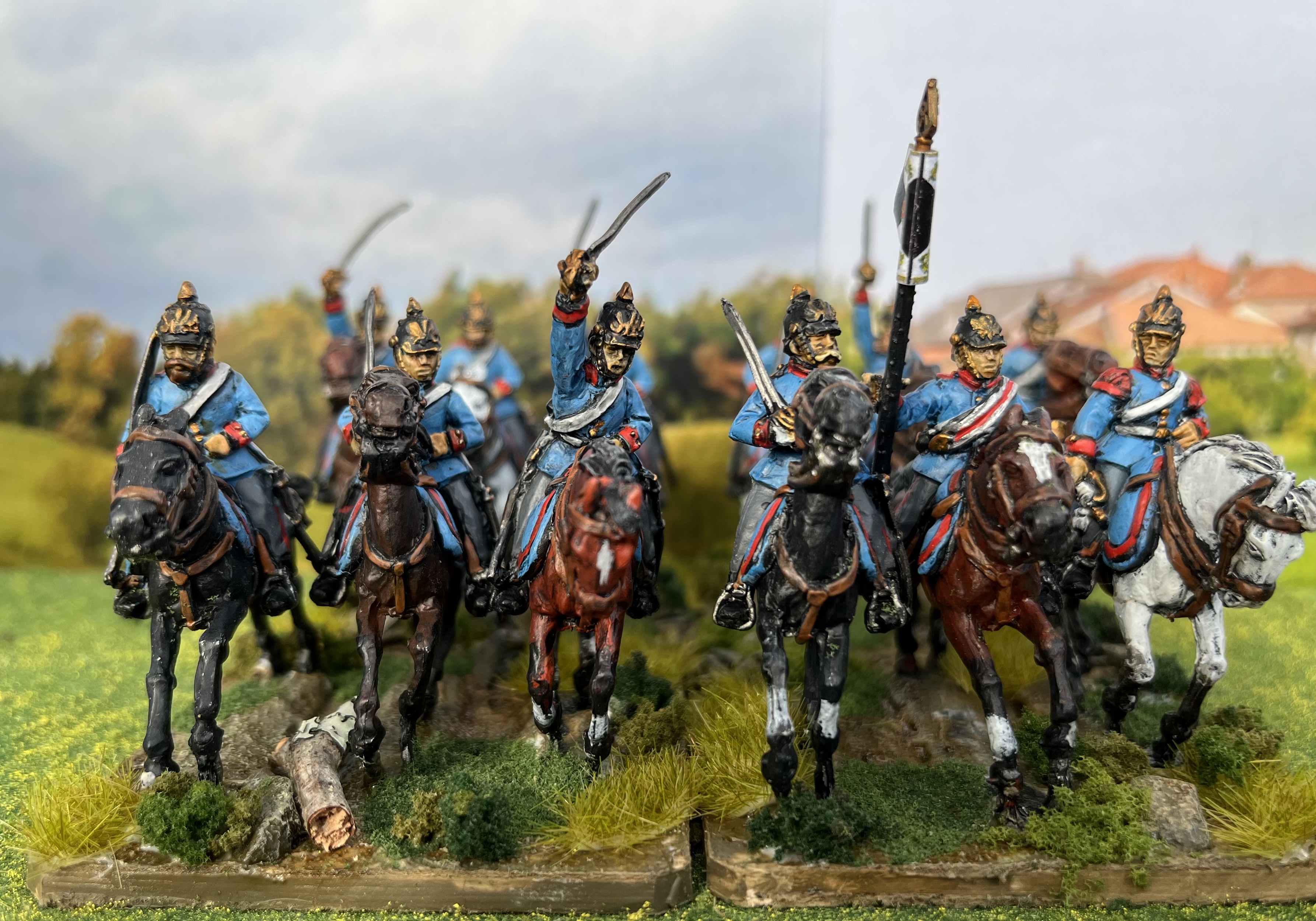
For my Franco-Prussian collection I have decided to build the German 5th Cavalry Division that consisted of nine regiments and two horse batteries, commanded by Lieutenant-General Baron Albert von Rheinbaben. There were three brigades, two of which each consisted of one regiment each of cuirassiers, uhlans and dragoons. The third brigade consisted of three regiments of hussars. The first part of this force I have done is the 12th Cavalry Brigade comprising:
- The Magdeburg Cuirassier Regiment No 7 - raised in 1815, the regiment saw service in the disturbances of 1848 and in the Austro-Prussian War, fighting at Königggratz.
- Altmark Uhlan Regiment No 16 - a new regiment, raised in 1866 saw its first action at Vionville.
- Schlegwig-Holstein Dragoon Regiment No 13 - another new regiment formed in 1866 from the fifth squadrons of the 7th Cuirassiers, 6th Dragoons and the 10th and 12th Hussars
The Brigade was commanded by Major General Friedrich Wilhelm Adalbert von Bredow. It is, of course, the brigade that made the famous “Death Ride” at Vionville on 16 August 1870.
 |
Uniform of a trooper in the 7th Cuirassiers (left) and an officer 16th Uhlans (right)
photographed at Musée de 1870, Gravelotte, August 2018. |
Here are the three regiments of my 12th brigade.
The Magdeburg Cuirassier Regiment No 7.
The Altmark Uhlan Regiment No 16.
The Schlegwig-Holstein Dragoon Regiment No 13.
The brigade commander (using the Steinmetz figure with a spare head from the plastic infantry set).
The whole brigade is seen here.
 |
But only three squadrons each of the cuirassiers and uhlans were involved in the “Death Ride”.
|

While working on these units I decided to read up on von Bredow’s ”Death Ride”. Surprisingly, for what is arguably one of the iconic events of the war, little is written about it, in English anyway (the notable exception being General Sir Evelyn Wood’s “Achievements of Cavalry”). The German Staff History describes the whole dramatic event in five paragraphs in a cold and factual style, while David Ascoli’s book “A Day of Battle” covers it with a little more dramatic flair, but still his description runs to only seven short paragraphs. Many other descriptions, in English, German and French tend be a regurgitation of the description in the German Staff History. For someone like me who likes to get down into the nitty gritty of how squadrons, companies, battalions and regiments acted this is woefully inadequate. So I dragged out the references and looked into the subject the more deeply. Soon I was digging down into the minutiae, the result of which in this rather lengthy post.
Thankfully there are two French texts in that provide the type of detail I like. I am sure there are equally detailed descriptions in some German texts, but sadly I don’t have access to them, nor do I read German with any competency. The work published by the French État Major, Section Historique in the years prior to the Great War provides an excellent description, with 21 pages of detailed commentary and analysis. Volume 2 of this work contains all the reports of the generals, regimental, battalion and battery commanders of the French Army that participated in the battle which you would think would be a mine of detail, yet of the maybe 30 French units and commanders directly affected by the charge (whose combined reports run to hundreds of pages) few even mention the event and of those that do few give it more than a sentence. Dick de Lonlay (pseudonym for Georges Hardouin) in his anecdotal history provides more detail, albeit rather flowery in places (understandable given that he served in the Guides of the Garde Imperiale) although some of the accuracy of his descriptions is doubtful.
For those unfamiliar with the battle (that is variably named Rezonville, Vionville or Mars-la-Tour after the names of the villages around which it raged) it was sparked early in the morning of 16 August 1870 when the leading elements of the German 5th and 6th Cavalry Divisions encountered the vanguard of the French Army of the Rhine retreating from Metz to Verdun. By sheer bluff and bluster the German cavalry succeeded in delaying the French advance until infantry from Alvensleben’s III corps arrived to sustain the fighting line. The early fighting see-sawed around Vionville, but Alvensleben was outnumbered 4:1 and by early afternoon his entire force was committed across a front of nearly nine kilometres and ammunition was running low in some units. Sometime after 1:30 PM the French had established a grand battery of ten batteries in a gun line across the ridge that ran Northwest from Rezonville to the Roman Road. This artillery soon began to cause distress to Alvensleben’s already stretched infantry and a renewed advance by the French 6th Corps threatened to envelop his left. In desperation he turned to the cavalry in an attempt to gain time to allow support to come up.
 |
| The Battlefield of Rezonville - Vionville - Mars-la-Tour (source David Ascoli, “A Day of Battle”). |
Five brigades of German cavalry were on the field. Three were from the 5th Cavalry Division: Barby’s 11th Brigade that had been sent to the extreme left, near Mars-la-Tour; Bredow’s 12th stood North of Tronville equidistant between Mars-la-Tour and Vionville and Redern’s 13th was south of Vionville, supporting the III Corps artillery line. Two further brigades from the 6th Cavalry Division stood West of the 5th Division, near Puxieux. Unable to locate Rheinbaben, Alvensleben, as the senior officer on the field, issued an order direct to von Bredow to take his brigade forward to disrupt and silence the French gun line.
A Brandenburger, von Bredow was 56 years old in 1870. He had entered Prussian service in 1832 as a junior officer in the Guard Hussar Regiment, but promotion in the peacetime army was slow and not until 1859 did he make colonel of the 4th Dragoons. Still at a colonel’s rank he commanded the 2nd Cavalry Brigade in the Austrian-Prussian War, fighting at Trautenau and Königggrätz. That war ended for him with promotion to major-general in command of the 7th Cavalry Brigade. On mobilisation in 1870 he took command of 12th Cavalry Brigade.
| Major-General Friedrich William Adalbert von Bredow 1814–1890 (source Wikipedia) |
|
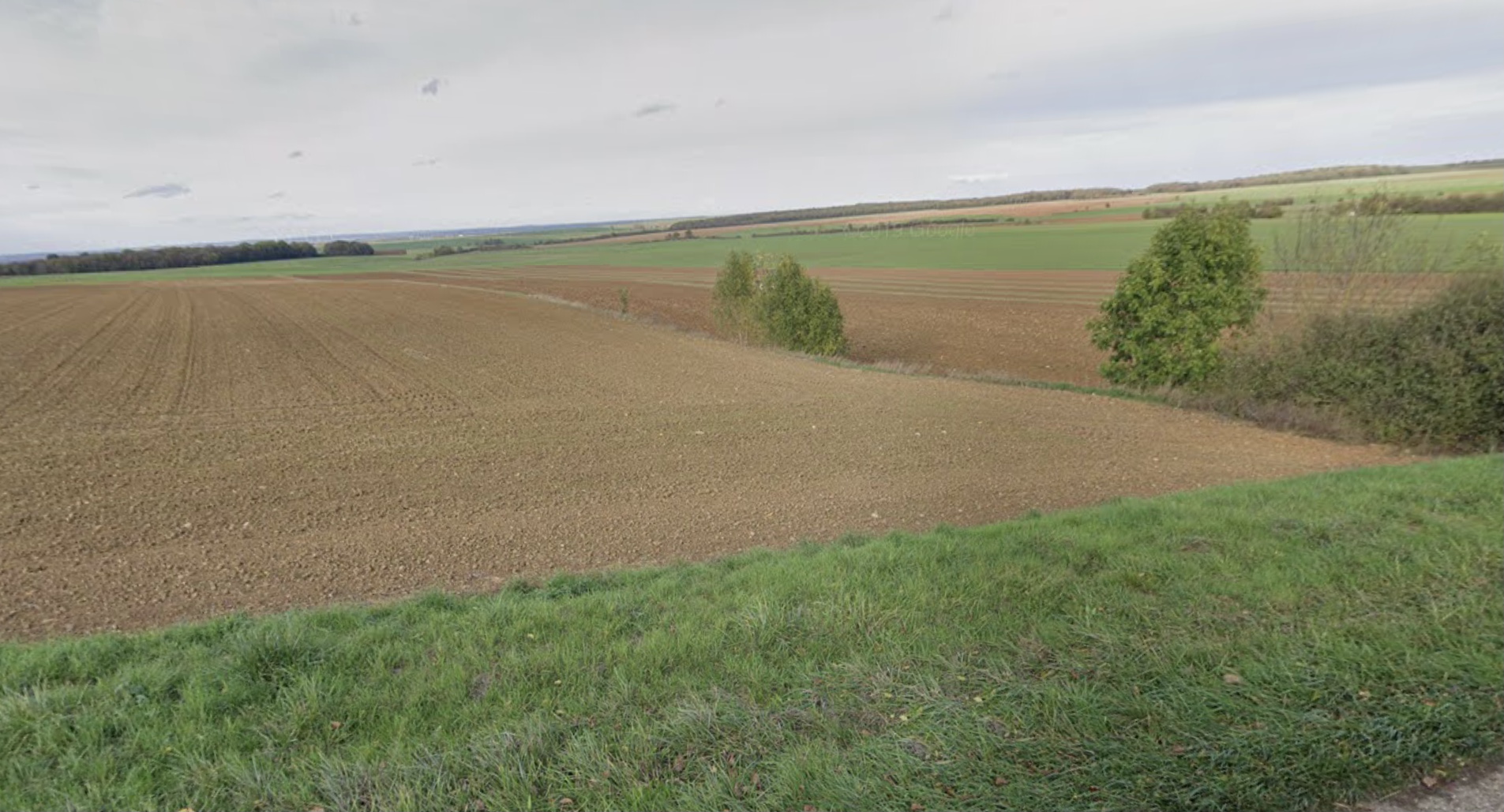
Von Bredow never questioned the order that condemned his brigade to destruction, stating “it will cost what it will”. He knew the attack could only succeed if it was boldly conducted and pressed home. Yet he did not rush to the attack, rather he took his time, carefully reconnoitring the terrain to determine a route to give him the best chance of success. The ground between Vionville and the French position was (and still is today) open and unobstructed by fence or hedge for around 1800 metres to the top of the Rezonville ridge and standing on the road at Vionville today the rise of 24 metres to the top of the ridge is barely discernible. The whole of that approach was swept by French fire and any attempt to attack directly across that open ground would have been easily broken up, as had happened to the French cavalry during their attack that morning over the same ground. A better option lay in just North of Vionville.
A few hundred meters north of Vionville the ground drops away into a shallow valley the bottom of which is 20 metres lower than the ground around Vionville. From that low point it rises to the east by nearly 45 metres in a little over 1,200 metres to the crest of the Rezonville ridge. The last 500 metres of that rise is at a lesser slope than the first 700, creating the military crest. A rapid advance from that low point would be concealed from the French atop the ridge until the cavalry crossed the military crest. At a full gallop charging cavalry would expect to cover that 500 metres in less than one minute. This was ground known to Bredow because his brigade had been positioned near during the morning before being forced back through the Tronville Copses by French artillery fire.
 |
| This view, captured from about 350 meters west of Vionville, shows the valley into which von Bredow led his squadrons. The woods in distance on the left are the Tronville Copses, the woods on the right skyline mark the edge of the Roman Road and the gap between the two is the approximate position of the French near St Marcel (source Google Street View). |
Bredow led the brigade from its position west of Vionville along the Metz Road towards the village. The brigade had already been been weakened earlier in the day by two detachments: a platoon of the 1st squadron of the cuirassiers had been assigned to relay service, and the 13th Dragoons had been sent to support of von Barby on the left. Bredow now weakened it further by detaching the 3rd squadron from the cuirassiers and the 1st from the uhlans to secure the Tronville Copses that would be on his left during the approach march that he wrongly supposed were held by French infantry. At around 2:00 PM the remaining five and three-quarter squadrons of the brigade, advancing in demi-column of squadrons (a formation where the four platoons of the squadron were formed in a column of successive lines), veered left to enter the shallow valley from which they would launch their attack.
 |
| Looking west into the valley that was von Bredow’s approach from the approximate point at which the line of attack was formed. Vionville is on the left. (source Google Street View). |
As it passed the southeastern corner of the Tronville Copses the column was briefly sighted by the French 6th Corps batteries on the heights west of Saint-Marcel, but the range was at the extreme limit of the guns and gunners were unable to bring fire to bear before the German troopers descended into the valley. The time that Bredow spent in reconnaissance paid dividends now as the column was completely concealed from the view of the French on the Rezonville ridge. Only a few stray projectiles found their way near the column.
 |
| The view from the base of the valley (the reverse of above) towards the military crest of the Rezonville ridge (source Google Street View). |
Once the brigade was in the valley it executed a change of formation to column of squadrons at open intervals to the left. The 7th Cuirassiers led the way, followed by the 16th Uhlans. At a trot the cavalry followed the lower contours for a little more that 1,000 meters north of Vionville, past the left of the infantry of the 37th Brigade, until they came to a point where a steep embankment lined with trees and brush obstructed further advance. Here Bredow gave the order “platoons to the right” and the regiments wheeled right from column of squadrons into demi-column and then to line facing due East. The cuirassiers were on the left with the squadrons formed, left to right, 4th, 2nd and 1st, and the uhlans on the right, with squadrons formed, left to right, 4th, 3rd and 2nd. The line was formed at around 1,200 meters from the French gun line and six squadrons, with a combined strength of 750 officers and men, were ready for action. The officers were briefed that they were to press home, to push on as far as possible and not to pause to take prisoners or seek trophies. It was 2:20 PM and the moment of high drama had arrived.
 |
Von Bredow’s approach and deployment.
(source Google Images, not credited) |
No sooner had the cuirassiers completed their deployment than the command to gallop was given and with the general leading from the front they thundered off. The uhlans, however, had not quite completed their transition to line and did not break into the gallop until the cuirassiers had gained some 100-150 meters on them. The result was that the two regiments advanced en-echelon. As the cuirassiers advanced the two most left platoons of the 4th squadron dropped back into a second line. In doing so they shortened the line slightly and allowed the cuirassiers to take advantage of a depression that ran towards the French gun line shielding them from from flanking fire of the French infantry along the Roman road that ran along the southern edge of the Bois de Saint Marcel and the Bois de Peirrot. The use of this depression kept the cuirassiers out of the line of fire longer than it did the uhlans who had no such terrain advantage in their favour.
 |
| An image I took in August 2018 from the Metz Road, looking North. The woods in the distance are the Bois de Saint Marcel and the Bois de Peirrot. The charge started a little beyond the left of the image and ended just to the right of the distant tree line, where the monument to the charge stands today. |
In the initial advance both regiments were shielded from the enemy by the undulating ground and only a few shots reached them. Indeed the advance was so well protected by both the slopes and the smoke of battle that Major von Dollen, commanding the 16th Uhlans, called out to his adjutant “I cannot see the enemy that we must attack!” Despite being behind the cuirassiers the uhlans, unshielded by the depression the cuirassiers were able to take advantage of, reached the crest first. They immediately came under the rapid fire of three companies of the 9th Chasseurs à Pied, that had been assigned to protect the 6th Corps batteries, from some companies of the 75th Regiment deployed south of the Bois de Peirrot and from canister fire from the batteries. Much of the initial fire was aimed high, doing little damage to the cavalry and the impetus of the charge was not slowed.
The reason for the lack of genuine effect of the French fire came in two parts. First, the French line was in transition. The 93rd Regiment, that had earlier been involved in driving the Germans back on Vionville, had withdrawn to the rear of the ridge to reform. The 75th Regiment, that the 93rd had relieved in that earlier fighting, had shifted right to a position south of the Bois de Peirrot, also towards the rear of the ridge, and had largely exhausted its ammunition. Only three companies of the 9th Chasseurs a Pied, that had been assigned to protect the six batteries of the 6th Corps, were on top of the ridge. With no troops on the military crest the forward slope of the ridge was not swept by fire and the cavalry was up and over the crest too quickly. Second, while the French artillery was numerous and had caused some discomfort for the Germans, some batteries (in particular the 5th and 12th batteries of the 8th Regiment) had been knocked about in the exchange with the German batteries around Flavigny. Two batteries from Forton’s Third Reserve Cavalry Division were called forward to bolster the line. At around the same time von Bredow’s movement to the valley had also been observed from the ridge and although the officer commanding the guns did not feel particularly threatened he brought forward Captain Delabrousse’s 7th battery of the 14th, placing it several hundred metres in front of the main gun line, to cover this approach. As these adjustments were being made to the gun line the German cavalry struck.
It is here that things get confusing and piecing together the exact sequence of action becomes difficult not only because events unfolded quickly, but also because the various accounts conflict. The cuirassiers crested the ridge immediately after the uhlans, emerging from their hollow amid the smoke in front of Captain Delabrousse’s battery, catching the French by surprise. The cavalry rode through the battery striking down sixteen gunners and eight horses.
The attacking line was already ragged and many of the horses were blown, the command to gallop having been given too early, but the Germans pressed on and struck Captain Abord’s 5th battery, 8th Regiment, the furthest left of the three batteries of Tixier’s Division, 6th Corps. Abord was also caught by surprise and the battery attempted to withdraw at the gallop, but was overtaken and ridden through by the uhlans at full gallop. The battery suffered surprisingly light casualties from the cavalry attack. It was, however, struck by friendly rifle fire directed at the cavalry that took the infantry officers some time to stop. In the brief action Abord was wounded while another 25 gunners and 36 horses became casualties. Two guns and three caissons were left on the field. So severe was the loss that the battery was compelled to retire to Gravelotte to refit and did not return to the fight.
The remaining two batteries of Tixier’s gun line, to the right of Abord’s battery, were able to contribute little to the fight. The 7th battery, 8th Regiment, was unable to bring guns to bear in time. The 12th battery of the same regiment was similarly surprised and completely masked was compelled to fall back hastily by prolonge towards the Roman Road. Gunners from these two batteries later recovered Captain Abord’s abandoned guns and caissons
Directly beyond the 5/8th were two 12lb batteries, Captain Lequeux’s 9th and Captain Lippman’s 10th of the 13th Regiment, from the Corps reserve, that were still in limber making for the front. They too were ridden through, the 9th suffering relatively light casualties of thirteen men and nine horses, while the 10th was not so fortunate, losing 22 men and thirteen horses. Both batteries turned away with little control trying to escape further damage.
Pressing on the cavalry ran up against Forton’s batteries that were moving forward. The gunners of Captain Coillot’s 7th, 20th Regiment, had only just managed to get their guns into position when the cuirassiers and one and a half platoons of uhlans swept onto them. Only four of the six guns were able to fire and the Germans rode through cutting down gunners, drivers and horses as they went. A number of troopers stopped amidst the battery and took to the gunners with sabre and lance. Coillot took a sabre wound to the head and three other officers were killed or wounded.
A short distance to the right Forton’s second battery, Captain Chardin’s 8th of the 20th, was also coming into action. Only three pieces were in battery when the cavalry struck. The remaining three pieces, still in limber, moved rapidly to the rear. Those gunners unable to reach the safety of the infantry were cut down. In this sudden action the two horse batteries suffered severely counting five officers, 51 men and 69 horses as casualties.
 |
The probable track of the charge.
|
The cavalry then pressed on towards the three companies of the 9th Chasseurs. The Chasseurs opened fire, but the distance between the guns and the infantry was short and the momentum of the charge was still not broken. The Chasseurs were scattered, with some retreating to the woods and other towards Rezonville, while a few held their ground and continued to fire on the cavalry. It was the fire of these companies that struck the retreating gunners of the Captain Abord’s battery.
The next target of the charge was Captain Heintz’s 6th Battery, 14th Regiment. This battery too had just unlimbered as the cavalry swept onto it without a chance to fire. It also suffered heavily, losing 24 men and as many horses.
The charging mass then spilled out to the back of the ridge where the French 93rd Regiment was reforming. Emerging from the smoke they were initially mistaken for French cavalry, but as soon as the error was recognised the battalion commanders of the 1st and 3rd Battalions called “Form Squares”. At a time when infantry firepower had largely rendered the square obsolete as a defence against cavalry it might seem an odd call, but most regiments had a high percentage of reservists who had only been introduced to the Chassepôt days earlier and perhaps their officers mistrusted their ability to repel the attack with fire alone. If few of these infantrymen were experienced with their new rifles, fewer, if any, had ever drilled to form squares and they executed the change so clumsily that their colonel described result as more of a circle than a square. The French infantry fired as best they could, but the Prussian troopers still pressed on, taking dreadful losses.
The Second Battalion of the 93rd had a particularly rough time of it. The two limbered batteries of the 13th Regiment in their attempt to avoid the uhlans tried to pass through the battalion intervals but drove into the centre of the column, knocking down entire files and creating a gap into which the larger part of the 16th Uhlans burst. The battalion colour guard was completely dispersed and a group uhlans swarmed around the eagle bearer. The standard pole had been broken by a projectile just below the eagle and the eagle fell to the ground. Fearing that the standard would be lost, the bearer picked up the eagle and concealed it as best he could while the standard, still in its oilskin cover, was hidden beneath the debris on the ground. The eagle bearer then retreated to cover with other parts of the battalion. The standard was picked up by a uhlan trooper (in defiance of the instructions not to collect trophies) only to be recovered later in the charge by a trooper in the 5th Chasseurs à Cheval and returned to the 93rd the next day. The uhlans collided with the infantry and lance and sabre crossed with bayonets. Despite their squares the regiment was split in two with most of it (including the eagle bearer of the Second Battalion with his precious prize) falling back towards the Roman Road while six companies, three each from the First and Third Battalions, backed away towards Rezonville.
Von Bredow had penetrated the French line and now attempted to veer South towards Rezonville. Still more French batteries deployed across the Rezonville ridge limbered up and retired in fear of being overrun. However, the German troopers now found themselves in a dreadful position. Their formation completely broken up by the charge and losses mounting, they were now trapped by two French cavalry divisions, Forton’s and Valabrégue’s, with a combined strength of 3,100 sabres that were formed in the hollows behind the ridge. Forton’s brigades lay directly across the flank of the cuirassiers about 400-500 meters distant. Forton immediately ordered General Prince Murat to charge with his two regiments of dragoons, the 1st and 9th. At the gallop the dragoons charged directly forward, but as the cuirassiers continued their charge past their line of advance, the dragoons wheeled to the left, a movement that changed their counter charge into more of a pursuit. The 9th Dragoons passed through the ranks of the cuirassiers who opened their ranks without stopping. The dragoons then slammed into the flank of the uhlans whose charge was halted at this point, ready to retire, and the Germans were driven back towards Rezonville. At that moment Valabrégue sent his two dragoon regiments, the 7th and 12th, forward from the opposite direction. The 5th Chasseurs á Cheval, from Valabrégue’s division also joined the fight, forcing the retreating German cavalry back in the direction from where they came.
Then to make matters even worse for the uhlans as they moved back past the corner of the Bois de Peirrot Forton called “Cuirassiers, attention; go” and released squadrons from his second brigade, the 7th Cuirassier Regiment supported by a squadron of the 10th Cuirassiers, holding three squadrons of the 10th as his only reserve. The cuirassiers’ charge was poorly conducted because they were loosed without any formation indicated and the squadrons surged forward in a confused mass with their officers struggling to get in front of the line and give direction. Nonetheless the uhlans suffered badly in this fight until the bulk of the Prussian 7th Cuirassiers, who by now had also turned about, could intervene. A desperate melée erupted between the French and Prussian 7th Cuirassier Regiments and the whole swirling mass of cavalry quickly became entangled with the artillery vehicles and isolated pockets of infantry.
Von Bredow’s now exhausted and disorganised squadrons were surrounded on all sides and were compelled to cut their way back to their lines. Twenty-five French squadrons converged on a narrow space cluttered with the debris of the artillery batteries, scores of dead and wounded men and horses. Scattered elements of infantry fired indiscriminately at any mounted soldiers, friend or foe. Until now the Germans had suffered comparatively low casualties (one source suggests that up to this point the losses of both regiments had been as low as 150), but now squeezed in all directions by the French cavalry and with horses unable to respond, the losses began to mount rapidly. Von Bredow, on his struggling horse, was pursued by a group of French cuirassiers and was only saved by the intervention of some German infantry who felled a cuirassier about to strike him with his sabre. Sergeant Gaebler, the standard bearer of the uhlans, lost control of his horse and the animal began to run away on him. He called to comrades to help him control the animal, which they did and a dozen or so men gathered around him and turned back toward their own lines. They soon encountered a party from the French 93rd Regiment that in the confusion they mistook for their own infantry. Realising their mistake they summoned the last bit of energy from their steeds and charged the infantry, forcing their way through, losing one man killed and two wounded on the way, but kept the standard safe. Major Count von Schmettow, commanding the cuirassiers, had his helmet punctured by two bullets, but was otherwise unharmed. However, the melée was brief and the German troopers were able to escape the clutches of their pursuers despite their exhausted horses. The French cavalry did not pursue far beyond their lines perhaps deterred by the advance of one of von Redern’s hussar regiments that came forward from Flavigny or perhaps by the memory of their morning’s failed attempt to carry Vionville in the face of German gunfire.
 |
| Major von Schmettow and his damaged helmet (source Google Images, uncredited) |
 |
The view west from the rear of the Rezonville ridge where the French cavalry engaged von Bredow’s troopers. The Bois de Peirrot can be seen on the right. The piece of woodland that juts forward in the middle ground marks the approximate position of the French batteries.
(Source Google Street View)
|
 |
“Rezonville” by Aimé Morot (1886) - the Prussian 7th Cuirassiers clash with the French 7th Cuirassiers as they began their retreat (photographed at Musée de 1870, Gravelotte in August 2018). Of interest here is that Morot was an admirer of the work of Eadweard Muybridge who famously captured photographic iqmages of galloping horses. Morot used Muybridge’s studies to capture the realistic actions the horses, although whether any of the exhausted German horses could have been moving at the pace portrayed could be questioned.
|
However, the French infantry along the Roman Road did not let the German cavalry off lightly. The 1st Battalion of the 9th Regiment opened a violent fire as the cavalry as they passed with 200 metres of their line. Portions of the 91st and 94th regiments also poured fire into the retreating horsemen. The 7th battery, 20th, having recovered from the initial impact of the charge and perhaps seeking some retribution added a few rounds to hasten their enemy’s retreat.
Various scattered groups of von Bredow’s regiments limped their way back to their lines as best the could, having ridden the better part of six kilometres since the start of the charge, to rally in the rear of Flavagny under the cover of their batteries. Initially neither regiment could form more than a single squadron from the survivors - the cuirassiers could only muster three platoons from the eleven that charged, and the uhlans initially counted only 6 officers and 80 men, but were later joined by 2 officers and 15 men who had retreated by a more circuitous route towards Mars-la-Tour. Soon after they were joined by the two squadrons that had been assigned to clear the Tronville Copses. Once reformed von Bredow took his squadrons back onto the high ground, but when French artillery began to range in on them they returned to Tronville, then to an area further to the south where they had bivouacked the night before.


 |
The Debris of the Charge - fragments from the Panorama of Rezonville, Jean-Baptiste Édouard Detaille and Alphonse de Neuville (1882)
(photographed at Musée de 1870, Gravelotte and Musée de l’Armée, Paris in August 2018). |
The whole event was over in little more than half an hour and the cost to the Bredow’s regiments had been huge. Of the 750 who set off, sixteen officers, 363 men and 409 horses were lost. The 7th Cuirassiers started the charge with 355 officers and men lost 7 officers, 189 men and 209 horses, while the 16th Uhlans charged with 395 and lost 9 officers (including the Major Dollen who was captured after being trapped under his fallen horse - is he that uhlan pictured immediately above?), 174 men, and 200 horses. At roll call that evening the Cuirassiers counted 220 officers and men and the uhlans 12 officers and 210 men in the ranks.
In critiquing the charge one French writer went so far as to say that the deliberate destruction of the cavalry should have seen Alvensleben dismissed from the service, conveniently ignoring the fact that French generals similarly committed their cuirassiers at Froeschwiller for a significantly greater loss for far less results. Others critics claim that because it was made with just two regiments, without support or a reserve and was so easily repulsed by the French cavalry, that the attack failed to produce any tangible results. It is hard to imagine how removing the pressure from the German infantry around Vionville by driving off ten of the twelve batteries that were deployed or moving into position across the Rezonville ridge, inflicting losses of 8 officers, 154 gunners, 148 horses to the 6th Corps artillery, plus 110 casualties on the cavalry from Forton’s and Valabrégue’s Divisions and scattering four infantry battalions could be termed a failure. Most importantly the action spooked French commander in chief Bazaine so severely that he forbade the further advance of the French 6th Corps and then became obsessed with a threat to his left. The suspension of the advance allowed the German X Corps came onto the field, extending Alvensleben’s line to Mars-la-Tour and effectively handed victory to the Germans, although both sides would claim victory. That night Bazaine turned the French Army back towards Metz. Two days later at the Battle of Gravelotte-Saint Privat the Germans slammed the door shut to bottle up Bazaine’s army in Metz, forcing its surrender on 27 October.
As devastating as the casualties were the charge is today generally recognised as the last successful massed cavalry charge in history.
 |
The monument to von Bredow’s charge today, about 1km North of Rezonville
(photographed in August 2018) |
Of the German senior officers involved in the charge, Von Bredow remained with the 12th Cavalry Brigade for the duration of the war and was promoted to lieutenant-general in January 1871. After the war he took command of 18th Infantry Division. He was awarded the Order of the Red Eagle in 1873 before retiring to his estate at Briesen in the same year. In 1889 the 1st Silesian Dragoons (No 4) had the name von Bredow added to it’s title. He died in 1890. Major von Dollen returned to his regiment from captivity after the fall of Metz. He then served around Paris during the siege and in operations in the Loire Valley. Made lientenant-colonel in 1871 and colonel in 1873, he too was awarded the Order of the Red Eagle and retired in 1895 with the rank of major general. He died at Gotha in 1906 aged 81. Major Count von Schmettow was killed at Beaugency on 9 December 1870 - he was 39 years old.
Principal Sources:
- Ascoli, David, A Day of Battle, London 1987
- Bonnie, Kaehler and Davis, Cavalry Studies from two Great Wars, Kansas City, 1896
- De Lonlay, Dick (G. Hardouin), Français & Allemands: Histoire Anecdotique de la Guerre de 1870-1871, Vol 3, Paris 1887
- Erb, Général, L’Artillerie dans les Batailles de Metz 14-16-18 août 1870, Paris 1906
- France Armée, Etat Major, Section Historique, La Guerre de 1870/71, Vol 12, Parts 1 and 2, Paris 1903-1913.
- Great German Staff: The Franco-German War 1870-1871, Vol 2, Nashville 1995
- Hohenlohe-Ingelfingen, Prince Kraft Zu, Letters on Cavalry, London, 1898
- Hozier, Henry M., The Franco-Prussian War: Its causes, Incidents, and Consequences, Vol 1, London, 1872
- Lehautcourt, Pierre, La Cavalerie dans la Bataille (15 et 16 août 1870), Paris 1906
- Wood, General Sir Evelyn, Achievements of Cavalry, London 1897