Showing posts with label War of 1812. Show all posts

Monday, 21 December 2020

Last Game for 2020?

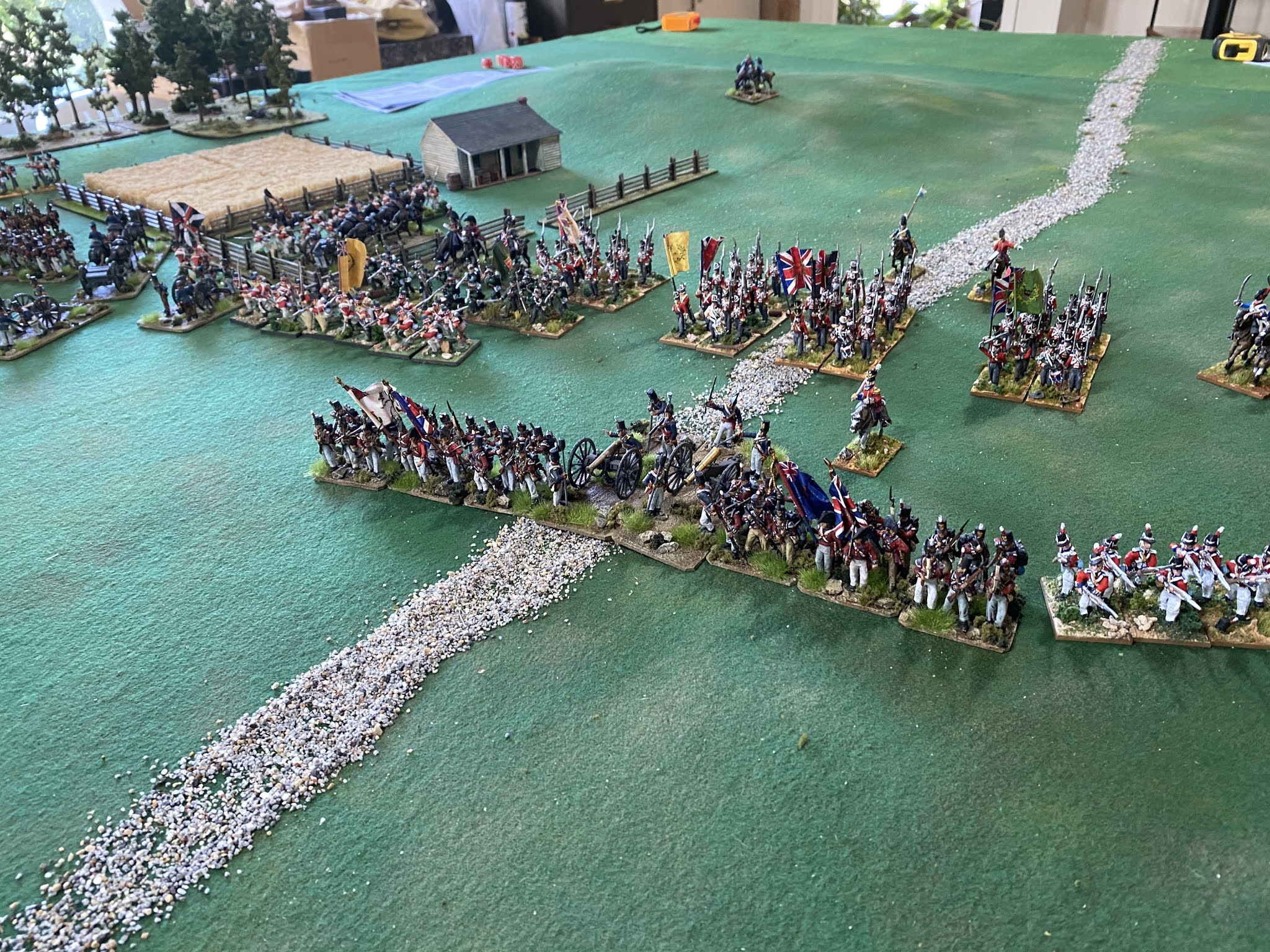
Yesterday (Sunday) while large parts of the globe are facing a worsening situation with COVID-19 seven of us got together on a hot and sunny day to play what could well be our last game for 2020 - a War of 1812 game.

Set somewhere in upstate New York stood a small town of significance because it held a good supply of grain. The place was guarded by a brigade of militia with a n antiquated gun. The town itself was protected by a blockhouse (with a touch of irony the game was played in the Auckland suburb of Blockhouse Bay about 800 meters away from the site of a blockhouse built during the New Zealand War in 1860 to protect the portage track between the east and west harbours of the modern city).

Intent of securing the grain the British mounted an expeditionary force of four brigades (19 battalions and four batteries) of regulars and Canadian militia. Upon hearing of the size of the approaching British force the militia commander called on four nearby regular brigades (14 battalions and 4 batteries) for help.

The British would arrive on the table in the position marked on the map on turn 1. The Americans would bring one column on turn 1 and the other on turn three. In the woods were five units of Indians, two allied the Americans and two to the British. The allegiance of a fifth Indian unit will be determined when contacted by rolling 1xD6 (456 British, 123 American).


The advance started slowly with the British working their way forward slowly, feeling out the woods as they went. They soon contacted a group of American allied Indians that roughly handled one battalion before they were shot to pieces by two converging British units. Then the second American allied unit was found. It too what defeated and sent packing, but not before it had delayed the British infantry for three turns. Meanwhile in the other wood the British found two of their own allied Indian groups and then when the found the fifth, it allied itself to them too.


The action started in front of the fort with the old gun popping away at the British, but doing little damage. Unknown to the militia commander the gun had the potential to burst after three shots and although it failed to burst, disaster struck the militia when a shot from a British howitzer set fire to the blockhouse and the militiamen failed to extinguish the flames. The fire quickly blazed out of control and the place was abandoned.

Meanwhile the Americans formed their main line perpendicular to the town intend in drawing the British on to them, using the militia (as the regulars delightfully described it) as “the speed bump to slow the British advance”.

The British infiltrated the woods opposite the town, but when they came to the edge found an American brigade drawn up facing them and were unwilling to exit the woods in the face of this force. One of the US regiments entered the woods to try to force the issue, but only got itself embroiled into an inconclusive fight that lasted for the rest of the game.

The British were now compelled to funnel themselves between the woods but soon found that the US artillery dominated the ground and although some battalions managed to make some initial headway against the militia, when one of the British brigades fell apart the game was up and they were obliged to concede.


It was a pleasant way to spend a lazy Sunday.

Tuesday, 1 October 2019

A North American Theme

After a month or more of working on European subjects, the last week has seen the completion of a couple of North American items.

First of all at two American command bases for the War of 1812. These were a part of the pack I got from Foundry a couple of months ago, but the the two mounted figures were missing their horses. The horses finally arrived and here they are based ready for a command.


Then there is the first two of what will be six battalions of British infantry for the American Revolution.


They are they first units that I painted using the new Games Workshop Contrast Paints. I am really pleased with the way the reds and whites came out, but the jury is still out on the overall result.

Sunday, 4 August 2019

American Generals and a Bit of Rebasing

With our fabulous week of gaming over and rapidly receding into distant memory it has been a long week, made seemingly longer by five days of software vendor presentations at work.

All these distractions have played havoc with my painting schedule, made worse by the fact that the lead pile is flat and orders placed to replenish it are still at least seven days away from delivery. Those same distractions caused me to overlook an event that would once have excited me - slipping past 200,000 visits to my blog. But as all bloggers know today such statistics mean very little since the Viagra advertisers and the bots from other dubious locations started worming their way through the blogger sphere.

Nonetheless I have had some items to paint. These were the Wargames Foundry American War of 1812 generals required for the recently played War of 1812 game that arrived too late (and with two horses missing I might add). So here they are, two mounted and four dismounted commanders. Two more mounted figures will join this set when the missing horses arrive.


Thanks to some miserable weekend weather I spent a bit of time rebasing some figures. These are the Crimean War British cavalry that I had painted back in 2016. So why rebase them? Well first of all I have committed to put on a Crimean War game at next year’s Tarawera gaming week and while that is still a long way off it has prompted me to look at completing the Heavy Brigade, the figures for which are back in production. Second, these regiments were originally organized in units of six figures and based two to a stand whereas my preference is to have three to a stand. So for the sake of consistency there was a need for change. Then I had the rather alarming thought that two stands of three made pretty small units and did I need to expand the size of these units?

Fortunately the answer to that question is no because the British only took two of squadrons of each regiment on the expedition and by the time they landed in the Crimea they had been ravaged by disease (which is why at Balaclava all five regiment of the Light Brigade counted only 668 officers and men), so two stands is not an unreasonably sized unit. It does mean, however,  that the Russian units, that were historically larger, will need expanding and the figures for that expansion have been ordered along with the Heavy Brigade troopers.

So here is rebased the Light Brigade.


Friday, 26 July 2019

War of 1812

A Wargames Scenario

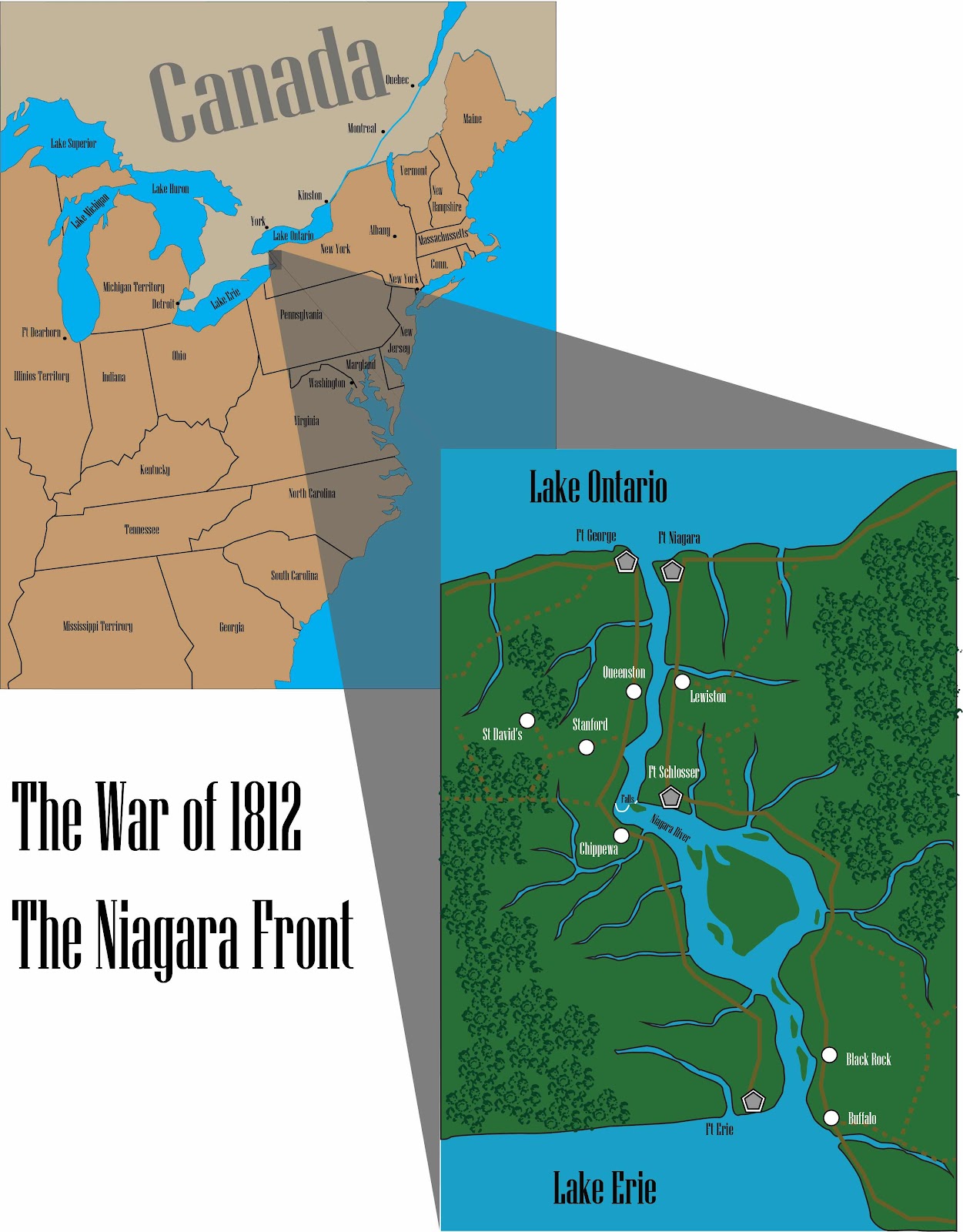
Today’s game, as the leading graphic indicates, was a War of 1812 game set in the Niagara front. I have played a little loose with the historical background, as those familiar with the campaign will note, and the tabletop terrain stretches reality even further. That said, here is the background and technical limitations of the game.


Background (with apologies to historical accuracy)

On 19 December 1813 Fort Niagara fell to the British and its recovery became a focus for the US military on the Eastern Great Lakes for the next year. All attempts to take it from the south and east were foiled, but in the late summer of 1814 a new plan was conceived. 

This plan involved gaining control of the Western, or Canadian, bank of the Niagara River. Success here would make the capture of Forts George and Erie at the northern and southern ends, respectively, of the Niagara River an easier task. Not only would this isolate Fort Niagara, but it would give the Americans complete control of Lake Erie and would open up the possibility of operations in Lake Ontario against the key Canadian settlements of Hamilton, York (modern day Toronto) and Kingston, effectively closing the Great Lakes to the British.

Major-General Jacob Brown’s American Division was charged with the operation. Major-General Phineas Riall commands the British forces in the area.


The Briefings

United States Forces

What you know of the British positions:
  • The main British forces are in camp south at Queenston
  • The British have a small force a the blockhouse at the bridge over the Chippewa River
  • Fort Erie is occupied by a militia force and is in a poor state of supply
  • There is a British allied Indian village somewhere on the woods to the west.

Troops Available

West Division: Major General Jacob Brown
Scott’s Brigade – 9th, 15th, 22nd & 25th US Infantry, 1 battery
Ripley’s Brigade – 1st, 8th & 18th US Infantry, 4th Regiment Maryland Volunteer Infantry and 1st Rifles, 1 battery
Porter’s Brigade – 5th, 14th &16th US Infantry, 5th Regiment Maryland Volunteer Infantry, two units of Indians 1 battery
Unassigned – 23rd US Infantry, 1 battery, 2 squadrons of light dragoons

Objective

In order of importance the US forces need to:
  1. Capture Ft Erie
  2. Establish a position north of the Chippewa by securing the blockhouse and bridge
  3. Contain the Indian threat.

Game Details

  • No British troops are deployed on the table at the start of the game.
  • The American forces have the initiative. 
  • Indians in the open move normally. In woods they move from woodlot to woodlot, but if they cannot be seen ei­ther they can move up to an additional two woodlots, ceasing movement as soon as they can be observed.
  • Brigade and Army Morale rules do not apply. 
  • In addition to normal rally rules all units with a “Rally” activation result can remove all losses at the beginning of their next player turn but:
    • Must not be engaged in any activity
    • Will lose one full stand

Table plan and arrival options. 

British Forces

You know:

A US force consisting of up to 12 infantry regiments (mixed regulars and militia), 4 guns, some cavalry and some Indians is on the eastern bank of the Niagara River ready cross. The crossing point is unknown.

Your Forces

At Fort Erie
An understrength militia battalion plus 1 gun
At the blockhouse across the Chippewa River Colonel Scott
1 battalion 103rd Foot, 1 battalion Upper Canada militia, 1 gun
At the Camp south of Queenston
1st Brigade 
1 battalion 13th Foot
1 battalion 44th Foot
Battalions West India Regiment
Battalions Canadian Voltiguers
2 batteries
2nd (Light Brigade)
2 squadrons 19th Light Dragoon Regiment
1 battalion 1st Foot
1 battalion 5th Foot
2 Battalions Glengary Light Infantry
1 battalion Royal Marines
2 batteries
Indians – Any point within 600mm of their village 
2 units (increases to 4 if the US forces attack the village)

Objectives 

  • Destroy the American forces, or contain them south of the Chippewa

Special rules that differ from those for the US forces

  • Troops in the blockhouse are not detectable until the Americans come within 600mm or when they fire the first time
  • Fort Erie garrison and the Indians are controlled by the umpire.
  • No British troops can move until an alarm is raised – and can only be raised if US troops are sighted by ANY British unit, except the troops at Fort Erie.

Table plan and possible US arrival options. 
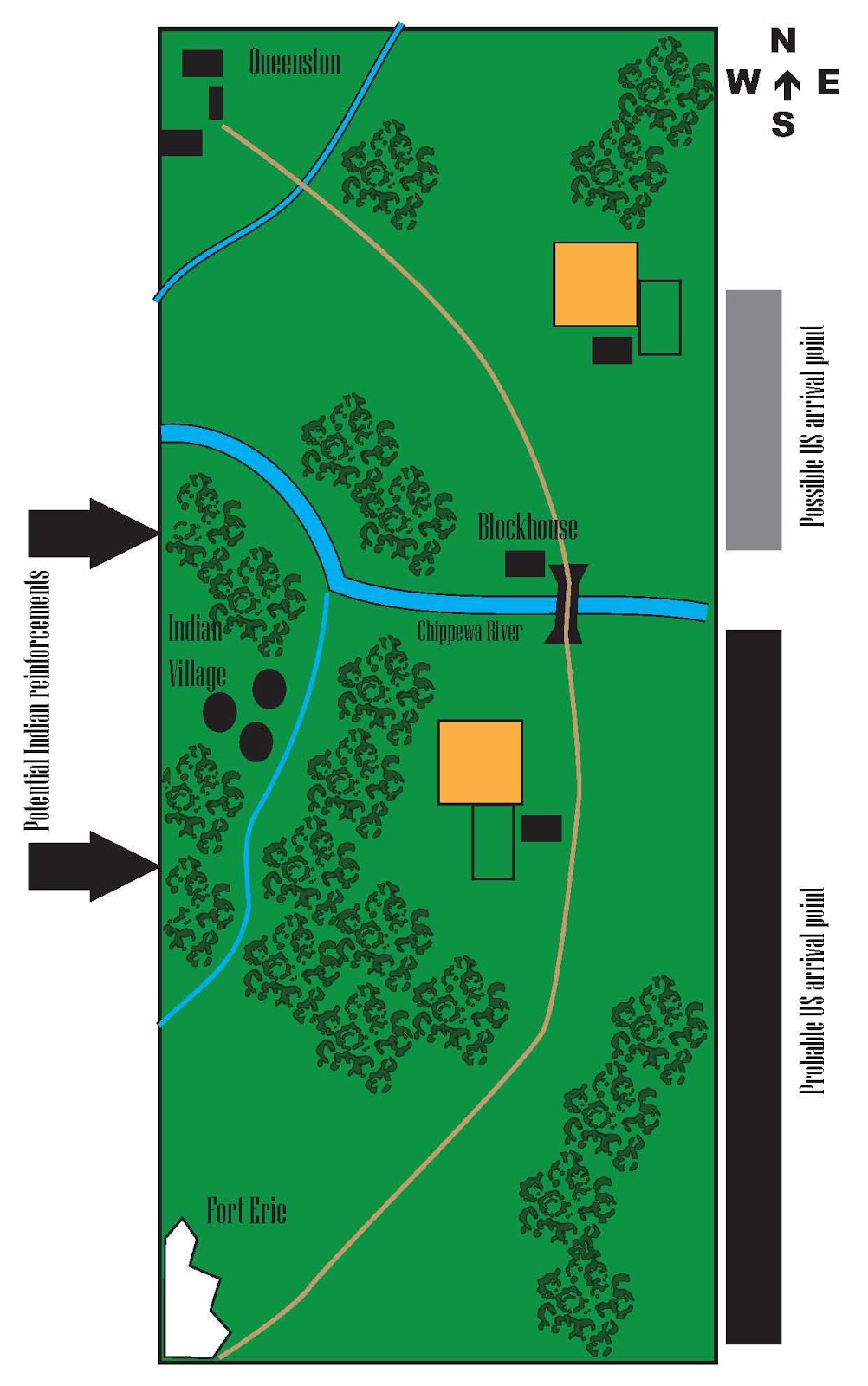

Game Details unknown to both sides

The Fort Erie militia will surrender if no British troops are visible and the Americans troops advance to within 500mm of the fort or fire on it. 

Also unknown is that a unit of Canadian militia cavalry is in the fort and will ride out of the fort as soon as any American troops are visible to the fort and will ride north to join the British main force, but will not attempt to fight unless attacked. Once the have arrived at the British position they must rally for one full turn and are then available to the British commander.

If the game is stalling because of a lack of troops the umpire can make up to two more battalions available as reinforcements to either side.

General Details

Rules

The rules used in the game can be found here

Terrain

  • The terrain is gently rolling. 
  • One southern end of the table is the outer works of the British Fort Erie.
  • At the northern end is a British camp.
  • The eastern side of the table, near the Niagara, is largely open with a couple of small farms. A road runs the full length of this side.
  • The rest of the terrain is largely wooded.
  • Two thirds of the way up the table on the eastern side is a blockhouse defending a bridge over the Chippewa River that flows into the Niagara.
  • The Chippewa is fordable to infantry and cavalry at any point 500mm west of the bridge. To cross river non-Indian troops must halt at the river edge spend the next turn in the river and are disordered and on the beginning of the next turn may will be on the opposite edge and are free to move normally but disordered for the rest of the turn (unless they stand still on the edge). British indians can cross at any point simply deducting 100mm from their move.
  • Half way up the table on the western side is an Indian village, located on a stream that flows into the Chippewa.

So how did the game run?

Well not at all like I expected it to.

The day dawned a bit overcast, maybe 6 degrees C. After a good breakfast we were at the table at 9:15.


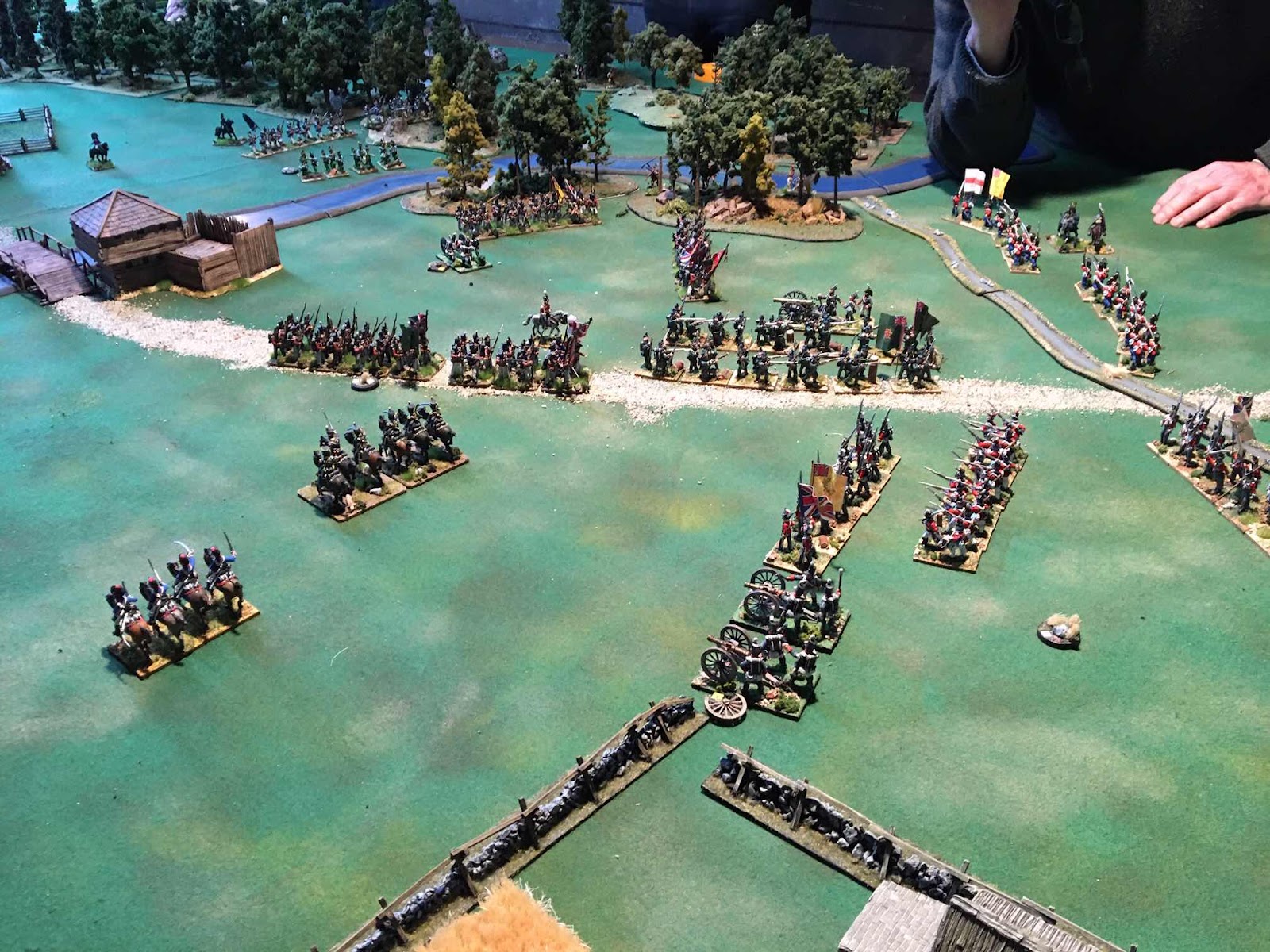
The Americans chose not to exercise the option to come on across the Chippewa and brought all three brigades on the table on the middle deployment zone.


The British then placed all their troops in camp and we started play. The Americans chose to press Scott’s brigade towards the fort while Porter and Ripley were charged with pressing towards the blockhouse.


On turn two the gun in the blockhouse opened fire and the British at Queenston assembled. They moved with alacrity and quickly began to form a strong position. When their guns opened the Americans quickly realised that they were not going to get across the bridge easily and withdrew to reassess, forming around the farm. The British then established a line to the west of the bridge, fearing a flanking movement.

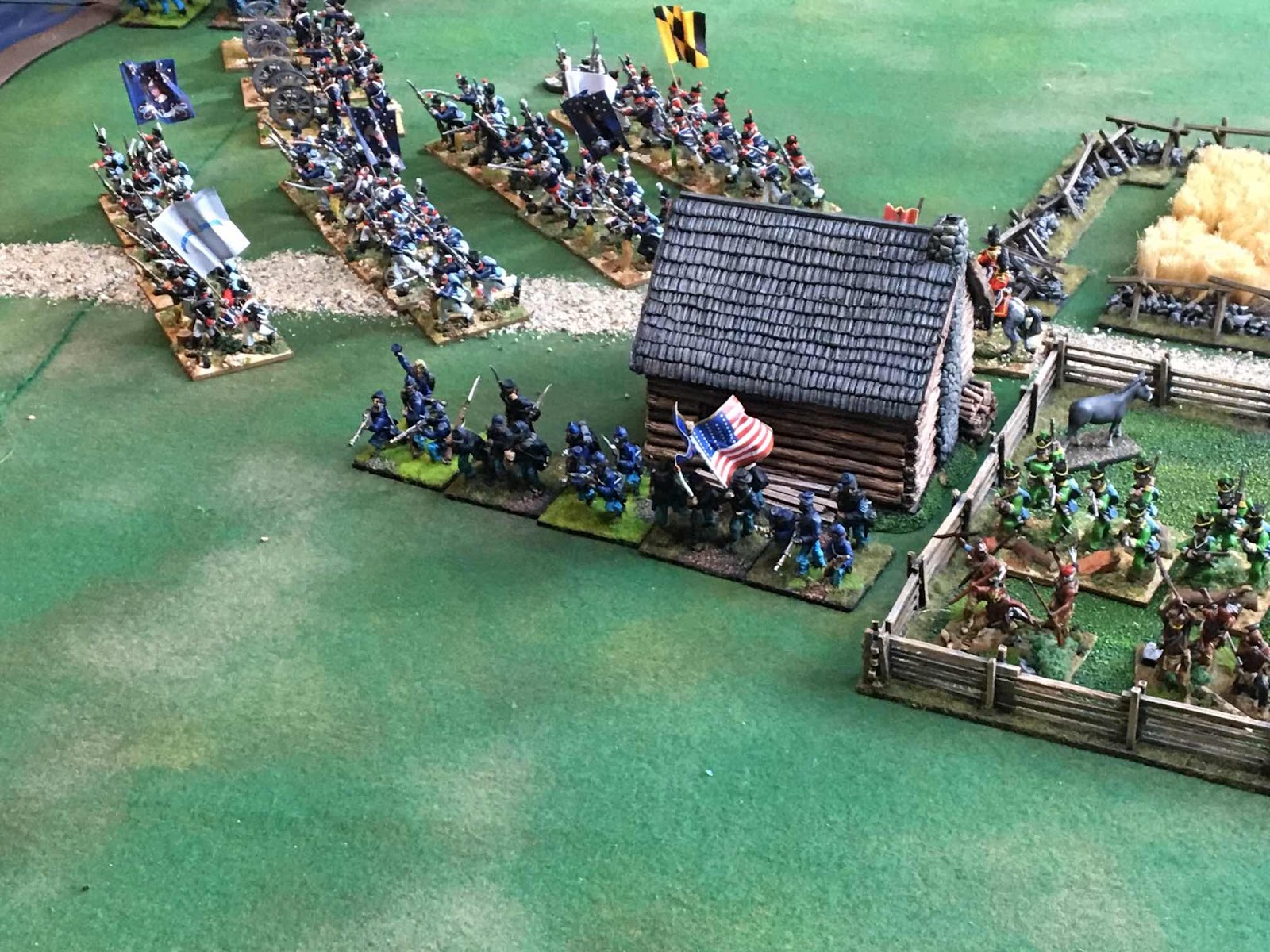


Meanwhile Scott approached the fort and the Canadian militia cavalry, not wanting to be a part of the surrender, rode north. Soon after the militia garrison sighted the Americans and surrendered.


Scott then turned back towards the bridge and encouraged by his success the Americans turned back towards the river. Ripley formed ready to storm across the bridge, it was going to be costly, but he should have been able to establish a position on the other bank, but the British 103rd stole a march and formed a line that would prevent their crossing. The Americans withdrew again and Scott moved back towards the fort intent on marching down the narrow valley towards the indian village. An extended fight then erupted between the two indian forces in the woods.


In time this advance was a success. Scott cleared the valley, even though an attack on the village brought out another two Indian units.

The British, realizing that the best success was gained by forming in front to Queenston and fell back, abandoning the blockhouse.


Sensing victory the Americans pushed forward across the bridge, but the British cavalry charged, and despite being at a disadvantage, routed the  American infantry and denied them the key victory condition of establishing a position on on the north bank, by occupying the blockhouse.

The game ended as a draw with a slight advantage to the Americans.


Saturday, 20 July 2019

More Americans...two types

This week sees a great deal march off the painting table.

First up are the two remaining figures from the War of 1812 command pack, including a figure of Madison in civilian dress, who will make an excellent militia commander, I am sure. It is just as well my friend Julian had the pack of unpainted Old Glory generals on hand because my order from Foundry has not arrived and I need the figures for a game next Thursday - not that it is anyone’s fault but mine because I ordered them quite late.

Next are four units, plus three command figures, from the American Civil War refurbishment project.


This makes six regiments completed in the project. Four regiments, four gun sets and a cavalry regiment are still to be done. I need to have another two regiments completed by next Monday.

Saturday, 29 June 2019

War of 1812 Indian Lodges

For the upcoming War of 1812 game at our annual weekend away there were two more pieces of terrain I needed...these two lodges/wigwams for a Great Lakes Indian village.


Attentive readers will remember that I started these a little over a year ago. When the weekend away was postponed due to illness I put these on the back burner, but with the event now less than 30 days away I needed to get on and finish them.


So here they are, three small structures to represent a Great Lakes Indian village. I made a few pieces of clutter for this village - a couple of fire places, a stack of furs and a couple of pots. I may add a few more items of clutter before the game.

Monday, 24 June 2019

War of 1812 Fortress

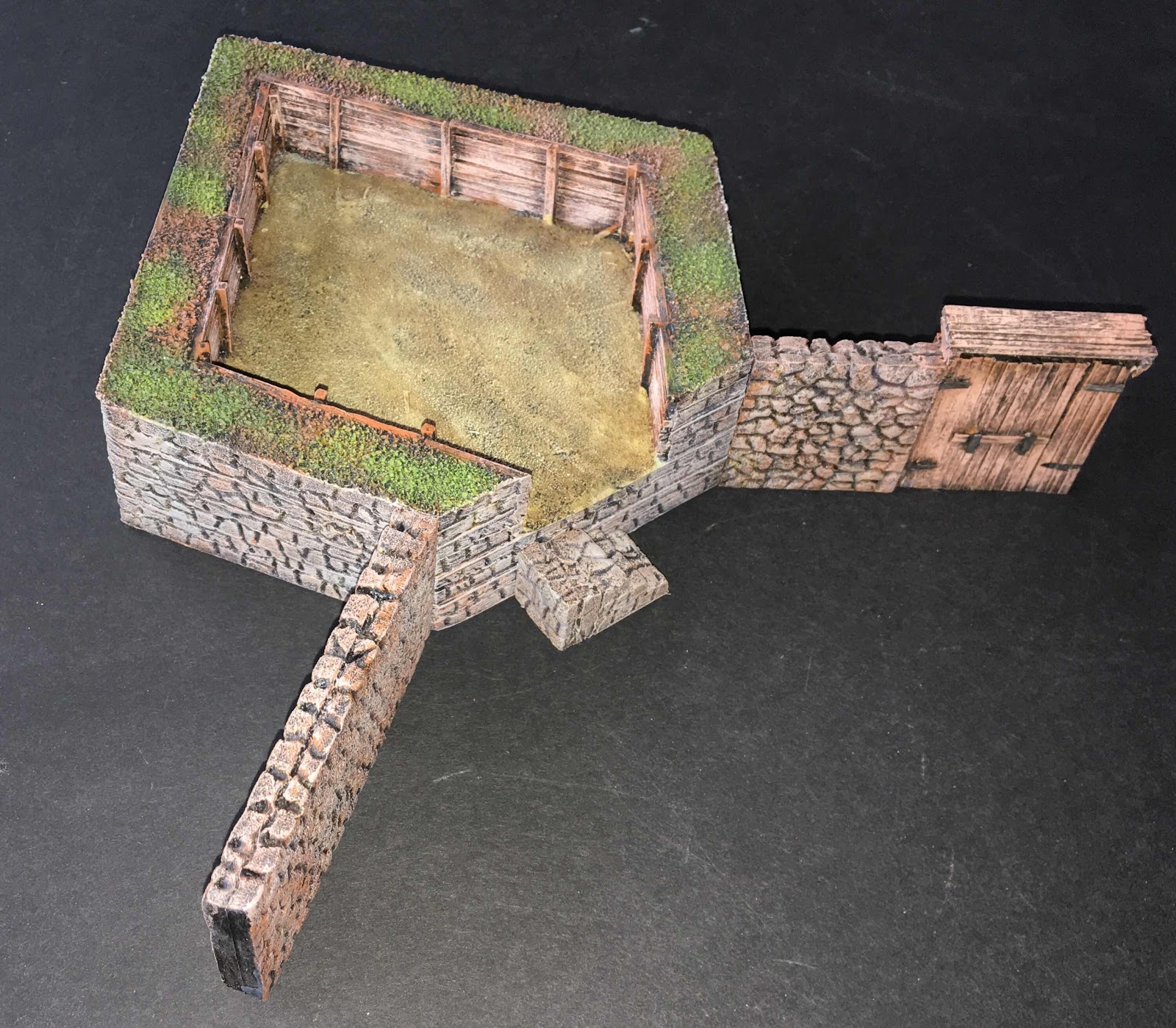
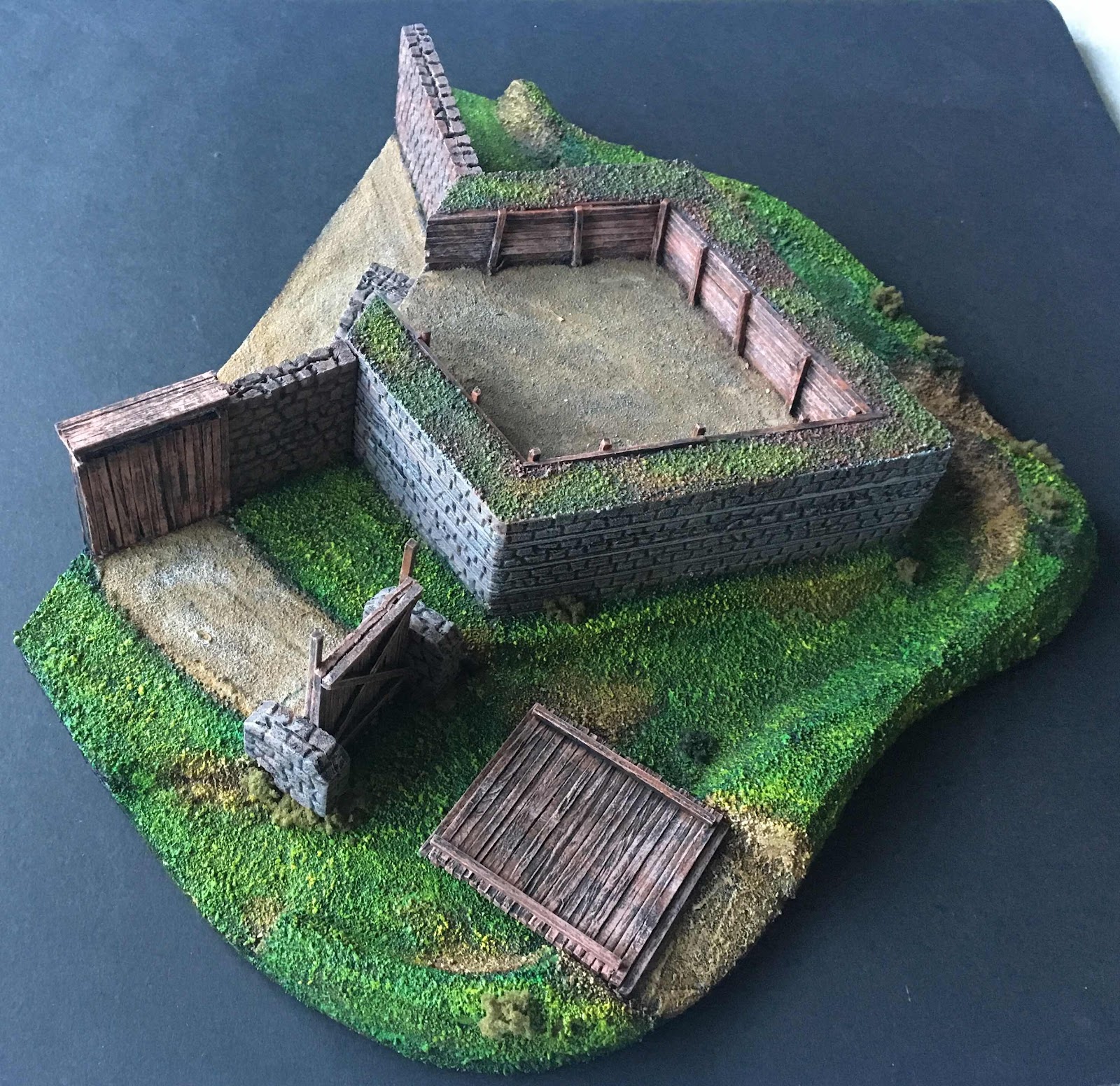
For an upcoming War of 1812 game (set in 1814) I need to represent Fort Erie on the table, from the land side. The fort is quite large and while it will play an important part of the game there are other important aspects to the scenario so I don’t want it to dominate the proceedings. Instead I have opted to represent it on one table edge with just one of the bastions, the gate and the ditch.

When I looked at the plans for Fort Erie the gate stood in the middle of two substantial stone barracks between two bastions. I didn’t want to go to the extent of building the barracks so I have had to employ some artistic license. My Fort Erie is going to have only a passing resemblance to reality.
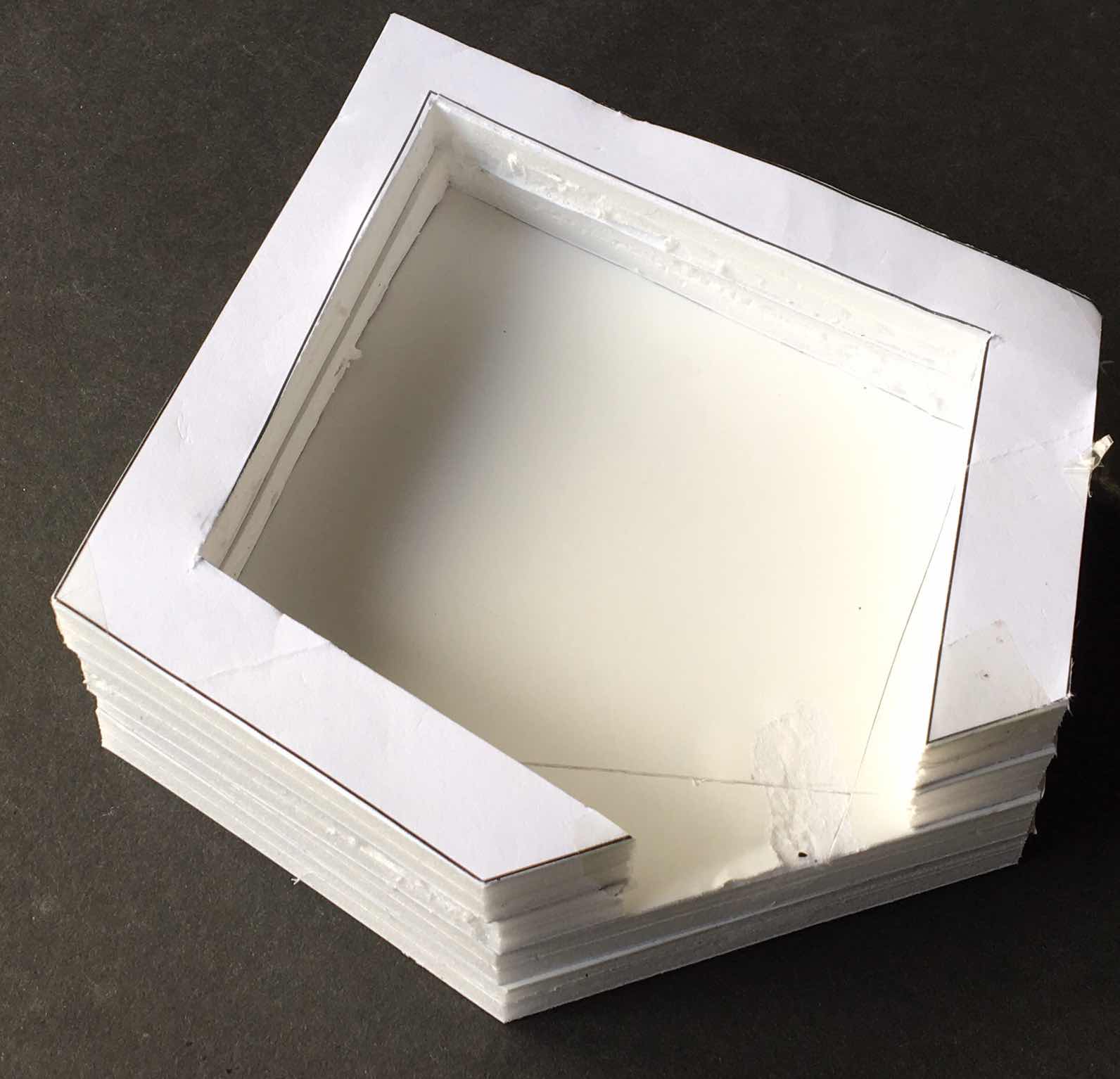
This also needs to be a quick build so I opted to use foamboard as the material of choice. Luckily I have a bunch of this that I have scavenged from various redundant promotional boards created by the internal communications team at work – I am sure you all of you in corporate life know these teams...the people with no budget, but thankfully their  wasteful use of this material can be very useful to a resourceful wargamer.

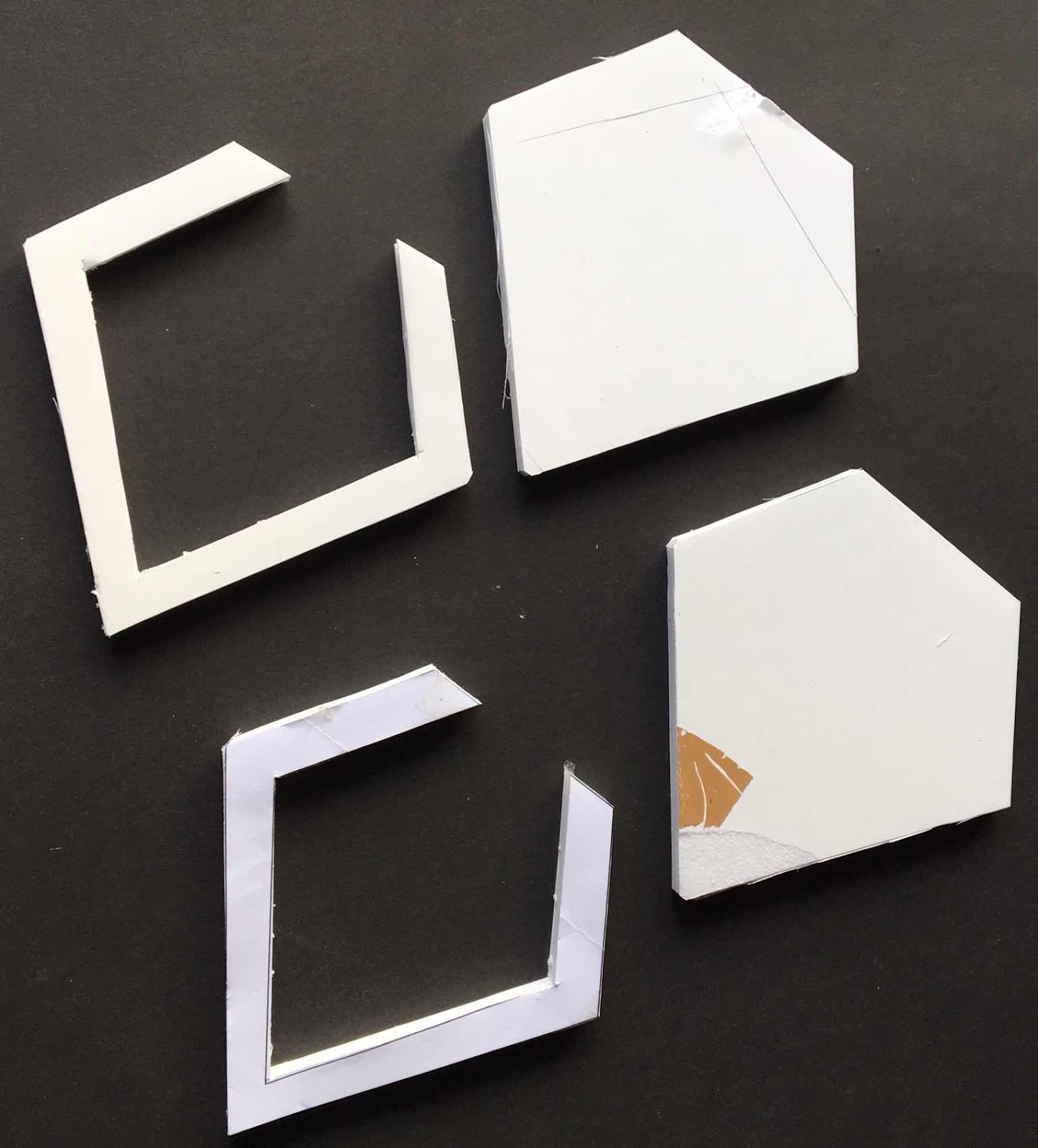
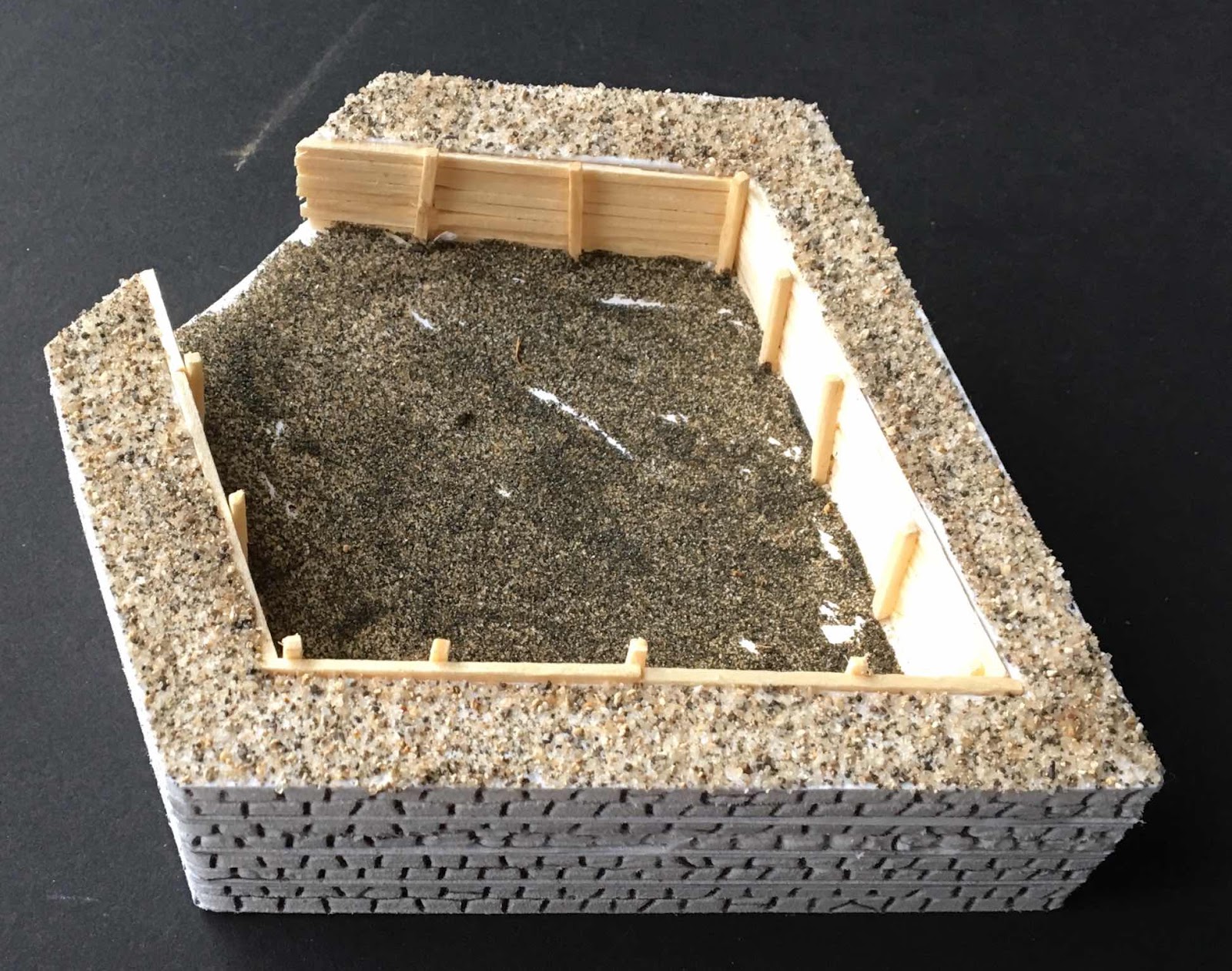
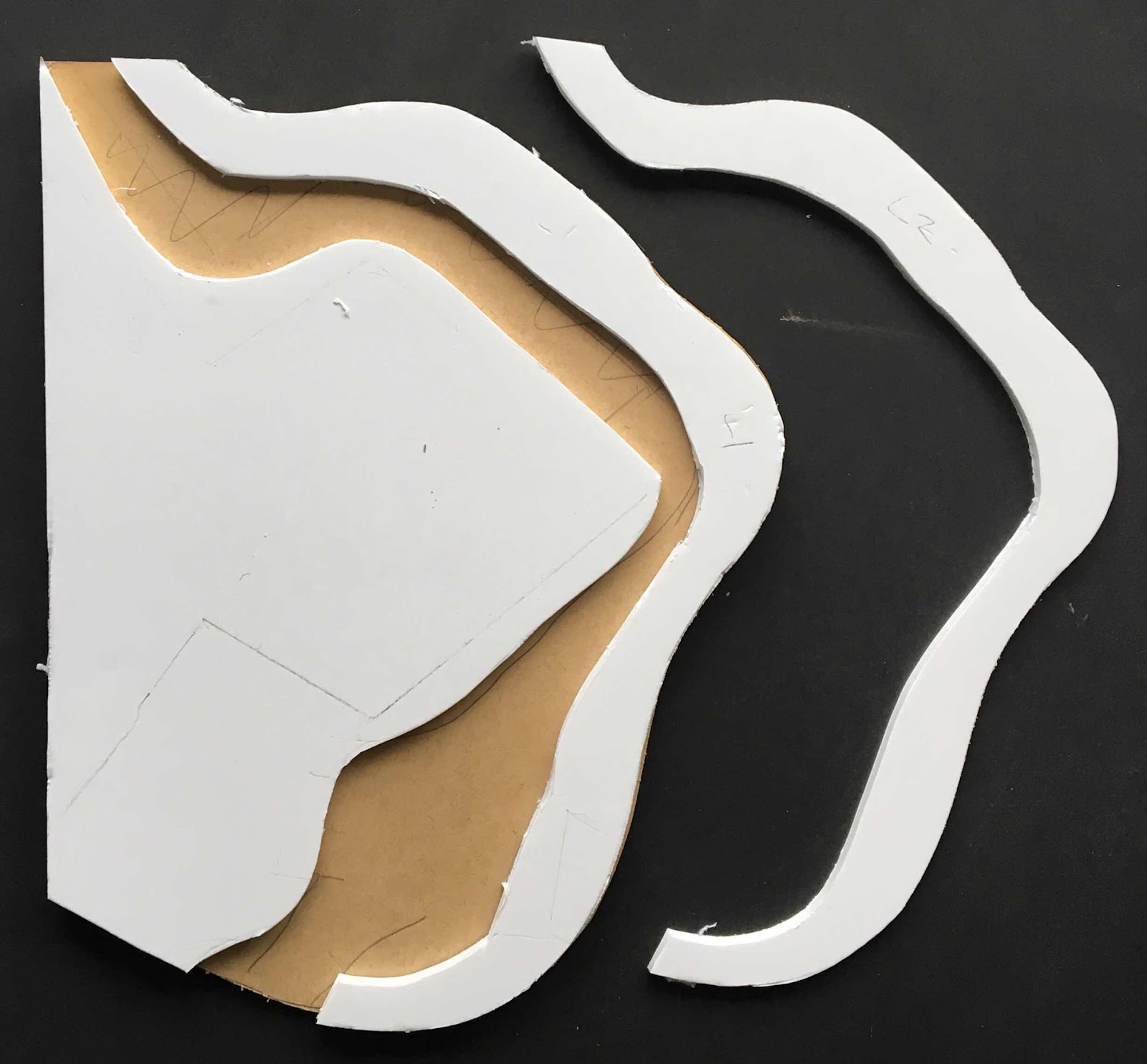
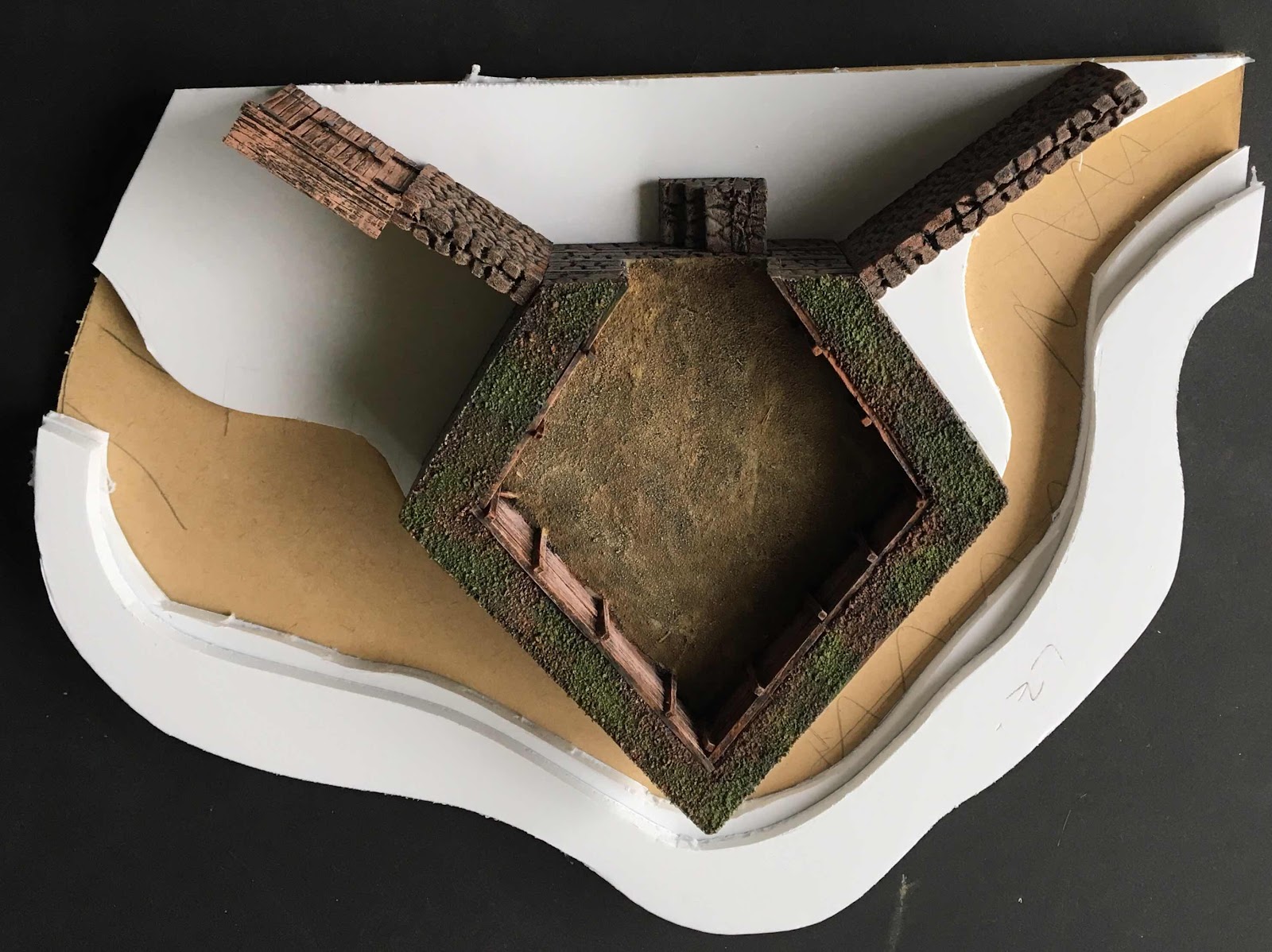
Since the bastion needs to be of a height more than man-height I chose to use some 10mm board that I had on hand and decided to use four pieces laminated together. I quickly sketched the outline of an elongated pentagon on the PC and printed it out. The size was 160mm on each axis. I then taped the printout to the board and cut out two solid pieces for the base and two hollow pieces for the walls.
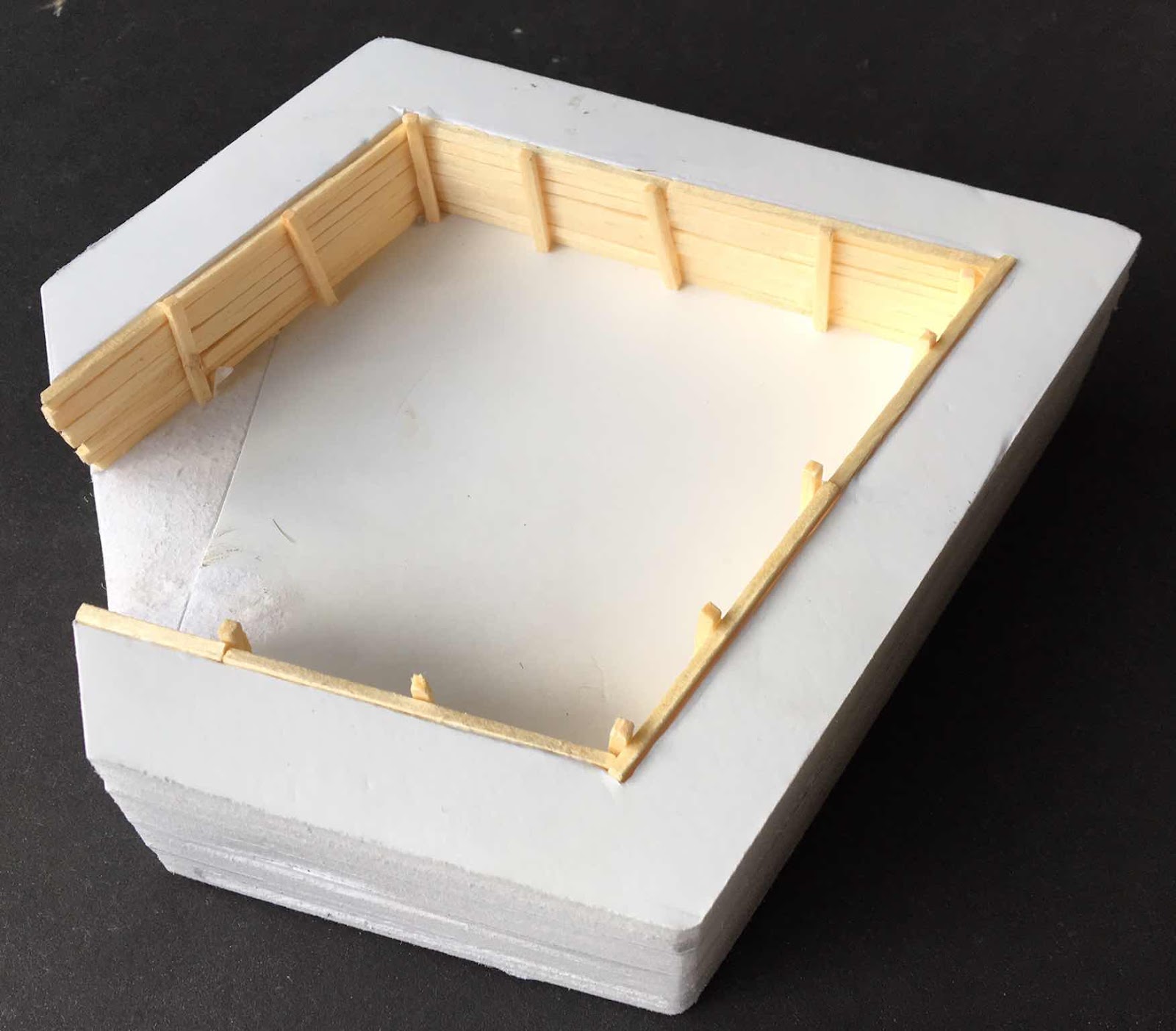


The various pieces were then glued together with PVA and when the glue was dry I sanded the outer sides to even out the irregularities of the cut.


I like to have a variety of textures on my models so I decided that the interior of the bastion would be braced by timber. This is probably not correct, but it will have great texture and at any rate Fort Erie was in poor repair in 1814 by all accounts so this could well represent some sort of repair. To construct this timbered effect I used my old standard – matchsticks.


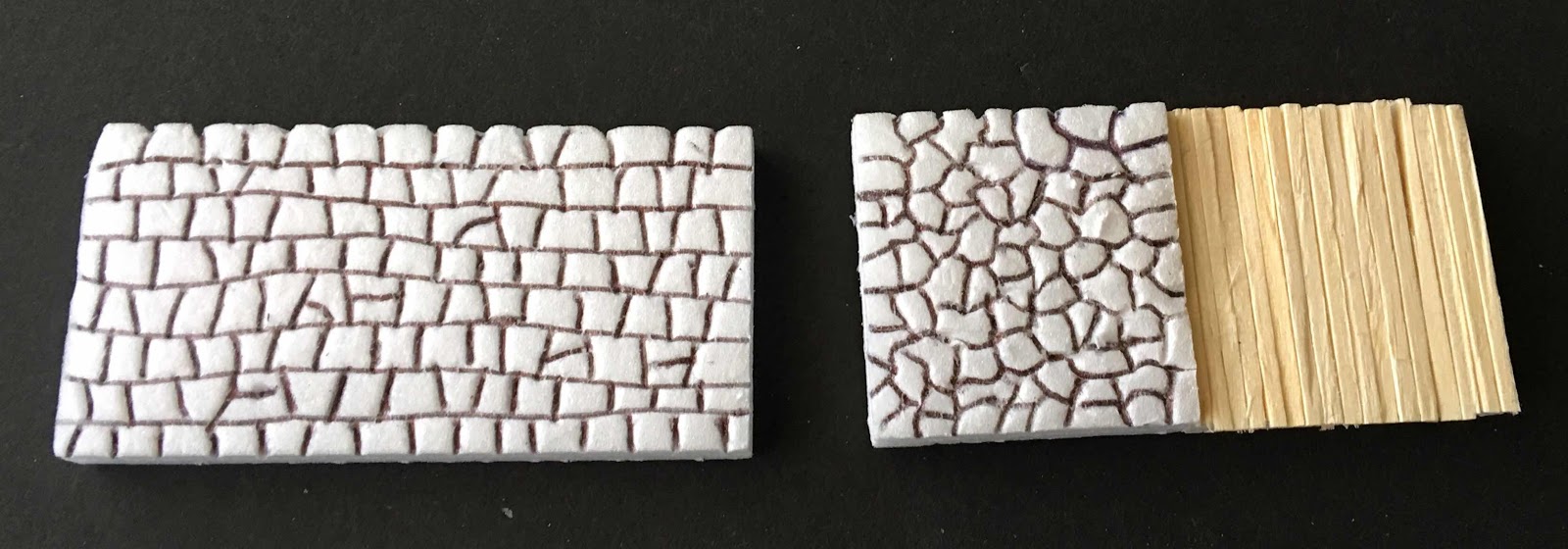
Once all the glue was set I went about marking up the stonework of the outer walls. This was a relatively simple task of drawing the “stone blocks” with a ballpoint pen, pressing hard enough to make an impression between 0.5 and 1 mm deep in the foam.


In modern images of the fort, the tops of the bastion wall are grassed, so my assumption is that they were filled with rubble and earth, some of which would be grassed in 1814 and some would not. So to gain some texture on the top I glued some coarse sand. On the interior I glued some fine sand to give the base a bit of texture and cover up any cut marks on the foam board.


At the same time I made two wall pieces that will extend either side of the piece. I removed the cardboard surface from the foamboard and sketched the stonework into the surface. At the same time I made the gate from matchsticks.


The various pieces were then painted – undercoated in black first then presented in various tones of grey/brown and washed with a thin coat of Aly’s Brown Liquid. The internal area of the bastion was given a suitable dusty floor look and the tops of the walls were made earth with some grassed areas. The whole surface was then coated with a brushed on matte varnish to seal the paint and provide a bit more rigidity to the foam.


The next thing to build was the ditch and the drawbridge. This was a simply a layer of 5mm foam board under the bastion and walls and then two pieces of 5mm for the outer mound, all fixed to a base of 4.75mm MDF.


For simplicity the surface was covered with coarse sand drybrushed various tones of brown, green yellow and white over black to create the earth and grass effect.


The stone supports around the base of the drawbridge are again foamboard etched and painted and all of the timber work is matchsticks.

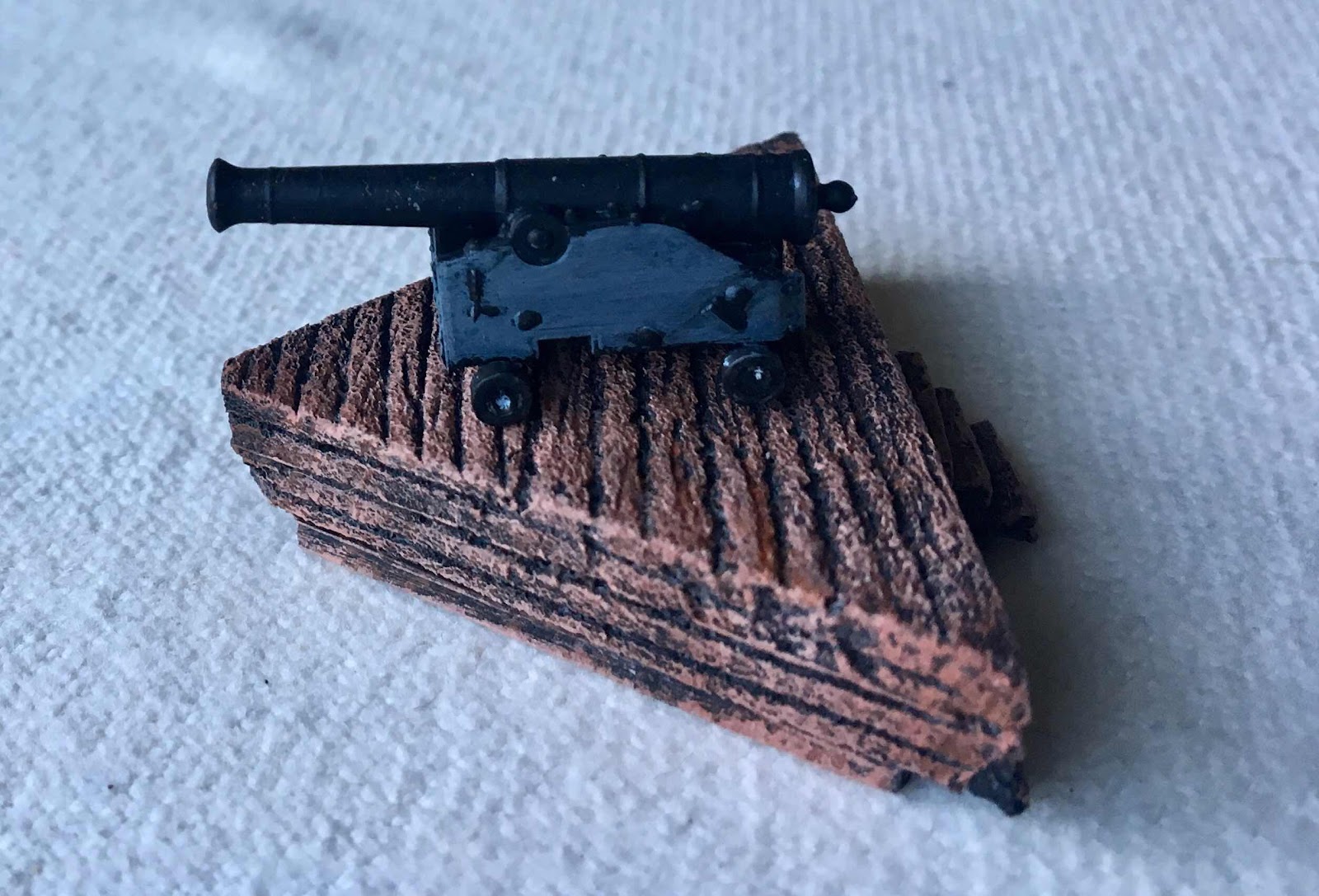
The final item was to build a platform on which a gun, made from barrels left over from the earlier project with the Victrix British artillery set, will sit. Once again 10mm foamboard was used for the platform.


And there it is ready for play in a few weeks time.