Sunday, 5 October 2014

Reminiscing - Wargames Holíday Centre 1986

In 1986, on my first visit to the UK and Europe, I spent a week at Peter Gilder's Wargames Holiday Centre. Just the other day I was cleaning up some old photos and I found the shots I had taken during that week 29 years ago. All of the pictures were seriously under exposed, but I scanned them and did a bit of PhotoShop work to try an clean them up. They brought back a whole batch of memories about that week and inspired this post.

Memories are a little hazy now, but I remember arriving in Scarborough on the afternoon of the Sunday and meeting up with the other attendees at dinner. I can recall most of the people there. There was one older chap, called Bob, a young chap from Bradford, three blokes from London and two others. After dinner Peter Gilder met us and we all drove in the Centre's minibus to the holiday centre, where for the  first time I saw the setup that I had seen many times in the Miniature Wargames magazine.

The games room was in a long rectangular building with two tables 27 feet long by 6 feet wide, and separated by a gap of 3 feet. Against one wall was another table, 3 feet wide, that could be used as troop assembly area, or for off table manoeuvring. After getting to know our host and the gaming facilities we were given the keys to the minibus and went back to the hotel in Scarborough. That minibus  became our self-drive transport for the week.

There were four games played. The first was a Napoleonic, followed by (not necessarily in order) Pony Wars and the Italian Wars. The last two days were a refight of Austerlitz, played across two tables and involving some 5,000 figures.

The Italian Wars game


The Pony Wars Game


The Napoleonic Games (the final three images are the Austerlitz game)


Friday, 3 October 2014

Crimean Project Advances

No time for photographs at the moment. I am too busy painting.


My order for Crimean War British arrived from Great War Miniatures on September 22 and I have been working on them intensely ever since.


I had ordered three battalions (the whole of the Highland Brigade), together with two guns and two mounted figures - Sir Colin Campbell and a highland colonel.


I have finished the mounted officers and the artillery and have done about two thirds of the infantry – the 42nd Black Watch and the 93rd Argyle and Sutherland Regiments. They are starting to look great, but those cursed cross-hatched socks have been driving me insane! I have never been much good at fine straight lines so they are a struggle for me – some are better than others I hope that when they are all based up, my average (or less than average in some cases) work will be concealed by the landscaping on the base.


This purchase completes the 1st Division, that comprises the Guards Brigade, the Highland Brigade and two batteries.


We have a long weekend away next week so I don’t know if I will get any time to get any photos done before then, but I shall try.


I am also working on tidying up some Foundry Franco-Prussian French that someone else had half painted. These are being worked on in the moments when the cross-hatching drives me to distraction.

Thursday, 18 September 2014

WWI in East Africa

In 2012 we travelled to Kenya and Tanzania. When we were driving from Arusha to the Serengetti I remembered the story of how the guns of the cruiser Koenigsberg were taken from the ship and distributed to various German units in German East Africa. My imagination soon began to run away and I as we drove along I gathered ideas for wargames terrain in the rich farmlands.


Some snapshots of the terrain in Tanzania between Arusha and the Ngorongoro, perhaps 60kms west of the battlefield near Taveta in 1916 and near where the Wintgens-Naumann raid passed in 1917.


On my return home I purchased Edward Paice's book "Tip and Run" and developed the idea more, but it only remained conceptual. When a friend of mine gave me a batch of painted Sikh infantry for my birthday, my interest was further piqued, but still iIdid not progress the idea - mainly because the Russo-Japanese project (followed by the Early WWI project) got in the way and the Sikhs remained in their box. But now in mid-September, while I wait for my next order from Northstar - three weeks and counting - and with everything cleared from the painting tray (well almost cleared), I decided to base up those Sikhs. Here is the result. 


This, combined with the fun we had with our recent 1914 and 1918 games, has got me keen. I can see a few command figures, a gun and an HMG team coming soon...

Monday, 15 September 2014

Wargames Rules

I have always written my own wargames rules. This started way back in the early days of my obsession and was forged by necessity. You see my first set of wargames rules was "Charge! or How to Play Wargames" by Brigadier Young and Colonel Lawford and the problem was that those rules were for the Seven Years War, but my interest was in American Civil War, so adaption was the necessity.

I did use some commercial rules back in the early 1980s - mainly the WRG Horse and Musket rules - so that I would have some opponents in club games. But ever since my involvement in club gaming diminished in the mid-1980s, self-written rules have been the norm.

Like all sets of rules mine are pieced from many sources and ideas, but nearly always they can trace their roots back to the days of Featherstone, Grant, Young or Gilder. My rules concepts have pretty much settled now and involve a couple of key modules that can be modified to suit the period. I have used a version of the activation table that has a faint similarity to the original Fire and Fury, I have used a hit and save method for all types of combat - both firing and close combat - and a very simple army morale.

Anyone who has ever gamed with me will probably tell you that my ideas change like the weather, which is probably true, because I am rarely satisfied with the way things work out. But then again my rules are not for publication.

I make my living in the aviation publishing sector and have realised that certain key elements in this medium can be applied to wargames rules. In aviation we use two publications to fly airplanes. One is the operating manual, that contains all of the normal procedures together with descriptions of all the aircraft systems. The other is the Quick Reference Handbook (QRH) that contains all the non-normal procedures. Pilots rarely use the operations manual in flight but nearly always use the QRH because it contains everything they need to know for general operations in one place as a series of checklists.

So I have applied this QRH concept to my rules. For most periods of play I operate eight standard checklists The checklists are:

• Initiative
• Leaders
• Activation
• Movement
• Firing
• Close Combat
• Leader Casualties 
• Army Morale.

By following the logic of the checklists, the player is led easily through the game turn, providing all of the basic information required. These two examples from the Crimean War QRH are the checklists for activation and firing.


I have found that with a few minor tweaks the rules can easily be adapted for almost any period of play between the English Civil War the Franco-Prussian War. With even greater adaption they can be used for 20th Century gaming, and we have successfully used then for WWI and Russo-Japanese War.

Wednesday, 10 September 2014

Tarawera Weekend - Day 5 Sunday 7 September

This the last day of our magnificent event for another year. As tradition would have it this day's game would be a naval game. This time it would be ironclads from 1866 - Austro-Hungarian against Italian.

With breakfast consumed and gear packed for the return home we set up for play.

On the Austrain side there were 11 ships, seven ironclads, one wooden ship of the line, two frigates and a gunboat, while the Italians had eight ironclads and two wooden frigates. 

For the next three hours these ships swirled around two small rocky outcrops in the Adriatic blasting and ramming each other at short range.


In the end the honours were even. Each side lost two ironclads and one wooden ship. Both sides were deemed to have withdrawn to lick their wounds.

Then it was time to pack the table away, pack the last things into the cars and have lunch.  Then our great week of gaming was all over - what took ten months to prepare for was over in what seemed like no time at all. 

At around 14:30 we hit the road, arriving home a little after 18:00.

Tarawera Weekend - Day 4 Saturday 6 September - Part Two

Once again, after a hearty breakfast we headed up to the garage for the first game of the day, a scenario set in Belgium in 1914. The rules for this game were that it had to be finished by 12:20 so that we could play the late war game in the afternoon.


The Belgians were already deployed in the town. The British were advancing up the road that led southwest and the French were just appearing on the Charleroi road (that ran south from the town). The German players had made their plans the evening before and were ready to move onto the table. At 08:30 we started the game.


The Belgians in the town, the HMG behind the barricade


The Germans chose to bring two companies, supported by a section of artillery and two HMGs, from the east of the town on the lower road and the third, supported by two HMGs and two batteries on call from the north of the town. At the same time the German jagers and uhlans, supported by a jager HMG deployed near the farm house.


The Belgian guide cavalry, deployed forward on the hill east of the town, rode forward dismounted and engaged the Germans approaching from the east, while Major Poirot went in search of fuel for the armoured car.


The German infantry advance from the east


Captain Hastings, with the British column marched quickly up the road but were halted abruptly when the cavalry, that was leading the column, came under rifle fire from the Germans north of the town. The French dragoons meanwhile, entered the town along with Captaine Legrand in his taxi.


The British guns deploy to cover the infantry advance


West of the town the Germans became tied up with the Guides and a platoon of French infantry, that were soon joined by the section of French artillery.


The Germans attempted to call their off table artillery, but failed to get a response.


Poirot finally found the fuel for the armoured car and refuelled it. But when he finally prompted Charles to get moving. The German artillery rained down on the road. The Armoured car bogged in a shell hole.


German guns shell the allied positions


Meanwhile the British infantry was caught by the Germans advancing from the north and fell back under fire. When a messenger to Poirot was told that British help was not needed, Hastings began to withdraw to take up skirmishing with the uhlans and jagers.


The British move against the jägers and uhlans


The British take position, with the cavalry HMG in the centre


Finally Charles’ armoured car broke free of the shell holes and drove off the table, ending the game in the Allied favour.


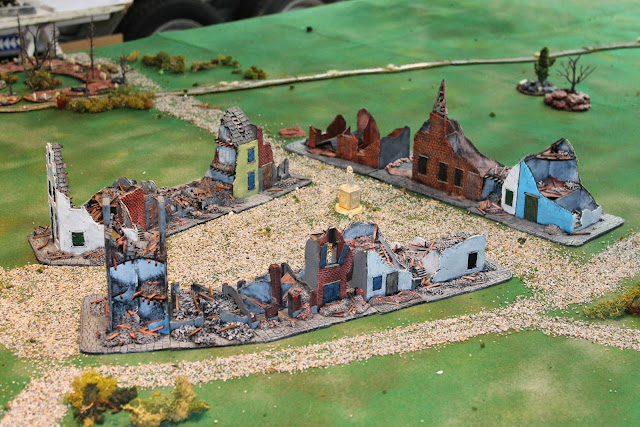
We quickly stripped the table of all its hedges, trees and intact buildings, replacing the buildings with their ruined equivalents and the woods with destroyed woods, ready for the 1918 game. The difference between two terrains was incredible.


The table for the afternoon game


The ruined town


The scenario for the afternoon had four German companies, including one of storm troopers, defending the ruined village against a combined Anglo-French force, supported by tanks. Both sides had air cover.


The British advanced from the south west while the French advanced north. The French advance stalled almost immediately and ground to a complete halt when their only tank, an FT17 was destroyed by German gunfire. To make matters worse for the French, their only aircraft was shot down by rifle and light machinegun fire.


The British pressed boldly through the destroyed woods, pressing their Whippet tank in front.


Above, the British advance and below the British gins engage


The British brought on their aircraft and the Germans countered by bringing theirs on. The two pilots managed to avoid each other and concentrated on making some ground attacks.


The aircraft swirl around


The British infantry attempted to assault the town but were bloodily repulsed.


The Germans in the town


 At the same time the Whippet attempted to drive through the German infantry north of the town, but bogged as it tried to cross the last obstacle.  


 The Whippet moves to attack, but bogs, then...


...breaks through the German line


The German anti-tank gun tried in vain to take out the British tank before it unbogged, but when the tank finally did free itself, it rolled over the infantry to its front and threatened the town from the north.


Here the game ended. 


We cleared the table and retired to the house for wine, Calvados, a filllet of beef, great conversation and DVDs.


Tarawera Weekend - Day 4 Saturday 6 September - Part One

This day is set to play two WWI games; one set in 1914 and the second set in 1918. I organised the early war game, and was scheduled for the morning. 


Since I prepared it, I will give the full details of the 1914 scenario here in Part One, then follow with the description of the game in Part 2.

1914 Briefings

General Situation
It is July 1914. Germany has declared war on Russia. France has declared war on Germany and Germany has declared war on France and Belgium, and has invaded Luxembourg. 

On the morning of 4 August 4th, while Britain declared war on Germany, six German infantry brigades advanced against Liege, where General Leman’s Belgian Third Infantry Division and a few disconnected brigades stood. The initial German attacks were repulsed, but when the Germans brought up their 420mm ‘Big Bertha’ guns they began to take out one Belgian battery after another. On 16 August the last of the Belgian forts surrendered. 

In the meantime the other four divisions of the Belgian Army fell back from the Frontier towards Antwerp and Brussels. The first elements of the British Expeditionary Force arrived in France on 12 August and began to assemble near Maubeuge forming the link between the French and Belgian Armies.

On 17 August the German army set the Schlieffen Plan in motion. By mid-day on the 17th the first patrols were approaching their next objective, Namur.

It is here that our story begins.


The map of the game table

Belgian Briefing
You are Major André Poirot, brother to the famed detective and ADC to General Ruldet commanding the Fifth Infantry Division. On 15 August you were ordered to proceed forward in the direction of Liege, with the purpose of securing and escorting to safety Archduke Charles, cousin to King Albert and fourth in line to the Belgian throne. Charles had been in Liege when the war broke out.

You met up with Charles and his entourage on the evening of the 16th at a village between Namur and Liege. Despite the seriousness of the situation Charles was remarkably cavalier. He has commandeered an armoured car, loaded it with personal booty, and had delighted at taking pot shots with the vehicle’s machine gun at German cavalry patrols. On the 17th you escorted the Archduke through Namur heading west. But progress was difficult and Charles insisted on pausing for lunch at one of his favourite bistros in the town. As you were ready to depart German patrols we seen near the walls of the fortress. Again Charles insisted in opening fire on them from the armoured car. Only after strenuous efforts did you manage to prevent him from driving forward in search of fresh targets. You lost several of your men in this absurd action. 

Progress west was slow because the roads were choked with refugees and you halted for the night of the 17th in the village of Deux Fesses, mid-way between Namur and Charleroi, at the home of one of Charles’ school friends. Concerned that you might be overtaken you advised headquarters of the situation, requesting assistance.

On the morning of the 18th you struggled to get Charles’ party out of bed and ready to move, after a heavy night. When he was finally ready German cavalry was spotted to the west, squarely across the road by which your retreat was to pass. Then to make matters worse Charles’ armoured car wouldn’t start – it was out of fuel.

Charles refused to leave the car (along with its stock of champagne and other booty) and insisted that you find fuel for it.

Your objectives:
Exit along the Charleroi road with as much of tour force intact as possible

• The Allied force will earn ten victory points for every Belgian platoon, squadron or HMG team that exits the table at a strength greater than half
• Twenty victory points are earned if the Charles survives (less 5 if he is wounded)

Order of battle:
• One infantry company (3 platoons of line infantry, each 4 stands)
• One platoon of Guides (4 stands) (mounted and dismounted)
• Charles’ personal armoured car, with HMG
• 1 HMG team, with dog carts

You may lay up to 1,200mm of barbed wire entanglements.

French Briefing
You are Capitaine Etienne Le Grand, great grandson of the famous Napoleonic general (famous in our gaming terms if not in reality). You command, 2nd Company, Third Battalion, 129e Régimént de Ligne operating near the Belgian border in mid-August.

Not only have you inherited your great grandfather’s name, but also his love for collecting antiquities. With much of the Belgian countryside abandoned by the general populace, the opportunities for an antiquities collector like you are ripe. And if you don’t take advantage you know that the Germans certainly will, right?

On the evening of August 17 your battalion commander orders you to advance on Deux Fesses, a village mid-way between Namur and Charleroi, where a small Belgian force accompanying an important Belgian diplomat is holed up and has requested assistance to flee the pursuing Germans. You are to move on the town with sufficient force to protect their withdrawal.

You can’t believe your luck because you know that in that village lives Albert Bertrand, a well known antiquities collector and friend of the Belgian Royal family. Bertrand is known to hold the very rare and valuable painting “The Fallen Madonna” by von Klomp, that would fill that vacant space in the ballroom of the le Grand family home.

You set off at 0400 hrs and at around 0900 you are approaching Deux Fesses.

Your objectives:
• Make contact with the Belgians
• Assist the Belgians to exit the table west along the Charleroi Road
• The Allied force will earn ten victory points for every Belgian unit that exits the table at a strength greater than half
• Twenty victory points are earned if the diplomat survives (less 5 if he is wounded)
• You can claim a personal victory if you locate and secure the von Klomp painting and survive the game.

Order of battle:
• 2nd Company, Third Battalion, 129e Régimént de Ligne (3 platoons, each 4 stands)
• 2 HMG
• 1st platoon, 2nd squadron of 12th Dragoons (4 stands)
• 1 section of artillery (2 guns)
• A taxi - your personal vehicle.

British Briefing
You are Captain Arthur Hastings, ADC to Brigadier General Hamilton, commanding 3rd Division, operating in southern Belgium. On the evening of 17 August you were called to HQ and ordered to take a scratch force towards the village of Deux Fesses, mid way between Namur and Charleroi. A small Belgian force accompanying an important Belgian diplomat is there and has requested assistance to flee the pursuing Germans.

You set off at 0400 hrs and at around 0900 you are approaching Grosses Fesses

Your objectives:
• Make contact with the Belgians
• Assist the Belgians to exit the table west along the Charleroi Road
• The Allied force will earn ten victory points for every Belgian unit that exits the table at a strength greater than half
• Twenty victory points are earned if the diplomat survives (less 5 if he is wounded)

Order of battle:
• One infantry company (4 platoons, each 4 stands)
• One HMG
• One troop of 17th Lancers (4 stands) (mounted and dismounted)
• One cavalry HMG
•1 section of artillery (2 guns)

German Senior Officer Briefing 
You are Hauptman Albert Hans “Hansi” Burkhalter commanding 3rd Company, First Battalion 105th Infantry Regiment and, in the absence of the battalion major, commanding the battalion. You are leading the division in the advance on Charleroi where you are to secure the rail yards.

During the 17th you have been skirmishing with a mixed force of Belgians. They appear to be remarkably well equipped and are accompanied by an armoured car that they seem to be willing to use with a recklessness unexpected of Belgians. As the day progresses a report is received from Divisional HQ citing rumours that Archduke Charles, 4th in line to the Belgian throne, is with this group of Belgians. Securing Charles would be a coup for the division.

As night fell, fearing that the Belgians could get away, you asked if cavalry could be despatched to see if it was possible to get ahead of the Belgians, to try to cut them off.

At dawn reports came back from the cavalry that they had succeeded in getting ahead of the Belgians, who are holed up in the village of Deux Fesses, mid way between Namur and Charleroi.

You will provide instructions to your two subordinate commanders, Hauptmans Rottenkoff and Grossblädder

Your objectives:
• Exit as many units as possible off the table along the Charleroi Road
• You will earn ten victory points for each company above half strengh that achieve this
• Capture or destroy the Belgian force
• You will earn ten points for each Belgian platoon, vehicle or MG captured
• You will earn 20 points if Charles is captured

Order of battle:
First Battalion 105th Infantry Regiment
• 1st Company (3 platoons, each 4 stands) Hauptman Norbert Rottenkoff
• 2nd Company (3 platoons, each 4 stands) Hauptman Rudolff Grossblädder
• 3rd Company (3 platoons, each 4 stands)
•4th Company (Not present - detached to guard the divisional supply train)
Attached and assigned at your discretion
• HMG Company (4 Stands)
• 1 section of 1st Battery, 59th Field Battery (2 guns)
On call (but not under your control)
• One field battery
• One howitzer battery

Also known to be operating in the area (but not under your control)
• Elements of 4th cavalry Division

Non-Player Character – under the umpire’s control
The umpire plays Lieutenant Wolfgang Klinkelpopper commanding 1st Platoon, 2nd Squadron,15th Uhlans, 6th Cavalry Division. On the evening of 17 August he has received the following orders from his squadron commander: 

“The infantry of the vanguard has requested assistance in arresting the retreat of a Belgian contingent near the village of Deux Fesses. You are to take your platoon, together with a platoon of jãgers and their accompanying machine gun, and pass around the Belgians and block the road to Charleroi. Caution is to be taken. Your goal is to delay the easterly progress of the Belgians. You are to avoid any serious engagement that is not to your advantage. If pressed you should withdraw slowly, continuing to threaten the enemy.” 

Order of battle:
•1st Platoon, 2nd Squadron,15th Uhlans (4 Stands - mounted and dismounted)
• 3rd Platoon, Cyclist Company, 5th Jäger Battalion (4 Stands - mounted and dismounted)
• 1 HMG from 5th Jager Battalion (1 Stand) 
Unattached - although not technically part of the command, the umpire will fire them during the game
• One field battery (6 stands each) - off table
• One howitzer battery (6 stands) – off table

The Table
The table measured 4.8 metres by 2 metres. Central to the game was the town of Grosses Fesses a small town of sixteen houses surrounding a central square, amid rolling hills and hedged fields. Five roads led to the town and four small wood lots were nearby.


The table looking east