Thursday, 6 July 2023

A Brigade Completed

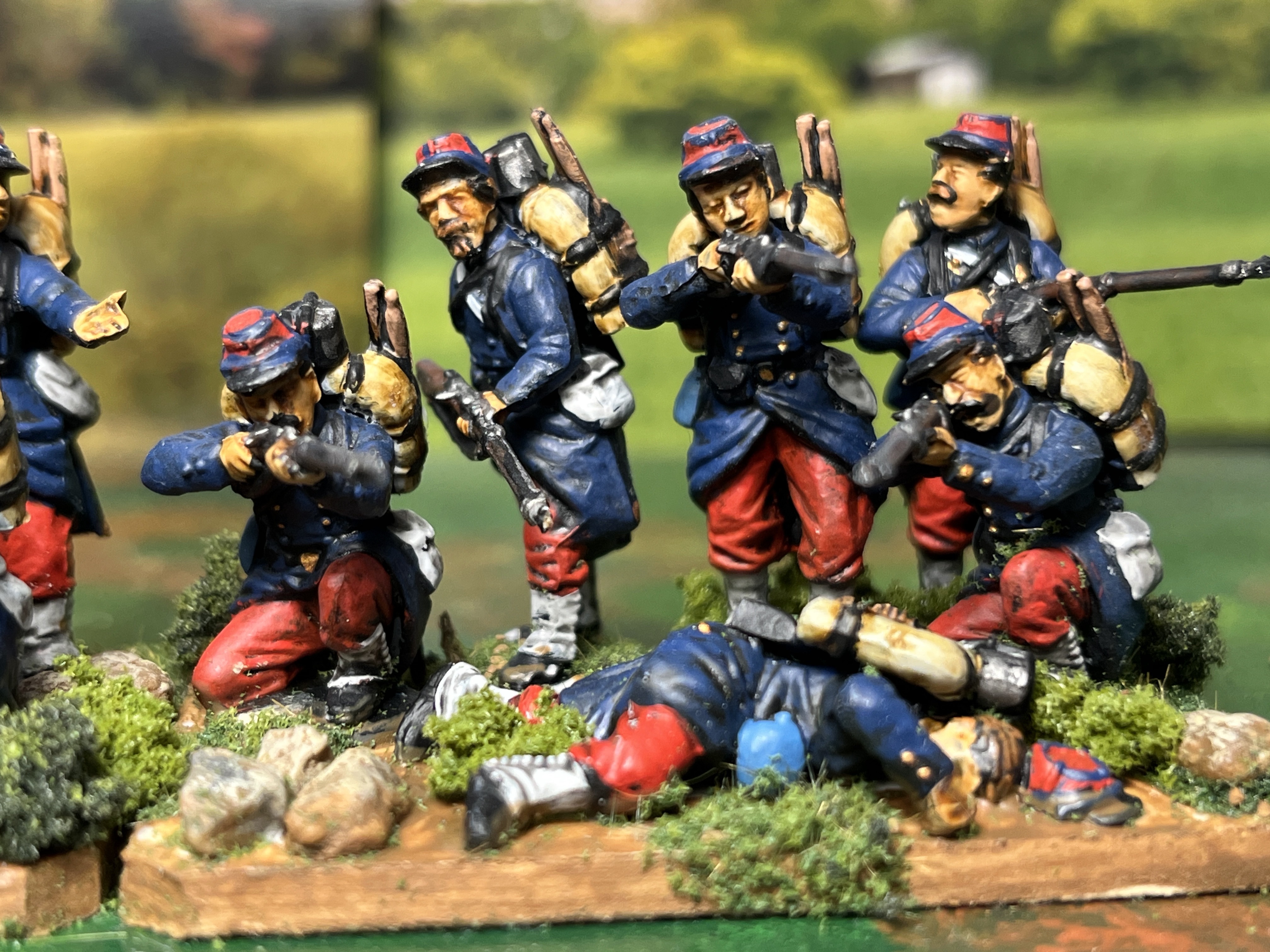
Today's offering is the First Battalion, 76e Régiment d'Infanterie, the last of the the three battalions for the regiment and marks the completion of Second Brigade, First Division, 2nd Corps.

The battalion


The regiment


The brigade

Commanding the brigade in 1870 was Général de Brigade Charles Jean Jolivet. Born in Paris in 1814 he enlisted as a private in the 14e Régiment d'Infanterie legere in 1832. He served ten years (1847-1857) in Africa and was in Mexico 1862-63. In 1863 he was made general de brigade and served in Africa again until 1865. In March 1870 he took command of Second Brigade, First Division, 2nd Corps which he led competently at Spicheren and the battles around Metz. Made general de division in 1871 he died in Paris in 1891.


Tuesday, 4 July 2023

They Just Keep Coming...

Today sees the completion of another Franco-Prussian War French infantry unit. This time it is Third Battalion, 76e Régiment d'Infanterie.

In keeping with what I did for III/77e they are in the firing pose.


The First battalion, the last for the regiment and the brigade, is on the painting table now and will be finished tomorrow. I will then take a brief break from the 1870 to work on a unit of Napoleonic Austrian hussars to finish off that project. 

Saturday, 1 July 2023

Half Yearly Review

At the start of the year I wrote "...I have only two projects on the books: a small expansion of the Russian Napoleonic infantry (half a dozen battalions of grenadiers) and the completion of the Franco-Prussians." But it didn't take long for a new project, the Austrian Napoleonics, to pop up...that damned butterfly fluttering around again!

The first project for year saw the completion of five regiments of Prussian cavalry for the Franco-Prussian War carried forward from last year. Their completion marked the pause in that project until the Prussian heavy guns were available (which they are now and are marked for working in September) and the Prussian generals that are due at some point "soonish" according to Michael Perry.

The Russian Grenadiers and a regiment of Prussian landwehr cavalry followed before the Austrians began to appear.

Six big ACW guns and a bit of work on some fantasy ruins has preceded the current FPW French work.

The raw painting count breakdown is: 565 foot figures, 75 mounted figures, 7 guns, 2 pieces of equipment and 32 terrain pieces.

Adjusting that for effort (counting 5 points per foot figures, 10 points for each mounted figures, gun or equipment pieces and 10 points for each hour's work on scratch built piece of terrain work) the results by project are:


In terms of games played I have managed ten, which is surprising really since I had four weeks holiday in that time.

So what does the next six months hold in store?

First up is a unit of hussars to finish off the Austrian Napoleonic project. There will be some Ottoman Turks much later in the year too. The main effort will  be the Franco-Prussians which, with retirement not far around the corner, will probably be my last big project...unless someone decides to make a full Franco-Austrian War range, in which case I will need to put retirement off another year!


Friday, 30 June 2023

Second Battalion, 76e Régiment d'Infanterie

The 76e Régiment d'Infanterie had a history much the same as its sister regiment, the 77e, and carried honours for Ulm, Jena, Friedland and Solferino. In 1870 it was brigaded in Jolivet's Second Brigade, Verge's Division with the 77e.


It was commanded by Colonel Pierre Francois Alphonse Brice, aged 59 years old, when the war broke out. A graduate of St Cyr he fought in the Crimea where he took a wound to his left eye and cheek in the storming of the Mamelon-Vert. Made colonel of the 76e in 1868 he led it at Spicheren, where it suffered 245 casualties, at Rezonville where it suffered 621 casualties  and at Gravelotte where it lost 51.


The depot battalions formed the 76e Régiment de Marche that was engaged in a number of small actions in Normandy. When the regiment was returned to France after the armistice 1871 it played a role in the suppression of the Commune.


It was heavily engaged again in the Great War in the Argonne, the Marne, the Somme and the Ardennes. It fought again in the Battle of France in 1940, reformed after the war and disbanded in 1976.


Tuesday, 27 June 2023

3e Bataillon de Chasseurs à Pied

Chasseurs had been a part of the French army since the of the 18th Century or earlier, but the Chasseurs à Pied of 1870 had their origins in the late-1830s as an informal unit called the Tirailleurs d'Afrique that was given a formal establishment in September 1839, based in Vincennes and named the Chasseurs de Vincennes. Under the colonelcy of the Duc d'Orleans they were trained as true light infantry and proved themselves highly effective in the campaigns in North Africa, so effective that in August 1840 a further nine battalions were established as a separate corps by royal decree. On the death of the Duc in 1842 they were named the Chasseurs d'Orleans in his honour. After the revolution of 1848 the battalions became known as Chasseurs à Pied. By 1870 there were twenty battalions in service.

The 3e Chasseurs were formed in 1840 and spent the next eight years in North Africa. Returning to France in 1848 the battalion went to the Crimea in 1853 and was fort in the battles of the Alma and Inkerman and were involved in the storming of the Mamelon-Vert at Sevastopol. Not engaged in the Italian campaign, the battalion formed a part of the garrison of the Pontifical States from 1860-65.

In the structure of the army in 1870 one Chasseur battalion was assigned to each infantry division. The 3e was assigned to Verge's Division, 2nd Corps (which is why it is a part of my collection), under Commandant Thoma. Heavily engaged at Spicheren it lost 6 officers and 225 men from 452 engaged. It fought again at Rezonville and Gravelotte and surrendered at Metz in October.

The depot companies formed the basis of the 3e Chasseurs de Marche and served in 16th Corps in the Army d'Loire, fighting at Valliere, Loigny and Moree.

In the Great War the battalion fought from day one to the very end of the war across almost every point of the western front from Belgium to Belfort, and counted 2,039 officers and enlisted  men killed during the war. 


Disbanded in 1929, it was restored in 1939, only to be disbanded again after the Fall of France the following year. Reconstituted in 1949 it was disbanded for good in 1955.

These are lovely figures, full of character, but the rifles and bayonets on the figures are very thin and I am concerned how they will stand up to handling during games.


Monday, 26 June 2023

War in the Crimea

Yesterday I arranged a Crimean War game. Having spent all last week on holiday I had given very little thought to the scenario, in fact the whole game was conceived on the morning of the game. 

The Russians were to be in position more or less diagonally across the table with 35 battalions, five large batteries and four cavalry regiments. The Allied were to attack with 13 British battalions (including three battalions of Guards) and five standard batteries, ten small cavalry regiments (the Heavy and Light Brigades), the French with 13 battalions and two standard batteries, and the Turks with four battalions and two standard batteries. While the Russians had greater numbers of infantry battalions, they were slower moving than the Allies and their dense formations made them more vulnerable to fire. The British infantry, the French Chasseurs and Zouaves were armed with rifled muskets and enjoyed a range advantage.

The Allies chose to hit the Russian left with the bulk of their force, hoping that the troops on the Russian right could be kept out of the fight for as long as possible. Keith, who commanded the British infantry, filed a much more detailed report than I can give here.

In the end, after a hard fought battle, the Russians were driven back, although the British and Turkish forces took a heavy bashing.

The Russians advance

"Forward the Light Brigade"...sadly they suffered much the same fate as the original brigade

French troops moving forward

The Scots Greys going forward

The Light Brigade about to be shot to pieces


A Russian battery about to be ridden down by the Royals

The Zouaves press on

The 11th Hussars are broken while charging a Russian square

Here they come!

The developing fight on the Russian left

The infantry form for the fight 

The French have arrived at the front


The confusion on the Russian left...

The French are unstoppable...

...and have broken the Russian left.

The Heavy Brigade advancing


Saturday, 24 June 2023

First Battalion, 77e Régiment d'Infanterie

Identified by its red fanion this is Commandant Mezerin's First Battalion, 77e Régiment de Ligne, the final battalion of the regiment.


For anyone interested in the weaponry of the Franco-Prussian War, Steve Shann (who wrote two Osprey  Men at Arms books on the French armies in 1870-71 and has published several other wargaming books) is about to publish a work on the mitrailleuse, the details of which can be found here https://steve-nationsinarms.blogspot.com/2023/06/new-book.html

Meanwhile here is the whole of the 77e Régiment deployed.