Sunday, 1 December 2013

WWI Project

Several months ago I started a WWI project, collecting figures for small forces of French, Belgian, British and Germans for use in 1914. I completed a company each of French and Germans, together with heavy machine guns and a German 7.7cm field gun. I also began work on a company of Belgian infantry, and have completed all but one platoon of the infantry, one HMG and a singe Minerva Armour Car.

This project was put on hold while I finished the Russo-Japanese armies for the Tarawera weekend, but now that those armies are complete (for now), I am getting back into the WWI.

I have ordered the the remaining Belgian infantry, two French 75mm guns and crews, along with a platoon of French dragoons. Apart from the  Belgian cavalry and a machine gun dog team, this will complete those two forces. The remaining Germans and the British will be ordered in the New Year.

However, judging from the last delivery, I am not expecting these figures to arrive quickly. So to fill in the  time until they arrive I have begun to work on some buildings for the Belgian/Northerh France area. The series will be based on some work I did some twenty-five years ago when I designed all of the buildings for Military Miniatures. Within that body of work I did a series in 1:300 scale that consisted of 16 gabled row houses that could be stood side by side to make street rows. The front and back of these were different so that they could be arranged in a large variety of combinations. This series will largely repeat that, but in 25mm. 

The intention is to make perhaps 14 houses that will be used in street rows, with a further six that can be ends - that is textured on three sides and not two. I have made the first four cardboard forms up and begun texturing the faces of some. One also has it roof tiles in place. The pictires below show those first four structures in a couple of combinations. There will also be some buildings in ruins.


Most of the buildings will have a standard frontage of 60mm, although some will be 80mm, and all with have a standard depth of 70mm with the total measurement from the front to back edge of the pavement of 135mm. Height will vary between 100mm and 140mm.

The building below shows  gabled building with the front and back texturing complete. All that need to be done is add the roof crest, chimneys and complete the pavements, perhaps another hour's work.


I was hoping to get a bit further on with these - I wanted to get the first four completed before the miniatures  order arrives - but I have a business trip that will take me away from home for the next week. I will post more images as the project progresses.

Sunday, 17 November 2013

RJW Game - Part 2


How the Game Ran

Barishenkov chose to deploy on the left, throwing up a short angled line of trenches, that were to be occupied by the rifles regiment, directly behind a line of trees that would conceal them from one direction. To the right of the rifles on the small hill was a machine gun, dug in, with the two field batteries to the rear. To the right, in the low ground between the hill and the monastery ridge, was a second line of trenches to be occupied by the 23rd Siberian Regiment. The 32nd Siberian Regiment and the second machine gun occupied the monastery. Barishenkov also had a significant trench prepared running back along the monastery ridge which he could not occupy.


Map Showing Barishenkov's Trench Lines (in grey)

When Barishenkov and Gemmersheim met they agreed that one of Gemmersheim's regiments would occupy the vacant trench with a second regiment held to the rear, out of sight behind the ridge. Gemmersheim's second brigade would deploy across the stream with both machine guns. His artillery would deploy with one battalion off table and one on, behind the semall ridge on the extreme right.

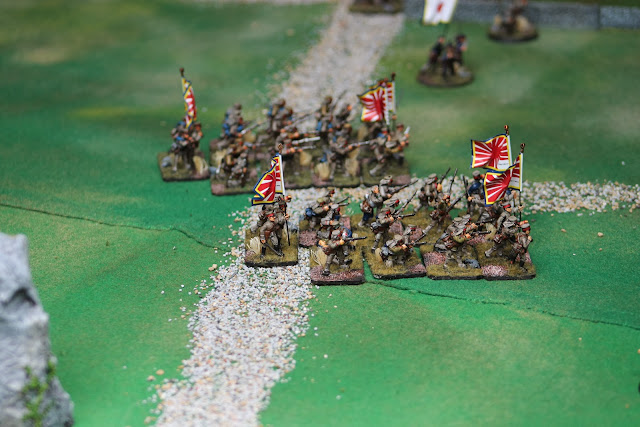
The Japanes 2nd Division, having arrived first, made a reconnaissance, starting on the table edge behind the farm,  running directly forward towards the trench on Barishenkov's left, then running along the stream bed to the Japanese left, across the front of the monastery and the trench on monastery ridge and then back through the Hutong. The reconnaissance observed all of the entrenched areas, but failed to detarmine whether the trench where the rifles were deployed were occupied. It also failed to identify the machine gun position on the small hill. They were fired on by the 23rd Siberians, but could not identify the  strength there. They did successfully discover that the monastery was held in strength, at least one regiment and determined the monastery ridge trench was unoccupied. 

With the reconnaissance completed the Japanese division commandrs made their plan of battle. TheJapanese  chose to try to envelop both flanks, with the 2nd Division on the right and the Guards on the left, and then exploit the centre with 12th Division, although 12th Division did toy with the idea of extendending even fiurther right for a short time.

During the night Popolov arrived on the field with his scratch force and occupied the monastery ridge trench with the infantry and machine guns. The deployment of Popolov in the trench was a surprise to both Barishenkov and Gemmersheim and the latter was compelled to redeploy further to the right. Popolov's four field batteries were deployed off table.

The Battle Begins

The Japanese attack began with the 2nd Division artillery attempting to swamp the Siberians in their trenches, but with little success. Meanwhile the Guards marched onto fhe table and were immediately struck by Russian gunfire and forced to halt their advance until their own guns could deploy.

The 2nd division quickly pressed one brigade forward to the edge of the farm and was struck by machingun and artillery fire from Barishenkov's position. The Japanese halted and brought forward their own machineguns to reply. Meanwhile the second brigade moved around the rear of the large hill to their right. 

On the left the first brigade of the Guard learned the hard way not to expose themselves to the Russian artillery fire and suffered heavy losses. They quickly sought cover behind the Hutong while their guns and their second brigade deployed.

The Japanese Stabilise Their Positions

By turn three the Japanese were beginning to form something of a battle line. The 2nd Division pressed beyond the road and discovered the position of Barishenkov's rifles regiment, but could make no impact on the entrenched Russians. Their flanking brigade was making slow progress around the large hill. The Guards, meanwhile, were doing better. Their artillery had come into action and caused some damage to Gemmersheim's second brigade that was digging in along the edge of the fields beyond the stream. The Guards soon had a good line formed along the road. The 12th Division had begun to arrive on the field and formed behind the woods on the ridge between 2nd and Guards Divisions.

It soon became apparent to Barishenkov that he was going to take the brunt of the Japanese assault and called on Gemmersheim for support. The latter responded by releasing his reserve regiment just as the Japanese 2nd Division closed in. Failing to gain effcet with his artillery by indirect fire, Barishenkov brought his guns forward onto this small hill. Exposed on the hill the batteries were immediately hit by the the fire of 12th Division's six batteries and quickly destroyed. The Japanese guns pounded the machine gun on the hill, damaging, but not destroying the piece. The Russians in the trenches began to suffer some damage, while the 2nd division closed in on the Rifles regiment.


The Rifles Regiment Defending Against the 2nd Division

Seeing that they were about to be overwhelmed the Rifles left their trench and charged forward in the hope of driving back the advance elements of the 2nd Division to gain some time for Gemmersheim's troops to arrive to help in the defence. It was a desperate attempt, but as a spoiling attack it had a chance of success. The Japanese were surprised and driven back, but were not driven off.

At the opposite end of the field Gemmerheim's right hand brigade was feeling the pressure from the Guards and was beginning to crumble. The artillery came forward and engaged the Japanese over open sights, but could only delay their advance. When two Japanese regiments moved to attack the Russians frontally, the Russian line failed and broke.


The Guards Attack the Russian Right

The End of the Russian Defence


The 12th Division forms for the attack

With the failure of the Rifles to drive off the advance of the 2nd Division the writing was on the wall for the Russian left and four regiments converged against one. In the centre the 12th Division was taking aim at the monastery, with the whole division preparing to attack the one Siberian regiment holding the place. The Japanese guns struggled to silence the Russians but sheet weight of numbers soon began to tell. The monastery fell to a determined assault.


The Final Assault on the Monastery

With the monastery in japanese hands the Japanese artillery was free to engage Gemmersheim's troops. Most of these troops were in the open and were soon cut to pieces the the gunfire. When 2nd Division finally drove off the Rifles and moved around the Russian left flank, Barishenkov was complelled to withdraw. Gemmersheim, unable to fight the battle alone was also compelled to retire and the battle ended.


The final advance of the 2nd division around the flank

The Japanese had won a decisive victory, but the Russians had fought hard and Gemmersheim at least kept his command - and certainly did not discrace the service. 

For the statistics, just under 1,000 figures, eighteen machine guns and twelve gun models were on the table. All of the infantry figures were by Tsuba Miniatures and all of the remainder by Redoubt. The game started about 9:00 in the morning and lasted until around 4:00 pm, with a reasonable break for lunch of course.

Thursday, 14 November 2013

RJW Game Part 1

For the last 29 years a group of friends have travelled to Lake Tarawera, south of Auckland, for a weekend of wargaming. When we started out we would drive down on a Friday night, game Saturday and part of Sunday then drive home. The “Tarawera Weekend” slowly stretched to a longer weekend, gong down on the Thursday instead of Friday, to the point has now extended to nearer to a full week this year, where we went down on the Tuesday, played games on Wednesday through Sunday, driving home on the Sunday afternoon.


My contribution this year was the Wednesday game - a Russo-Japanese War game. My apologies for the distortion of historical fact here, but here is the basis of the scenario. Set after the fall of the Motien Pass and before Liaoyang, the scenario sees the Japanese First Army trying to position itself for the advance on Liaoyang.


Background


Facing the Japanese advance is the 5th Siberian Division under General Barishenkov. Now Barishenkov had taken over command of the Division after it had been defeated at the Yalu. The Division was badly demoralised and had lost most of its artillery and machine guns. Barishenkov had done wonders to restore morale. He scrounged together a couple of batteries and some machine guns, but as the situation worsened to the south west one of his brigades was stripped away and he was left pretty much on his own to face the threat from the Japanese First Army.


When Motien Pass fell the Russian CinC, General Kuropatkin, recognized the threat to this left flank and moved to strengthen it. He had little faith in the Siberian troops and ordered General Gemmersheim’s newly arrived European Ninth Infantry Division to Barishenkov’s support, reminding Gemmersheim that a defeat here could have serious ramifications in European Russia, where the war was unpopular. Kuropatkin closing remarks to Gemmersheim were “Do not disgrace the Service.”


The dispatch of Gemmersheim to Barishenkov’s support set up a potential for conflict. First, Barishenkov had little respect for the European commanders who he seemed to have little understanding of the way this war was developing. Second, Gemmersheim and the European generals had little respect for the Siberians, whose record in the war was not good. Third, Kuropatkin sent his chief of staff, General Popolov, (with four batteries of artillery) to liaise between the two officers, both of whom were mistrusting of his intentions.


The Japanese side was far more ordered. The First Army was ordered to clear the mountains of Russians and prepare to advance on Liaoyang. The CinC, General Kuroki, advanced promptly and soon came up on Barishenkov’s position at Chaiotou and prepared to attack. However, before he could make his formal plans, he was called to an urgent conference at Dalny. Not wishing to miss the opportunity to drive off Barishenkov, Kuroki ordered his three divisional commanders to coordinate an attack.


The Terrain


I wanted a terrain that was both challenging to play on, but visually impressive. The area is mountainous with deep valleys. I read in several accounts in this area that described the terraced hillsides and fields of Kaoliang that stood six to ten feet tall. So I envisioned one end of the table as the end of a narrow valley that opens out into an area of broad cultivated ridges along the rest of the table.


I built two terraced hills that would sit on one end then a long narrow ridge that extended through the centre of the table. There would be three built up areas; a large walled housing structure - a hutong - in some parts of China - and a walled monastery that would make excellent strong points, and one small farm. Most of the area will be heavily cultivated (including some Kaoliang – for which I would simply use my existing wheat fields) and the fields surrounded with stone walls (based on a wartime photograph). Although the area is heavily wooded, I chose to have only a few areas of woods purely to break up lines of sight. A stream would run diagonally through the table.


The map of the table


The actual table layout


Deployment


Since Barishenkov was in position he got to deploy first. His two regiments, two batteries and two machine gun stands were augmented by a Rifles regiment He was allowedpo  deploy up to the half way point in the table and within 1 meter of the ends. He could prepare up to 1.2 meters of trenches. Once the deployment was decided, any troops or trenches that could not be seen from a given location on the opposite table edge were to be removed.


The commander of the Japanese 2nd Division is the first Japanese unit to arrive on the field and would then be allowed to make a reconnaissance. To make this recon he will have a pieces of string 6 meters long. Fastening one end to the starting point on the table edge he would trace the route of the recon party back to finish point on the same table edge. The string could pass through any part of the table and it may be possible for the recon party to observe any trenches or troops that fell within their line of sight (a die roll 3,4,5,6 if in the open, 5,6 if covered or 6 of well covered to see.) If the recon party string passed within 150mm of an enemy position the recon party would roll a die and if a 1 was scored, the recon party would survive, report the position and move on, if a 2,3 they would be repulsed without gaining any useful information and could move on, a 4,5 the party would identify the position, but be repulsed with enough losses that they could not continue. A 6 the recon party is lost and does not return and the recon has failed to gather any information.


Once the Japanese recon is complete the three Japanese players will make their plan on the understanding that:

The 2nd Division will be on the table on turn 1 at position A

- The Guards Division will begin arriving on turn 2 (last units on turn 4) at position B

- The 12th Division will follow the Guards, but may take a different route to begin arriving at point C on the map on turn 3. But the arrival on turn 3 will not be certain. On turn 3 the player will be told he needs to roll 1xD6 and will require a 4,5 or 6 to arrive. Then on turn 4 he will require a 3,4,5 or 6 and so forth until on turn 6 arrival is guaranteed.

- The Japanese will have problems with their artillery. Each division has two battalions each of three batteries. Because I have models for only six batteries of the 18 that are available for the Japanese, only six can be on the table, the remainder having to be positioned off table. Both the Guard or 12th Divisions will march their forces with one infantry brigade leading, followed by an artillery battalion, then an infantry brigade and then an artillery battalion, so that artillery will be delayed coming into action.


Russian planning is less coordinated. After Japanese planning is completed, Barishenkov’s troops will be laid out again and he may change the position of one unit.


All other Russian units arrive on the table as follows:


Popolov personally arrives on the table and is informed at this point that during the night a mixed force that had been escorting a machinegun company has stumbled across his camp and he has ordered them to join him. This force consists of two machine gun stands and seven infantry stands. This force can be deployed anywhere on the table up to 1 meter from the friendly edge. His artillery is to be deployed off the table.


Gemmersheim:


- 1st Infantry Brigade: Arrives at Position E on turn 1

- 1st Artillery Battalion: If Popalov decides to keep his batteries off table this battalon may arrive at E on turn 2

- 2nd Infantry Brigade: Arrives at Point E on turn 3

- 2nd Artillery Battalion: Is available off table on turn 3


Saturday, 28 September 2013

Back into it...

I haven't posted much recently because we have been on holiday in Europe - two weeks in Italy and one in France.

As any good wargamer knows, any holiday should include some wargames highlights and for me there were four wargames highlights:

First was a visit to the museum inside the Vittoro Emanuel memorial in Rome and the examples of the Bersaglerie uniforms from 1866 contained therein.

Second was the Naval Museum in Venice. This was four floors of displays of model ships, uniforms and equipment. 

Third was the Musée de l'Armée in Paris - surely a must for any wargamer who visits that city.

Fourth was finding a model soldier shop in Paris, a mere 150 meters away from the hotel. These were real model soldiers - 54mm and 30mm flats. I bought a couple of 54mms, but was really tempted by the flats.

My time away was tinged with a little sadness when I read that Donald Featherstone had died. While I wasn't a fan of most of his writing, his "Wargames Campaigns" is among my favourites.

On our return there were three little parcels of RJW figures waiting to be sorted for painting.

Tuesday, 20 August 2013

Ligny Refought

On Sunday our regular group played a Napoleonic game based on Ligny. There were four players per side and one umpire. It was the fourth game we have played in the Waterloo series this year.


Vandamme attacked first against a weakly held Prussian right at St Armand, but despite some initial success struggled to make headway and after a while shifted right, across the stream in an effort to join Gerard's attack on Ligny.


On the opposite flank Gerard was cautious, expecting (quite correctly as it turned out) a Prussian force to advance against his right. The Prussians took advantage of Gerard's caution and pressed forward.


Meanwhile the Prussian cavalry arrived and filled the space between the two Prussian wings. But no sooner had the Prussian troopers begun to form up than the French Guard cavalry arrived. The two cavalry forces were soon locked in combat in which the Prussians were bested and driven from the field.


Gerard managed to drive off the Prussians he had been fearing on his right, but his left collapsed to s strong Prussian assault. The Guard infantry then intervened and after a very close fight managed to drive back the Prussians.

The French now were free to march against Ligny and the battle ended. 

Saturday, 17 August 2013

The RJW Armies Expand

Well the great annual weekend of wargaming at the lake was postponed - it was actually to be more of a week than a weekend this year - equally due to a leak in the roof of the lake house and to illness of one of the party. So instead of ending tomorrow, we don't go down until November.

There is a silver lining to this dark cloud, however, and that is the expansion of the RJW armies for use in my scenario for that weekend. My intention was to expand the Japanese by four regiments and the Russians by two. I placed the order on Tsuba Miniatures. True to form Markus' service was up to the usual standard and eight days later they were on the doorstep - literally half the world away. 

But I stuffed up the order and ordered too many Japanese rank and file - 42 too many figures to be precise. So there has been a change of plan and instead of four regiments, with the addition of some more command packs I will have expanded he army by eight regiments. So by the time that the game is played in November there will be three divisions - the whole 1st Army. The Russian expansion will go ahead as planned.

I have also been working on some more pieces of scenery for the game. I have finished a small temple plus two stone and thatch buildings and started work on some unique hill pieces.

Tuesday, 13 August 2013

Reminiscing

Maybe it is an odd thing to admit to, but I can't remember a time in my life that didn't feature model soldiers. The first "little men" in my service came from my aunt who sent me some Britains 54mm guardsmen in 1966 either for my birthday or Christmas and from that moment on I was hooked. The next defining moment in my magnificent obsession came in 1968 when I saw the film "Custer of the West". The Civil War scenes at the beginning of the film started my life long interest in the American Civil War - although when I bought a DVD copy of the film a few years ago I was bitterly disappointed that it didn't live up to my childhood memory! 

What kicked off this line of thought was reading this article on the BBC news site a while ago about H.G. wells and his book "Little Wars" http://www.bbc.co.uk/news/magazine-22777029. I suppose all of us who have suffer from this obsession have a trigger point that moves us from playing with toy solders to gaming with model soldiers and for many it was H.G. Wells' book. But for me that moment came in 1972 when my parents gave me the book "Charge!: Or How to Play Wargames" by Peter Young and J.P. Lawford. I still think this is the best wargames book ever written - and my copy is still in near mint condition. At least once a year I break it out and read part of it again. .


What makes this book so great for me is the stories told in the examples. There are the two players, Smith and Jones, who have a banter between them. "Oh bad luck, old chap"' says Smith with a wry smile as Jones removed the five casualty figures... In many ways that same, or similar,  banter is present in the groups of people I have gamed with all my life, so there is ring of truth in it and I love it.

Other books have had an influence on my obsession with model soldiers such as, Terry Wise's "Introduction to Battlegaming", Charles Grant's "The Wargame" and Donald Featherstone's "Wargames Campaigns", but "Charge!" still holds the prime position.

Not only was "Charge!" my first wargames book, but it also inspired me to write my first set of rules. This was by necessity because while Charge was written for Seven Years War battles, I wanted to play American Civil War games, so there was a need to customise. Since that time I have rarely used a commercial set of rules, and when I did they were heavily customised.

Oh well, enough reminiscing...back to the painting. I have decided to expand the Russo-Japanese armies by adding another six Japanese infantry regiments and two more Russians, plus eight Japanese and two Russian machine guns.