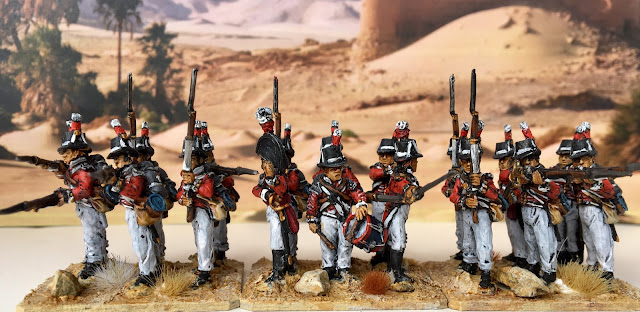


Next on the painting table is the 13th Regiment of Foot.


This week’s focus has been on completing the generals and adding the first of the émigré regiments for the British in Egypt.
Of the generals I have done three brigadiers in Doyle, Coote and Craddock.


The first of what will be four émigré regiments is De Watteville's Regiment founded by Louis de Watteville, the son of a Swiss mercenary who commanded a regiment in the service of the Netherlands. Louis served as a junior officer in his father's regiment against Revolutionary France and when the Dutch were defeated by the French he took up similar commission in a Swiss corps in the Austrian army in 1799. When Austria too was defeated, the various Swiss units were disbanded and de Watteville’s regiment was created by patching together parts of several Swiss regiments – Salis, Roverea, Courten and Bachmann – and signed on in British service as mercenaries.

On arrival in Egypt each of the contingent parts of the regiment still had their distinctive facings – Salis blue, Roverea/Courten black, Bachmann red - and I have represented them in this way, with Bachmann on the left of the line (right when viewed from the front) Salis on the right and Roverea/Courten in the centre. There is some evidence that later in the campaign they were issued with a new uniform matching that of the Roverea contingent. The regimental flags were taken from the Perry site – they were not issued with British colours until 1805.

The regiment continued service with the British throughout the Napoleonic Wars, chiefly around the Mediterranean. It served in the Peninsular Campaign from 1811 to 1813. Sent to Canada in 1813 to fight in the War of 1812 the regiment was retired at the end in 1815 and for their services the surviving soldiers were granted land in Canada. If I ever decide expand the War of 1812 force I think I will have to add de Watteville.

Louis de Watteville’s career reached its pinnacle in Canada. Promoted to major-general in 1813 and separated from the regiment, he commanded the district of Montreal for a while, before assuming command of the Right Division on the Niagara front after Raill was wounded and captured at Lundy’s Lane and participated in the Siege of Fort Erie. After the war he retired to Switzerland.
Two items were finished over the weekend. First was the second of the five gun sets that will be included in this army. This time the crew are loading the 6lb gun. In the set two figures wear the regulation cocked hat and two wear the fatigue cap.


Second is the first batch of generals. This set contains figures representing Generals Abercrombie, Hutchinson and Moore. I have done Abercrombie and Hutchinson as the senior command group and the Moore as a brigadier.


The 28th (North Gloucestershire) Regiment of Foot is the second of the British in Egypt infantry to pass through the uniform store and the first in this collection in the stovepipe shako. As my good friend Lawrence reminded me the 28th had a unique honour: at the Battle of Alexandria the French cavalry succeeded in breaking through the British lines, reformed behind the 28th and began to charge while the 28th was still heavily engaged to the front. Hurriedly the order was given for the rear rank to face about and fighting back to back the regiment successfully defended itself. For this action the regiment was accorded the right to wearing the regimental number on both the front and the back of the shako.


The second piece off the painting table this weekend is the first of the artillery. Listed as "Foot Artillery firing 6 Pounder in Mother Shipton hats", this set has a unique gun. To prevent the wheels sinking into the desert sand the gunners tied staves from wooden barrels to the wheels.


A second gun set, this time in cocked hats, is assembled an ready for work.
