Monday, 20 January 2014

Still More Scratch Building and the German Cyclists


First of all here is an image of the German MG carriage and limber complete with the horse team. While three of the images that I have show a four horse team, another shows a two horse team. Since the former were of WWII vintage and the latter of WWI vintage, I chose to go with a two horse team.


I had been trying to find images of the French cavalry machine gun carriage. I had found a very crude drawing in the Funcken “Uniforms of WWI” book and then an illustration from a graphic novel. Then by sheer chance I stumbled across these photo in a completely unrelated discussion thread.


It showed the details I wanted and was all I needed to get started. Fortunately I had a spare Hotchkiss MG left over from the Russo-Japanese project so I didn’t need to make the weapon. The rest was an easy task with plastic card and a bit of green stuff. I have done a four horse team this time, but without the riders - unless I have a sudden rush of blood to the head and change my mind about the riders, which is always a possibility. I will post some images of this when the horses are painted and the model based.


I also knocked up a refugee wagon, based on a contemporary propaganda postcard. It looks pretty good, loaded with household packages. I may do a second wagon as well.


The German Jäger cyclists arrived from Dixon Miniatures just after Christmas and have finally painted them. They are intended to be used in conjunction with the uhlans, when the come. The jäger unit will also have an HMG (and the MG carriage of course) attached to them.


WWI Project – Buildings Phase 3: The Town Increases

have had a productive weekend. I finished off the last of the texturing detail on thirteen biuldings on Friday, while I waited for a service man to turn up to repair the stove and then painted them over the weekend.


Of the thirteen structures, eight are intact buildings and five are ruins. The intact structures pretty much complete the main street of the town. I still have four buildings to make to finish the town, including a church, a workshop and two houses, and will start them next week.


The ruins are designed to replace the intact buildings. They do not exactly match the intact structures, but they do match the frontage so that for every 60mm frontage intact building, there is a 60mm frontage ruin. The two or three odd shaped buildings will have unique ruins. There are still ten ruins to go.


Here are a few shots of the finished models.


First of all the main street of the town.


And second, the first batch of ruins.


Friday, 17 January 2014

A Bit More Scratch Building

Following my success with the scratch building of the French ammunition wagons, I decided to expand my scratch building experiments to a German machine gun carriage and limber. After some searching on the web and with some assistance from a post on the Miniatures Page I gathered enough information to start.

I built the packed MG08 first from plastic card and green stuff. It was remarkably easy and I had most of it finished in one evening. Next was the MG carriage, which was a little more fiddly and took a couple of days to put together. Finally I made the limber, which was a relatively simple construction.

Once the basic models were made I put some stowage on the MG carriage and the leather satchel on the back of the limber with some green stuff. I have started work on the horse teams, but they will take a few more days.

The finished, but unpainted, models are shown here:


And then the painted model:


The MG carriage

The limber

Next will be a French MG carriage, although there is not as much detailed information on this, and then two more German limbers for the two field guns I have.

Sunday, 12 January 2014

WWI Project Continues

I am waiting until the end of the month to buy any more figures. In part this is because I need to clear some of the Christmas debt on the credit card and in part because I want to get further ahead with the buildings that I mentioned in earlier posts.

While I have made great headway with the buildings I still have a way to go. Eight of the village street buildings are finished (although only three are painted) with three in progress, and will probably be finished this week. I have also completed four ruins. I have several other cardboard forms either ready for texturing, or in the sketch stage, one of which is the village church and another is the local garage. I hope to be able to post some images of these in a week or two.

In the meantime I have received a small packet of jäger cyclists from Dixon which have been assembled and will be painted after the current batch of buildings are finished.

I have also done a bit of scratch building. I found this picture of a French 75 in action:


I suddenly had the urge to make the ammunition wagon to go with the two 75mm guns that I bought in December. I dug around on the web and soon found more images, but more importantly, some plans and broke out the plasticard and glue and got to work.

The plans I had didn't have a scale, but I was able to work out a size based on the wheel size and then scaling that to the size of the wheels that I had on hand. In no time at all I had the base shape built and within a few hours the basic model was completed. The next day I added some of the details with Green Stuff and the result was this:


After adding a few more details the model was finished. I was so pleased with the first one that I made a second wagon for the second gun, this one slightly different - with one of the doors closed. With the two of them finished, they were painted and then based as below:


This attempt at scratch building has pleased me so much that I have started on a horse drawn version of the machine gun carriage for the French and German cavalry.


Monday, 2 December 2013

WWI Project - Buildings Phase Two

Well the first three buildings are completely finished and painted now. The images below show them in a few combinations.

Another three buildings are nearing completion and the cardboard forms for another two are ready for texturing. I have another eight forms to make to complete the sixteen double faced buildings I need that will form the main street and the two parallel streets of the town.

I will then start work on the ten or so buildings that will form the outer edge of edge town. The rear of these will face the countryside and may as a result have back yards and the clutter you might
expect of buildings on the edge of town.

And then there are the ruins, maybe as many as ten structures.

Sunday, 1 December 2013

WWI Project

Several months ago I started a WWI project, collecting figures for small forces of French, Belgian, British and Germans for use in 1914. I completed a company each of French and Germans, together with heavy machine guns and a German 7.7cm field gun. I also began work on a company of Belgian infantry, and have completed all but one platoon of the infantry, one HMG and a singe Minerva Armour Car.

This project was put on hold while I finished the Russo-Japanese armies for the Tarawera weekend, but now that those armies are complete (for now), I am getting back into the WWI.

I have ordered the the remaining Belgian infantry, two French 75mm guns and crews, along with a platoon of French dragoons. Apart from the  Belgian cavalry and a machine gun dog team, this will complete those two forces. The remaining Germans and the British will be ordered in the New Year.

However, judging from the last delivery, I am not expecting these figures to arrive quickly. So to fill in the  time until they arrive I have begun to work on some buildings for the Belgian/Northerh France area. The series will be based on some work I did some twenty-five years ago when I designed all of the buildings for Military Miniatures. Within that body of work I did a series in 1:300 scale that consisted of 16 gabled row houses that could be stood side by side to make street rows. The front and back of these were different so that they could be arranged in a large variety of combinations. This series will largely repeat that, but in 25mm. 

The intention is to make perhaps 14 houses that will be used in street rows, with a further six that can be ends - that is textured on three sides and not two. I have made the first four cardboard forms up and begun texturing the faces of some. One also has it roof tiles in place. The pictires below show those first four structures in a couple of combinations. There will also be some buildings in ruins.


Most of the buildings will have a standard frontage of 60mm, although some will be 80mm, and all with have a standard depth of 70mm with the total measurement from the front to back edge of the pavement of 135mm. Height will vary between 100mm and 140mm.

The building below shows  gabled building with the front and back texturing complete. All that need to be done is add the roof crest, chimneys and complete the pavements, perhaps another hour's work.


I was hoping to get a bit further on with these - I wanted to get the first four completed before the miniatures  order arrives - but I have a business trip that will take me away from home for the next week. I will post more images as the project progresses.

Sunday, 17 November 2013

RJW Game - Part 2


How the Game Ran

Barishenkov chose to deploy on the left, throwing up a short angled line of trenches, that were to be occupied by the rifles regiment, directly behind a line of trees that would conceal them from one direction. To the right of the rifles on the small hill was a machine gun, dug in, with the two field batteries to the rear. To the right, in the low ground between the hill and the monastery ridge, was a second line of trenches to be occupied by the 23rd Siberian Regiment. The 32nd Siberian Regiment and the second machine gun occupied the monastery. Barishenkov also had a significant trench prepared running back along the monastery ridge which he could not occupy.


Map Showing Barishenkov's Trench Lines (in grey)

When Barishenkov and Gemmersheim met they agreed that one of Gemmersheim's regiments would occupy the vacant trench with a second regiment held to the rear, out of sight behind the ridge. Gemmersheim's second brigade would deploy across the stream with both machine guns. His artillery would deploy with one battalion off table and one on, behind the semall ridge on the extreme right.

The Japanes 2nd Division, having arrived first, made a reconnaissance, starting on the table edge behind the farm,  running directly forward towards the trench on Barishenkov's left, then running along the stream bed to the Japanese left, across the front of the monastery and the trench on monastery ridge and then back through the Hutong. The reconnaissance observed all of the entrenched areas, but failed to detarmine whether the trench where the rifles were deployed were occupied. It also failed to identify the machine gun position on the small hill. They were fired on by the 23rd Siberians, but could not identify the  strength there. They did successfully discover that the monastery was held in strength, at least one regiment and determined the monastery ridge trench was unoccupied. 

With the reconnaissance completed the Japanese division commandrs made their plan of battle. TheJapanese  chose to try to envelop both flanks, with the 2nd Division on the right and the Guards on the left, and then exploit the centre with 12th Division, although 12th Division did toy with the idea of extendending even fiurther right for a short time.

During the night Popolov arrived on the field with his scratch force and occupied the monastery ridge trench with the infantry and machine guns. The deployment of Popolov in the trench was a surprise to both Barishenkov and Gemmersheim and the latter was compelled to redeploy further to the right. Popolov's four field batteries were deployed off table.

The Battle Begins

The Japanese attack began with the 2nd Division artillery attempting to swamp the Siberians in their trenches, but with little success. Meanwhile the Guards marched onto fhe table and were immediately struck by Russian gunfire and forced to halt their advance until their own guns could deploy.

The 2nd division quickly pressed one brigade forward to the edge of the farm and was struck by machingun and artillery fire from Barishenkov's position. The Japanese halted and brought forward their own machineguns to reply. Meanwhile the second brigade moved around the rear of the large hill to their right. 

On the left the first brigade of the Guard learned the hard way not to expose themselves to the Russian artillery fire and suffered heavy losses. They quickly sought cover behind the Hutong while their guns and their second brigade deployed.

The Japanese Stabilise Their Positions

By turn three the Japanese were beginning to form something of a battle line. The 2nd Division pressed beyond the road and discovered the position of Barishenkov's rifles regiment, but could make no impact on the entrenched Russians. Their flanking brigade was making slow progress around the large hill. The Guards, meanwhile, were doing better. Their artillery had come into action and caused some damage to Gemmersheim's second brigade that was digging in along the edge of the fields beyond the stream. The Guards soon had a good line formed along the road. The 12th Division had begun to arrive on the field and formed behind the woods on the ridge between 2nd and Guards Divisions.

It soon became apparent to Barishenkov that he was going to take the brunt of the Japanese assault and called on Gemmersheim for support. The latter responded by releasing his reserve regiment just as the Japanese 2nd Division closed in. Failing to gain effcet with his artillery by indirect fire, Barishenkov brought his guns forward onto this small hill. Exposed on the hill the batteries were immediately hit by the the fire of 12th Division's six batteries and quickly destroyed. The Japanese guns pounded the machine gun on the hill, damaging, but not destroying the piece. The Russians in the trenches began to suffer some damage, while the 2nd division closed in on the Rifles regiment.


The Rifles Regiment Defending Against the 2nd Division

Seeing that they were about to be overwhelmed the Rifles left their trench and charged forward in the hope of driving back the advance elements of the 2nd Division to gain some time for Gemmersheim's troops to arrive to help in the defence. It was a desperate attempt, but as a spoiling attack it had a chance of success. The Japanese were surprised and driven back, but were not driven off.

At the opposite end of the field Gemmerheim's right hand brigade was feeling the pressure from the Guards and was beginning to crumble. The artillery came forward and engaged the Japanese over open sights, but could only delay their advance. When two Japanese regiments moved to attack the Russians frontally, the Russian line failed and broke.


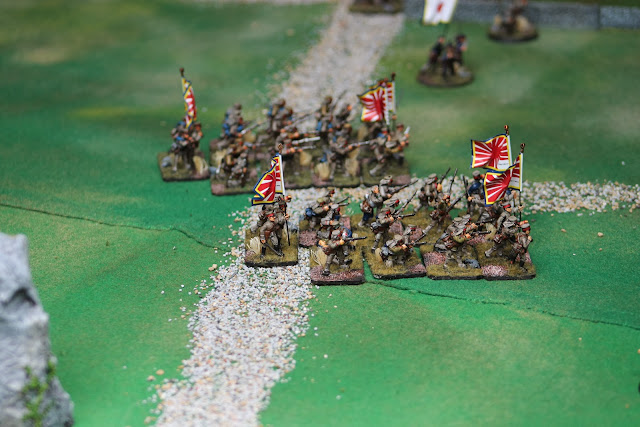
The Guards Attack the Russian Right

The End of the Russian Defence


The 12th Division forms for the attack

With the failure of the Rifles to drive off the advance of the 2nd Division the writing was on the wall for the Russian left and four regiments converged against one. In the centre the 12th Division was taking aim at the monastery, with the whole division preparing to attack the one Siberian regiment holding the place. The Japanese guns struggled to silence the Russians but sheet weight of numbers soon began to tell. The monastery fell to a determined assault.


The Final Assault on the Monastery

With the monastery in japanese hands the Japanese artillery was free to engage Gemmersheim's troops. Most of these troops were in the open and were soon cut to pieces the the gunfire. When 2nd Division finally drove off the Rifles and moved around the Russian left flank, Barishenkov was complelled to withdraw. Gemmersheim, unable to fight the battle alone was also compelled to retire and the battle ended.


The final advance of the 2nd division around the flank

The Japanese had won a decisive victory, but the Russians had fought hard and Gemmersheim at least kept his command - and certainly did not discrace the service. 

For the statistics, just under 1,000 figures, eighteen machine guns and twelve gun models were on the table. All of the infantry figures were by Tsuba Miniatures and all of the remainder by Redoubt. The game started about 9:00 in the morning and lasted until around 4:00 pm, with a reasonable break for lunch of course.