Thursday, 8 December 2022

Polish Lancers…in Russian Service

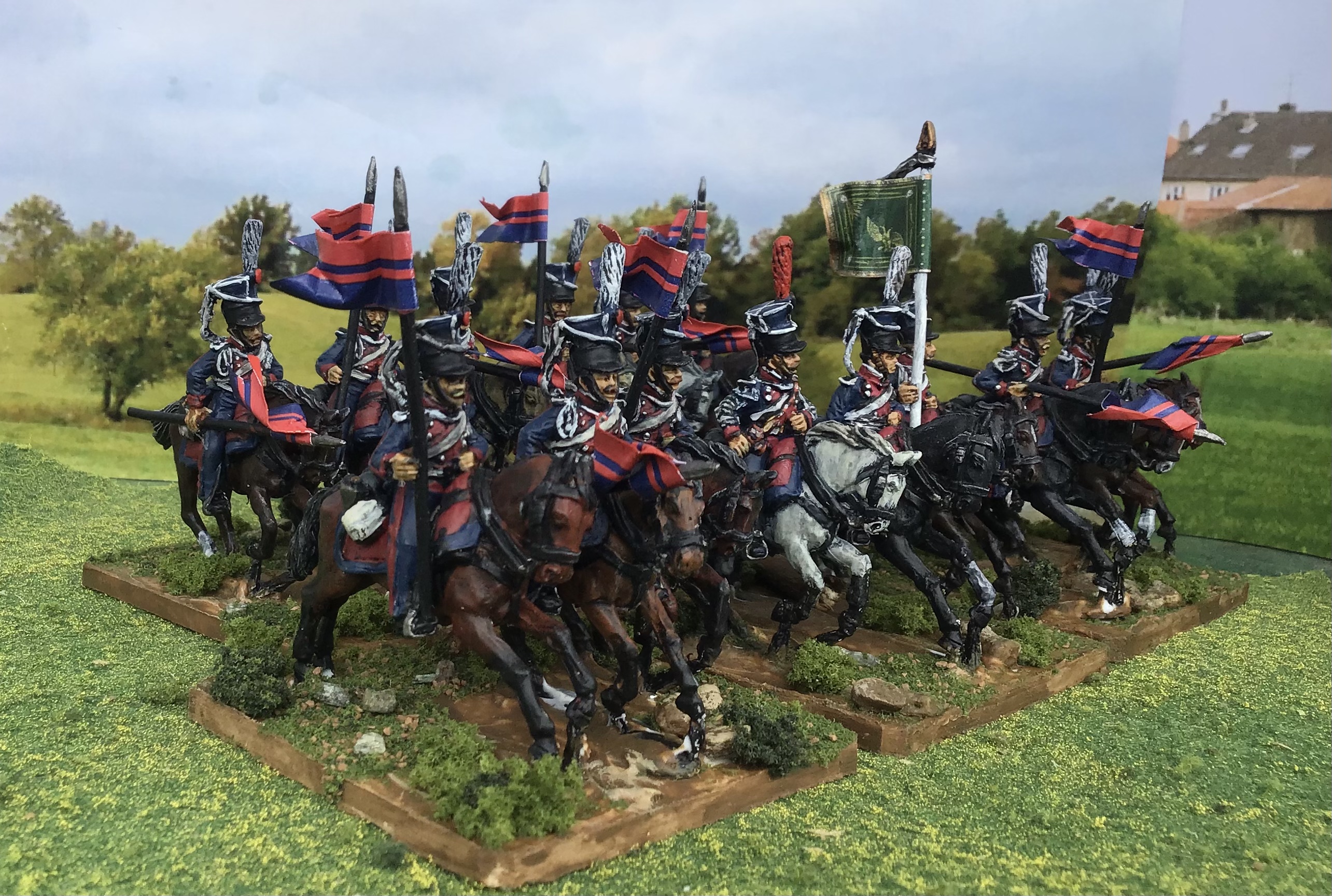
Prior to 1803 there were no line lancer regiments in the Russian Army. Certainly there were plenty of Cossacks whose preferred weapon was the lance, but the first line regiment was the Grand Duke Constantine’s regiment. After Austerlitz two more regiments, the Polish and Lithuanian Regiments, were formed from horse regiments of the same name, recruited largely from Poles and Lithuanians living in the western fringes of the empire. 


Although well renowned for their horsemanship and fighting skills they were largely mistrusted by the Russian higher command, who believed their loyalty was suspect. By 1808 another four regiments had been added to the arm and in December 1812 seven dragoon regiments were converted to uhlans, although since many did not receive their new uniforms until late 1814, they were often referred to as “dragoons with sticks”.


I have chosen to do the Polish Uhlans for no other reason that I like the carmine saddle cloth and facings. As with the other light cavalry regiment in this collection, the hussars, these have been done as a large unit, with 15 figures instead of my usual 12 to represent the larger establishment of the light regiments.

Monday, 5 December 2022

Action at Quiberon Bay

Today’s game was set in 1795 and based loosely on the disasterous attempt to establish a Royalist base at Carnac at the northern end of Quiberon Bay. In the original expedition the four British infantry battalions failed to cross the Channel due to bad weather, but in this expedition a significant British force of eight  battalions plus a force of marines and sailors from the fleet supported a small emigre force four battalions and a gun in a beach landing somewhere in the bay.

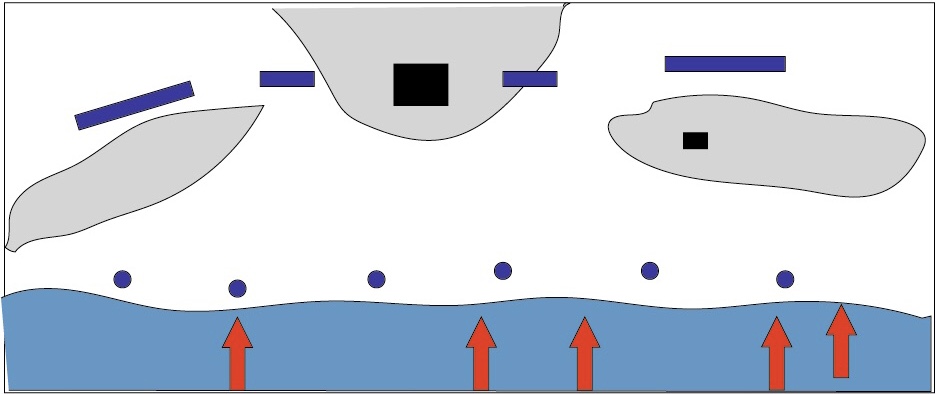
The map of the table is as below, with the starting positions of the French Republican forces shown in blue and the landing places of the British/emigre forces shown in red (the emigre troops landed on the extreme left, the British infantry in the two centre locations and the naval troops with the two arrows on the right.

The Republicans had heard from their spies that an attempt to land was to be expected and as the game began the French hussars picketed the shore line, although a heavy fog prevented them from seeing the approaching boats (the fog would lift on a die score of 4+).


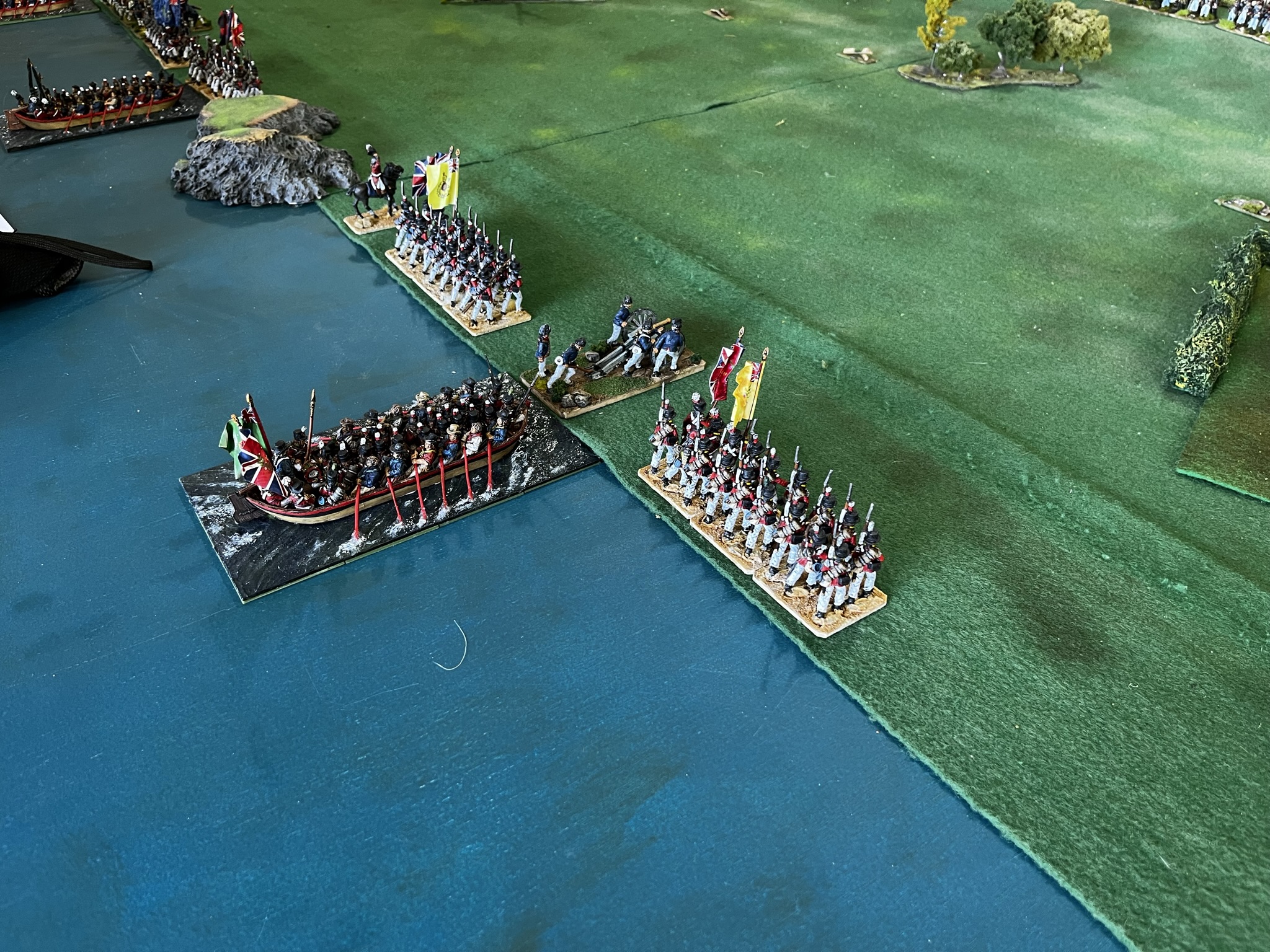
The boats hit the shore just as the fog began to lift and the battalions disembarked.


The French pickets raised the alarm  and the Republicans were called to arms.


While the British and emigre forces formed up on the beach the Republicans came forward more quickly than anticipated and a difficult fight developed in front of the emigre landings where two attacks from the cavalry were repulsed before a proper line could be established.


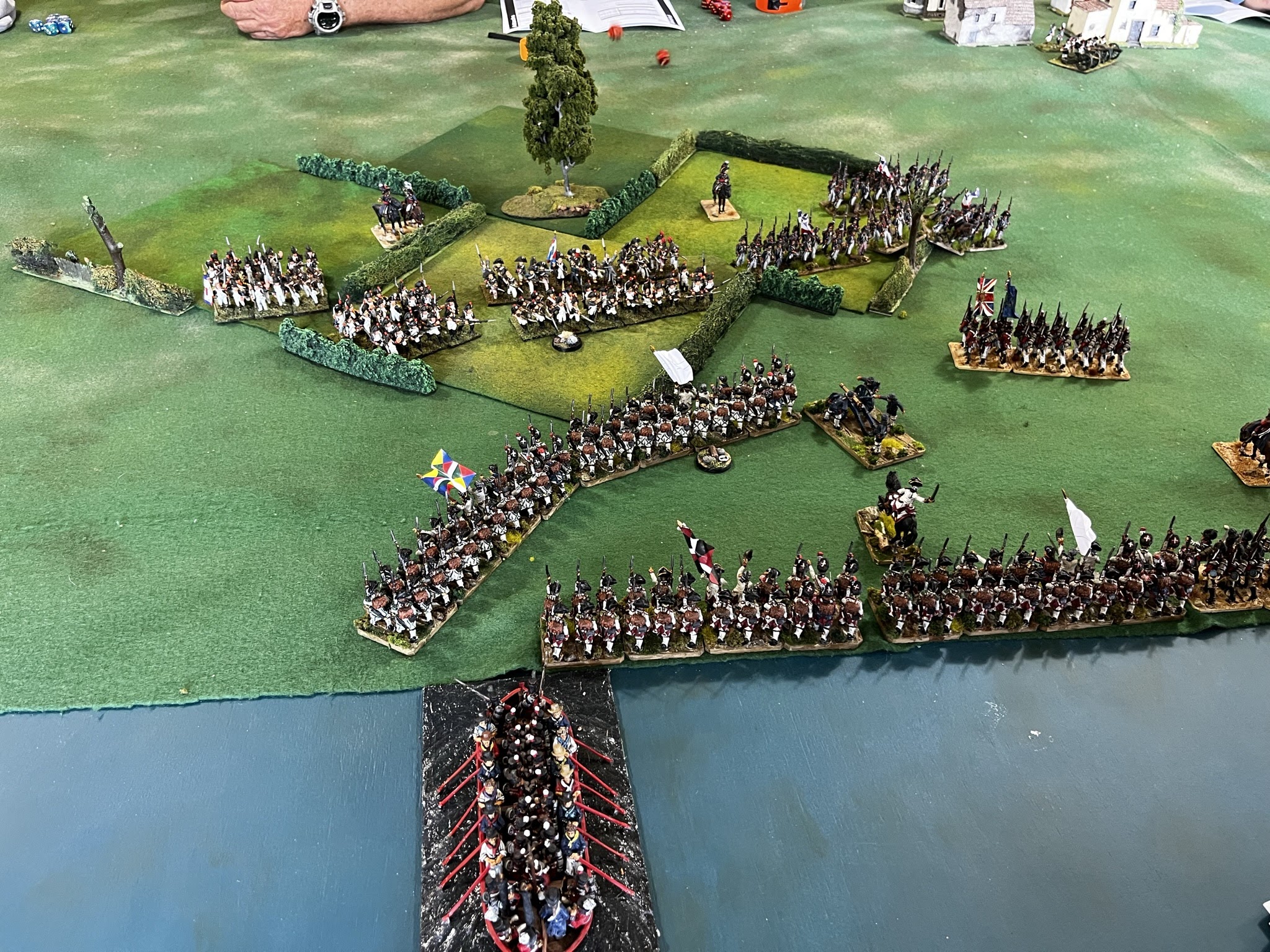
At the British landing point things did not go well with two battalions sent packing. Only the intervention of two battalions of guards in the second wave brought some stability.

An attack in the flank of one of the guard battalions threatened to turn the tide again, but by a miracle of dice rolling the guards repulsed the attack.

Then conjunction with the emigre troops they pushed back the Republicans and things looked grim for the Republican cause.


But the naval contingent, despite the efforts of the gunners and the marines, failed to make any headway against the Republican left. 


When the naval contingent gave way, four fresh Republican battalions were free to operate against the British flank and the line was rolled back on the emigre forces. An evacuation was the only option, but no one will ever know the number that got away…because we called the game there.

With the loss of the American Revolution and the disasters of Dunkirk and Hondschoote, this was the last straw. The British military had fallen to its lowest point. Questions were asked in the house and there were calls for the Government to resign. The only positive to come out of the whole debacle was that the Duke of York undertook a series of reforms that would transform the army and turn its fortunes around.


Saturday, 3 December 2022

Prussian and Russian cavalry

After last week’s small offering, today’s post offers a considerably higher figure count - 25 new cavalry in all. Not all of these were painted this week though, most having been completed in the previous two weeks, but were waiting for their officers and trumpeters to arrive.

At the top of the menu is the first of two regiments of  Russian horse jägers. This was a new type of cavalry for the Russians, created as the equivalent of the French Chasseurs-a-Cheval. Eight dragoon regiments were converted to jägers in December 1812, wearing essentially the same uniform as they did as dragoons, but with a shako with a tall plume instead of a helmet and curved sabres instead of the straight dragoon sabre.

Represented here is the Niejine (Nezhinsk) regiment, converted from one of the dragoon regiments created  in 1806.


In the second batch of figures are two small units of Prussian Mounted Volunteer Jägers. It’s not that I really need any more Volunteer Jägers, but with this set you get so many legs and torsos to make up a variety of cavalry types and it seems such a waste to simply throw them away. So I bought some extra horses and have made these two small units (they probably should be tiny - single stand - units really, but this gives me a bit more flexibility).

One with shoulder scales…

…and one without

Also included here is a Prussian cavalry brigadier, painted as a dragoon colonel, made from left over body parts and a spare horse.


Wednesday, 30 November 2022

Hussars!

Just a light offering today…a single stand of Russian Napoleonic hussars. This is an expansion to the Pavlograd Hussars that are already in the collection - an expansion because in general the Russian light cavalry (like the Austrians) were organised into larger regiments than the dragoons and cuirassiers. Adding another stand to the regiment seemed sensible.

What wasn’t sensible was ordering the figures without looking at what I already had. The result is that I bought troopers in campaign dress waving swords whereas the existing regiment were all in full dress with shouldered swords. This meant three differences: arms are waving over their heads, they are wearing overalls instead of tight trousers and they didn’t have plumes. Thankfully I had plenty of spare plumes from the shakos of the Russian Mounted Jägers from the plastic Allied cavalry sets, so some careful use of a drill, some steel pins and superglue solved the missing plume issue. The other two differences I just have to live with.


And the whole regiment.


Monday, 28 November 2022

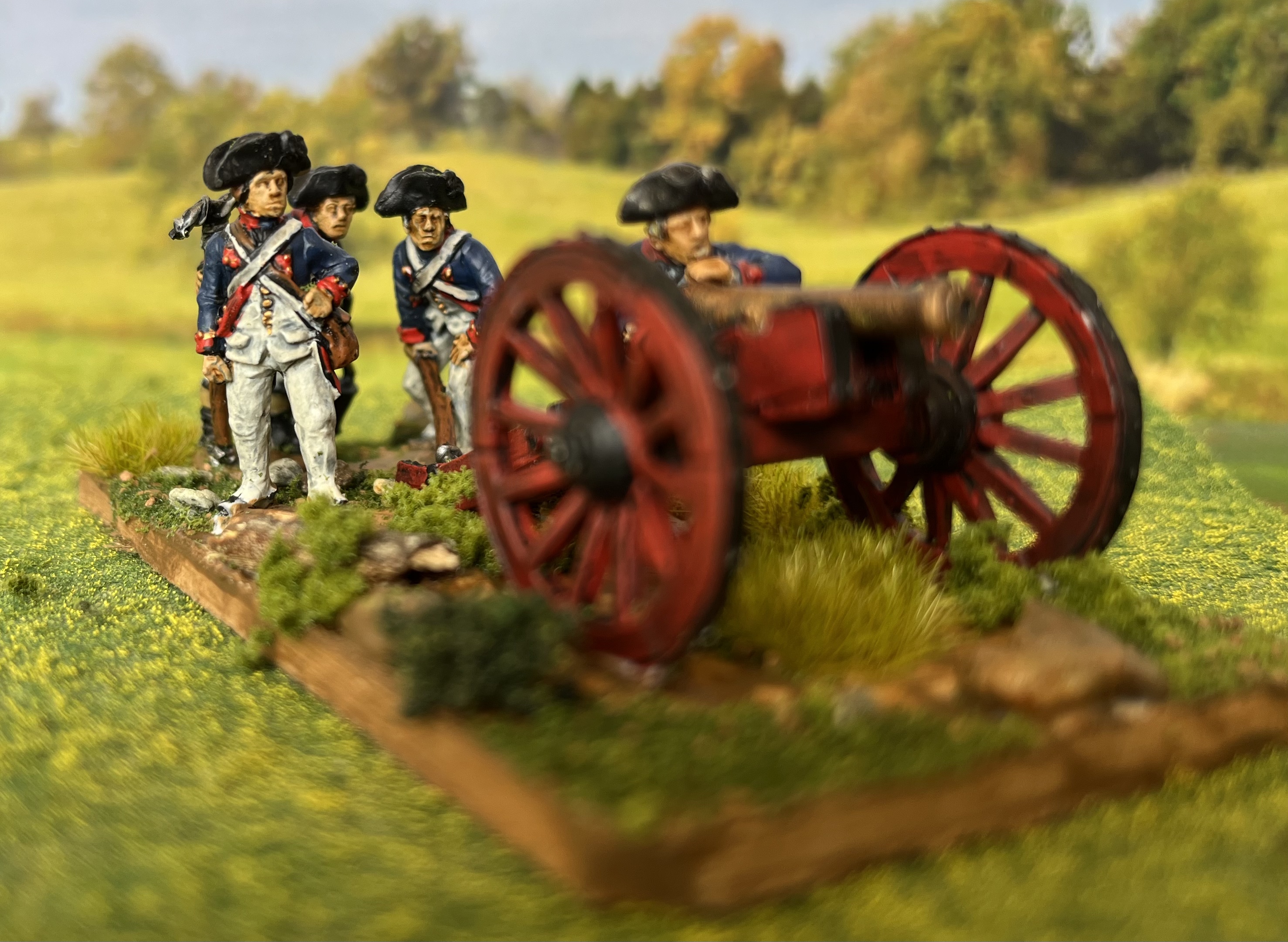
AWI Artillery

This is the third gun and limber set in my AWI American collection.


I really like the way the crew are posed aiming the gun.


Only one infantry unit remains to complete this collection. That unit fits into the painting schedule sometime in the middle of December.

Wednesday, 23 November 2022

Prussian Neumark Dragoons, No 6.

Completed more than a week ago I have finally completed the bases of this the last of three Prussian dragoon regiments in this expansion.


All that remains to be completed in this expansion now are two small units of mounted volunteers and a couple off mounted officers, but before I move on to them there are some Russian light cavalry in the queue.

A parade of the Prussian cavalry will follow in time.


Monday, 21 November 2022

A Break from the Routine

The last couple of months have been chaotic for me, with a couple of big project deliverables, some very tight deadlines and a major international audit. To get away the routine of daily life in the city we escaped to our favourite NZ destination, Wanaka, for a few days. 

Following our usual practice we flew into Queenstown, had coffee in Arrowtown, visited a couple of our favoured wineries and enjoyed a lunch in Cromwell before checking into our hotel in Wanaka in the early afternoon.

The view from the room wasn’t as spectacular as our last stay, being a ‘garden view’ this time rather than a ‘lake view’ room last time, but pleasant enough all the same, although the low cloud makes this image seem a lot darker than it really was.


After settling into the room we decided to walk onto town and spend the rest of the afternoon and evening there. With a forecast of light rain showers we went prepared with light waterproof jackets, something we soon came to regret as not only did it not rain, but the low cloud kept the heat and humidity in…the temperature may have been only in the low 20s (C), but the humidity was in the mid-90s.

After poking about in a few shops, we found space in a bar we have visited before and spent the first part of the happy hour there. The place was obviously the favourite of the local builders and by 5:00 it was filled with tradesmen enjoying Friday after work drinks. It was amusing to sit back and listen to their banter. An excellent Chinese dinner followed washed down with a nice rosé.

The walk back along the lake shore, through the arcades created by the willows and the taller poplar and beech trees in the balmy evening was very pleasant, although the fragrance of the lupins in bloom along the path was almost overwhelming.


In the early twilight the famous Wanaka tree reflected in the calm water - the first time in our visits here that I have seen the tree in leaf. But in the distance, to the east, the rain was approaching.


As we got back to the hotel the first spots of rain began to fall. Within a few minutes the fall was steady although it didn’t last long. It had been a long day - we had been up since 4:00 AM - so an early night was in order.

Saturday was a very quiet day for us. We had planned to head over to Tekapo to the hot springs, but the forecast was for heavy rain (mind you the forecast for Wanaka was for rain and not a drop fell) and since the weather looked more promising for Sunday, we decided to postpone the visit and potter around the town instead for a bit of shopping, have some lunch and then read on the hotel balcony in the warmth of the afternoon…with a glass or two of Central Otago Pinot Noir.

Of course one of the more important aspect of the trip (some might say THE most important) was the ability to forage along the lake shore for some basing stones. About kilogram of varied size schist rubble was gathered and bagged for transport.


There was also a nice range of twigs available for foraging, but at that suggestion I was met by some odd looks that made me think better of it. Drinks and dinner in town closed out the day.

Sunday dawned a much more promising day for our trip to Tekapo and we headed off just after 9:00AM.


Travelling through the fabulous scenery of the Lindis Pass, the Mackenzie country and past Lake Pukaki we arrived at Tekapo a little after 11:00.

The view up the Lindis Pass (although this shot was taken the way back to Wanaka actually)

We drove down to the hot pools, that were a little underwhelming too be honest, but having driven two hours to get there we spent some time soaking in the warm water, with a few drops of rain falling. We then went on to lunch before a visit to the lovely stone Church of the Good Shepherd at the head of the lake before a return to Wanaka for afternoon drinks and a walk into town for dinner.


Walking back to the hotel, looking to the north, the sky was looking ominous and a few drops of rain fell.


But the weather did not turn dramatically, although there was a light rain shower. So much for the four days of rain that was forecast for the region (although in fairness apparently they did have torrential rain on the Thursday in Wanaka).

Monday was a travel day for us (and another day with just a few spots of rain). We checked out of the hotel about 9:30 and stopped for a coffee in town before heading off for a leisurely drive to Queenstown where we had lunch in our favourite Indian restaurant before heading to the airport and some time in the lounge before our flight home and the end of another epicurean adventure.

It was a great break away from the hassles of the city with great food, wine and scenery, but always a bit deflating to be home, especially when it is work tomorrow, but what helps to counteract the deflation is this sight on the doorstep…


… parcel one of two from Nottingham with fresh recruits for the Russian Napoleonic and Prussian Napoleonic and Franco-Prussian armies,
.