Showing posts with label Historical Research. Show all posts

Sunday, 8 February 2026

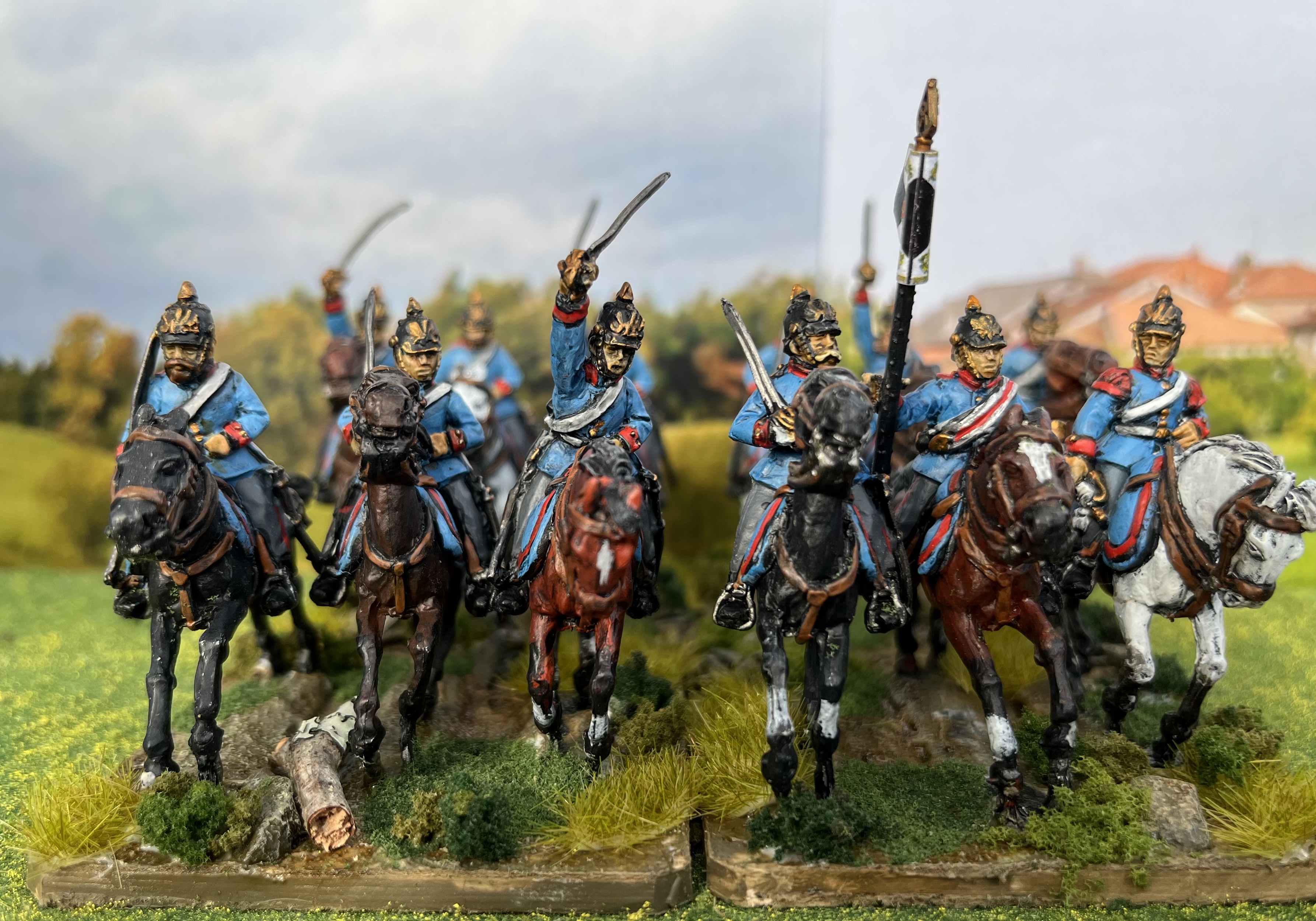
The Last Great Cavalry Battle on the Planet

Three and a half years ago, I wrote a post to celebrate the completion of a brigade of Prussian cavalry for 1870 and described the action known as von Bredow's "Death Ride" on the afternoon of 16 August 1870 (LINK).

After writing that post, I was keen to write about another cavalry action that took place a few hours later, just seven kilometers west of the scene of von Bredow's charge. There, on the hard-packed, dusty fields near the village of Ville-sur-Yron, 5,000 French and Prussian cavalrymen met in the last great cavalry battle on the planet. But I never seemed to find the time to put in to the necessary research. Now I have found that time.

Like von Bredow's charge, there is very little published on this action in English. The English version of the German Staff history covers the action in eight paragraphs in the blandest of terms, and David Ascoli's book on Mars-la-Tour gives it only nine paragraphs and is equally short of detail. Thankfully, there are two very good French studies and one in German, and snippets can be gleaned from several others in those languages. I was greatly helped by Google's Gemini AI tool with the translation of multiple pages, particularly of German text in Gothic print!

To make identifying French and German units a little easier, I have identified French units in italic type. German corps are identified in Roman numerals, the French in Arabic.

**********

Carrying on from my earlier description of the battle, while von Bredow's charge had gained temporary breathing space for Alvensleben's III Corps, the French—outnumbering the Prussians by nearly three to one—still threatened to overwhelm them. Relief for Alvensleben came when Bazaine’s obsession with his left flank saw him pull two divisions from Leboeuf's 3rd Corps out of the fight to reinforce that flank, ordering Leboeuf to hold his position with his remaining two divisions at all costs.

When Ladmirault's 4th Corps fell in on Leboeuf's right, the two generals decided to press forward against the exposed Prussian left. So, at 3:00 PM, two of Leboeuf's divisions, with one of Ladmirault's extending further to the right—perhaps 30,000 men in total—pressed forward with two more 4th Corps divisions to the rear. Facing them in the Tronville Copses were four battalions from Alvensleben's 6th Division, maybe 4,000 men, with von Barby's cavalry brigade to their left. The flank was easily turned and the Prussian battalions were driven back with heavy losses.

The occupation of Mars-la-Tour and the Tronville Copses was Ladmirault's for the taking. It looked as though Alvensleben's left would be driven back against its right like a closing book. However, when victory was within sight, Ladmirault faltered. Fearing the arrival of considerable Prussian reinforcements, he halted the advance and fell back on the high ground near Bruville.

True to form, Prussian reinforcements came up just in time. Marching to the sound of the guns, the leading elements of von Voigts-Rhetz's X Corps began to arrive on the field as Ladmirault retired. Woyna's 39th Brigade was immediately pressed forward. With his flank now exposed by the withdrawal of Ladmirault, Leboeuf was compelled to withdraw from the Tronville Copses. Voigts-Rhetz ordered Wedell's 38th Brigade forward on Woyna's left to take the French in the flank.

Wedell stormed forward a little after 5:00 PM, descending into a wooded ravine about a mile north of Mars-la-Tour. Unwittingly, he had blundered into the center of the French position; the ravine was swept by a storm of Chassepôt fire. The brigade went into action with 4,546 men and, in a short but brutal period, lost 2,614 officers and men before fleeing back in disorder with French infantry in pursuit.

The general situation after Wedell's repulse (base map taken from David Ascoli's A Day of Battle)

In desperation, Voigts-Rhetz turned to the brigade of Guard Dragoons that had accompanied him to the field. The brigade went forward boldly and caught the French completely by surprise. The Prussian cavalry rode down a regiment of French infantry, and after a brief combat, the French counter-attack faltered. The dragoons retired from the fray, leaving 220 of their comrades on the field. For the second time that day, Ladmirault pulled Cissey's Division back, but Grenier's Division continued to extend to the right.

It was now 6:00 PM and the threat to the Prussian left was every bit as serious as it had been two hours earlier. To bolster his left, Voigts-Rhetz turned yet again to the cavalry. Von Barby's 11th Cavalry Brigade was sent to secure the left and flank the French infantry beyond Mars-la-Tour.

Fifty year old Adalbert Roderich Levin von Barby was a career cavalry officer from a noble family. He had graduated from the Academy in Potsdam in 1831 and was posted to the prestigious Gardes du Corps Regiment. He remained with that regiment for the next 27 years, rising to the rank of captain in 1858. During the 1859 mobilisation he served on the staff and in 1862 transferred to the 1st Cuirassiers as lieutenant colonel then as colonel in 1866. He led the regiment in the Austro-Prussian War fighting at Battle of Königgrätz and Tobitschau. Late in that campaign, in a skirmish at Biskupice, his regiment charged and broke an Austrian square, for which he received the honour Pour le Merite. He was and given command of the 19th Cavalry Brigade in 1868 and then made major general commanding 11th Cavalry Brigade in 1870.

The 11th Brigade had been weakened by detachments and at the  time of its despatch to the left consisted of the 9th Dragoons, three squadrons of the 13th Uhlans, and two squadrons of the 4th Cuirassiers. To this force Voigts-Rhetz added the 13th and 16th Dragoons, three squadrons of the 10th (Magdeburg) Hussars, and two squadrons of the Guard Dragoons. In all, Barby moved with 22 squadrons.

Meanwhile, Ladmirault had been massing cavalry on his right. Elements of four cavalry divisions were operating in the area. First was Legrand's Division from Ladmirault's 4th Corps, consisting of two brigades: Montaigu's (2nd and 7th Hussars) and Gondrecourt's (3rd Dragoons—a second regiment, the 11th Dragoons, was detached and posted further east with the left wing of the corps). Second was the 2nd Chasseurs d'Afrique from Barail's First Reserve Division. Third were the 2nd and 4th Dragoons of Maubrance's Brigade and three squadrons of the 3rd and one of the 10th Chasseurs à Cheval from Brucard's Brigade, all from Clérambault's Division of the 3rd Corps. Finally, there were the Lancers of the Guard and the Empress’s Dragoons from de France's Brigade of the Guard Cavalry Division.

Both of the Barail and Legrand were officers of considerable experience, and both, like von Barby, had served in the cavalry their entire careers. Fredéric Legrand was the elder of the two and was 60 years old in 1870, born at Versailles in 1810. He came up through the ranks, having joined the hussars of the Royal Guard in 1828. He served in the Belgian campaign of 1831-32 and in 1837 was commissioned sous-lieutenant in the Spahis de Bone. Made captain in 1844 he served with the 2nd Spahis in 1845, the 4th Lancers later the same year and then the 3rd Spahis in 1847. Three years later he was chef d'escadron with the 2nd Chasseurs d'Afrique. In 1852 he was lieutenant colonel of the prestigious Guides of the Guard. He then transferred to the 11th Chasseurs a cheval as colonel in 1855 and the 5th Cuirassiers a year later. Promoted to general de brigade in 1868 he commanded first at Lunéville before returning to Africa to command the Subdivision of Oran. His promotion to general de division came in 1868 and command of the cavalry division, 4th Corps in July 1870.

Ten years Legrand's junior, Francois Claude du Barail was also born at Versailles, in 1820. Like Legrand he came up from the ranks, enlisting at the age of nineteen in the Spahis of Oran. He served in many actions in North Africa and was commissioned lieutenant in 1844 and made captain four years later. Promotions to chef d'escadron in 1853 and a lieutenant colonel of the 1st Chasseurs d'Afrique in 1854. He transferred to the Guard in 1857 fo command the Chasseurs of the Guard, then to the first 1st Cuirassiers. In 1860 he returned to African service in command of the 3rd Chasseurs d'Afrique and when with parts of that unit went to Mexico he went with it and he was cited for his part in the actions of Choula and San Lorenzo, in 1863 he was made general de brigade and commanded the cavalry brigade in Mexico, before returning to France the following year to command the Light Cavalry Brigade of the Guard. In 1870 he was given command of the 1st Reserve Cavalry Division.

De France's Brigade had formed part of the escort for the Emperor as he made his way towards Verdun, but when the Emperor's column reached Conflans, the brigade had been deemed unnecessary and was detached. Also detached there was Lajaille's Second Brigade of Barail's Division. This brigade consisted of the 2nd and 4th Chasseurs d'Afrique, but the 4th had been attached to Margueritte's First Brigade, which was providing Napoleon's escort.

All this left Barail as a divisional commander without a division. As the senior officer, he added the chasseurs to de France's Brigade and moved all three regiments to the right. There they took position, formed in close columns near the Jarny/Mars-la-Tour road, slightly behind the Gréyère Farm, and awaited orders.

Legrand had spent much of the afternoon covering the front of 4th Corps, but as more and more Prussian guns came into action, the cavalry was withdrawn behind Bruville. These regiments marched and counter-marched across the open fields for several hours, until around 6:30 PM they were joined by Clérambault's regiments.

Having rallied from their earlier action, the 1st and 2nd Guard Dragoons were moved to the left of Mars-la-Tour. Shortly thereafter, Lieutenant von der Planitz's 1st Horse Battery (Guard Artillery Regiment), supported by the 4th Squadron, 2nd Guard Dragoons, was sent further to the left. They deployed on the high ground north of Mars-la-Tour, about 1,500 meters from the Gréyère Farm.

Planitz opened fire, and the 7th Hussars found themselves under an oblique fire. Legrand pulled his regiments back into some lower ground behind the farm to avoid the shells. Encouraged by the French withdrawal, Planitz moved his battery forward, which brought him into the line of fire of the 5th and 6th Batteries, 19th Horse Artillery Regiment, attached to Barail's Division.

The increase of activity on his right flank concerned Ladmirault, who came forward to the farm to observe the situation himself. He was concerned that a cloud of dust in that direction indicated a significant force. Believing that Planitz's deployment might be the precursor of a larger attack, he ordered a 12-pound battery to deploy near the Gréyère Farm to oppose it. He placed the 5th Chasseurs à pied in the ravine of the Fond de la Cuve, west of the farm, from where they could bring the battery under rifle fire. He also had the 98th Regiment drawn up behind the farm. He then instructed Barail to clear out the German battery.

Barail acted promptly, ordering the 2nd Chasseurs d'Afrique to attack. The regiment, broke into columns of platoons, crossed the narrow bridge that carried the farm track across the Fond de la Cuve at a gallop. They formed a column of squadrons without halting, facing southwest across the Mars-la-Tour road. Colonel Martinière rode to the front and called, "To the cannons!"

The view to the top of the rise where Planitz' battery stood, from the Gréyère Farm track. The Mars-la-Tour Road runs along the skyline  on the right

The regiment set off at the gallop en fourrageurs (open order) to minimize losses. Planitz's gunners were caught by surprise, and only a couple of rounds were fired. 

In response to the chasseurs' charge, the 4th Squadron, 2nd Guard Dragoons, charged to give the gunners a chance to get away. The gunners hurriedly limbered their guns and retreated towards Mars-la-Tour. French reports claim that the chasseurs rode through the battery and put most of Planitz's gunners to the sword, forcing the remainder to run for their lives and abandon their guns. Yet Planitz's report for 16 August shows only three men wounded, three horses killed and four wounded. These losses, the lieutenant wrote, were inflicted by French rifle fire. 

The first three squadrons of the chasseurs conducted a right wheel to face the Guard's charge, while de la Jaille held the 4th squadron back as a reserve. The chasseurs and Guard Dragoons soon became locked in an unequal fight. One squadron was unlikely to hold back three for long, but the Guards' charge had caused confusion in the French ranks, and during that moment of chaos, the Prussians brought forward fresh troopers.

Fortunately for the Prussians help was at hand. As the French cavalry began to mass across the Fond de la Cove Colonel Count von Finkenstein, of the 2nd Guard Dragoons, noted that his single squadron was insufficient to hold the position if charged and rode back with haste towards Mars-la-Tour to seek support. There he found the 13th (Oldenburg) Dragoons, which had arrived at Mars-la-Tour around 5:00 PM. Finkenstein requested support and the call was answered. Deploying rapidly, the 13th Dragoons plunged into the melee. The French forward squadrons gave way easily in the face of the fresh, formed enemy and fell back behind the 4th Squadron, which had been deployed as skirmishers and opened a fire with their carbines that caused the Prussian cavalry to halt. The other squadrons of the Chasseurs rallied and retired to the ravine.

The Charge of the 2nd Chasseurs d'Afrique

Following the Chasseurs' charge, there was a brief lull on this part of the field as both sides began to build up cavalry strength. Scouts had reported to Ladmirault that there was a “large mass of cavalry coming from Mars-la-Tour...” This was undoubtedly von Barby's Brigade, which had advanced northwest of the town. However, from his position between Bruville and the Gréyère Farm, Ladmirault would not have been observe this force personally and without confirming the reports, responded by sending an ADC, Captain de la Tour du Pin, to Barail, Legrand, and De France with instructions to: "Gather all the cavalry; have them charge en masse, in order to clear the right of the threatened line.”

As soon as he received the order, Legrand ordered his three regiments forward. Montaigu's hussars led the way, forming a column of platoons and crossing the Fond de la Cuve at a dry spot just downstream from the Gréyère Farm. Once across the stream, they deployed facing the direction where the Chasseurs could still be seen skirmishing with the Prussian cavalry a while earlier: the 7th Hussars on the left and the 2nd to their right. The 3rd Dragoons were slower crossing the stream but would fall in behind Montaigu.

De France's Guard Cavalry Brigade also came across the stream. It had set off a little after Montaigu, crossing in a column of fours at a small bridge west of Bruville. The Lancers of the Guard led the way, forming a column of platoons upon crossing the stream and then wheeling left into line to the right-rear of the hussars, with their right flank brushing the grounds of the La Grange Farm. The Empress Dragoons, following the lancers, were slow to cross the bridge and moved still further to the right and rear of the lancers, behind the farm. The whole formation, when completed, would be an echelon about 1,000 meters long.

While the French were deploying Colonel von Brauchitsch of the 13th Dragoons had observed the build up and approach of the French cavalry. He sounded the assembly, disengaged from the 2nd Chasseurs d'Afrique and reformed on the high ground.

Von Barby at this time was advancing from Mars-la-Tour. He had drawn his command up in two lines a few hundred meters north and west of the town. He too observed the French deploy, he sent the three squadrons of the 10th Hussars forward to support von Brauchitsch. His own brigade was to the left-rear of the forward units, but made slow progress due to the hedges and ditches around the town. The regiments moved in a column of squadrons with the 19th Dragoons on the right, the 4th Cuirassiers in the center, and the 13th Uhlans on the left. The 16th Dragoons were held back behind the Uhlans.

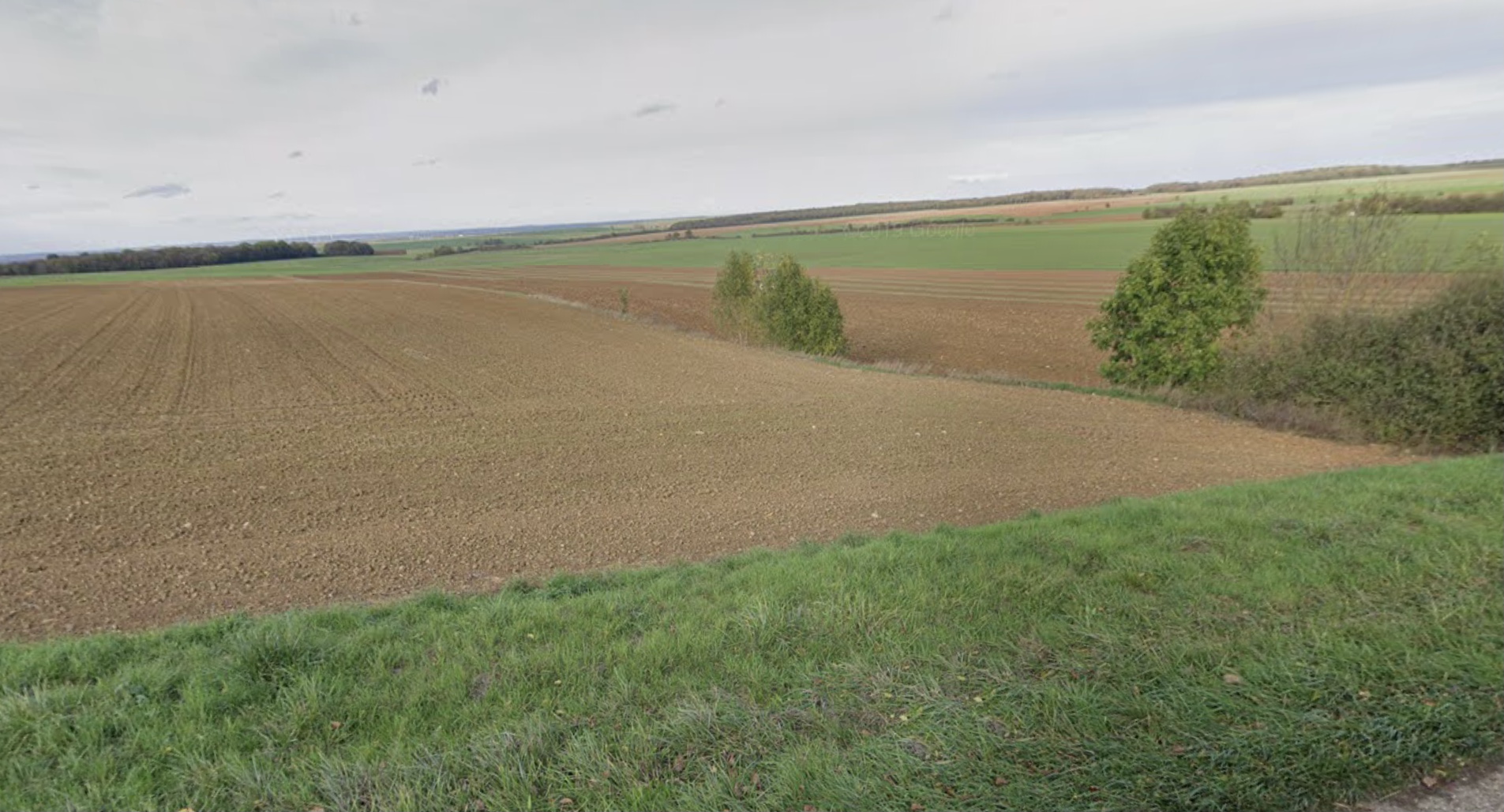
The terrain where the cavalry masses were forming, north of Mars-la-Tour and east of Ville-sur-Yron, was (and still is today) a broad open plain that lies between the Yron and Fond de la Cuve streams. A slight ridge runs north from Mars-la-Tour, along which the road to Jarny runs as far as the junction to Ville-sur-Yron. The ground then descends gently to the northeast for the next 1,000 meters to the junction of the Gréyère Farm track. The whole area was open fields, free of fences, walls, or hedges as far as the La Grand Farm. In the summer heat of August 1870, the ground was hard-packed and dusty.

Looking North from the Ville-sur-Yron Road across the crest of the plain. In the centre is the modern day monument to the cavalry battle

A clearer view of the monument

The view West across the plain from the Jarny Road

While Montaigu was deploying, he was approached by Barail, who was impatient with the deployment and suggested to Montaigu that now was the time to go to the rescue of the 2nd Chasseurs d'Afrique. Montaigu, however, would not be drawn and replied that he would await the orders of Legrand, although he did go forward on a personal reconnaissance. There he observed that the Prussians were advancing slowly. Fearing that he would be charged, he sent word to the Chasseurs d'Afrique to clear the area. He then headed back to his brigade, intent on taking the initiative and charging the Prussians. He arrived back at his command just as Legrand arrived at the head of the 3rd and 4th squadrons of the 3rd Dragoons.

Legrand noted that the Prussians were now further to the right and placed the two squadrons of dragoons behind the hussars, facing the Prussian dragoons. The remaining squadrons of the dragoons had been delayed in crossing the stream and were well behind. When Montaigu reported his intentions to attack to Legrand, Barail—who was also present—protested that twenty minutes earlier “...I advised General de Mointaigu to charge, to take advantage of the disorder that my Chasseurs d'Afrique had thrown among the Germans. More German cavalry have arrived,” he went on, “and are well-positioned now. It is too late; the moment has passed!”

Legrand was not to be deterred and said to Barail, “It is all the same to me. I have been ordered to charge; I charge.”

Nonetheless Legrand seemed reluctant to make the attack. Colonel Carrelet of the 2nd Hussars requested permission to open fire with the Chassepot carbines upon the mass of German cavalry in the hope that the fire might shake the enemy. However, the distance was extreme—between 700 and 800 meters—and any fire was unlikely to have and serious impact.

Around this time, Lieutenant Niel, another of Ladmirault's ADCs, arrived with orders from the impatient general to attack without delay.

Legrand's mind was made up. He replied to Carrelet, "No, no! With the saber!".

Carrelet repeated his request: "Let us fire a volley before charging, General."

Montaigu stepped into the conversation: "No, the order is formal," and, drawing his sword, he cried out, "With cold steel! Forward, gentlemen!"

With that, the brigade set off at the gallop, still partly in column at half-distances. From the start, the pace was too great. The enemy was between 600–800 metres distant and upslope. 

Atop the rise, Colonel von Brauchitsch held his nerve, and the Prussian 13th Dragoons stood stationary with the 4th Squadron, 2nd Guard Dragoons to their left, awaiting the onslaught. When the French were still 500 metres away, he saw that they threatened to turn his right. Brauchitsch ordered a wheel by platoons to the right at the trot, then ordered a wheel back in, then charged. It was a risky movement in the face of a charging enemy, but he had confidence in his troopers.

As the two lines came within 200 metres of each other, a cry went up in the 7th Hussars: “It is the Guard!” The pace of the hussars slowed momentarily before resuming at the gallop. Meanwhile, the left most squadron of the 13th Dragoons and the 4th Squadron, 2nd Guard Dragoons, had taken measures to face the 2nd Hussars, who extended beyond their left and threatened to flank the German line. This opened a gap in the line that portions of the 7th Hussars passed through, attempting to turn back on the Prussians. A vicious melee erupted in the open fields.

The 2nd Hussars met the Guard Dragoons head-on with Montaigu in the lead. The length of the charge and the maneuvers of the day were taking their toll; the horses were struggling. The attack began to falter, and Montaigu fell wounded and was captured. At that moment, Colonel von Weise brought the 10th Hussars forward on the left of the 13th Dragoons in platoon columns. Finding the ground in front of them clear, the 3rd and then the 4th Squadrons deployed on the march and wheeled into the 2nd Hussars. At the same time, the 2nd Squadron moved to the right of the dragoon line. One platoon extended further left and threatened to flank the French line, while the remaining three platoons struck those French hussars that had succeeded in pushing through the dragoons, plugging the gap. After a brief melee, the French hussars, checked in front and now flanked by the 10th Hussars, gave way and fled back to the ravine, followed hotly by the 10th Hussars. But when they neared the ravine, the 2nd Chasseurs d’Afrique, who had rallied there after their earlier charge, received them with heavy carbine fire.

As the hussars gave way, the first of von Barby’s Brigade came into view. As a result of the delays in the field around Mars-la-Tour, the 19th Dragoons were ahead of the rest of the brigade, heading for de France's Brigade. As the Dragoons crossed the Ville-sur-Yron road they descended into a shallow depression from which they could not see over the crest. When they reached the crest they found themselves further right than expected and were close to the 3rd and 4th Squadrons of the 3rd Dragoons, Immediately Legrand ordered the charge with himself and the regiment's Colonel Bilhau in the lead. The 19th Dragoons were still moving at the trot and the 1st Squadron, on the right of the line, was forced to wheel right to face the French dragoons. The 1st and 2nd Squadrons of the 3rd Dragoons, which arrived just as the charge commenced, extended the charging line to the right.

The 3rd Dragons and the right hand squadron of the 19th Dragoons became mixed in the fight with Montaigu’s troopers. The remaining three squadrons of the 19th Dragoons quickened their pace from trot to gallop to charge. The horses of the French dragoons, like those of the hussars, were “a bit breathless,” but they smashed into the Prussians, the 1st and 2nd Squadrons striking the flank of the Prussian dragoons. The two lines intermingled in a furious melee of sabres and pistols that would last half an hour. Legrand had his horse killed, and in the fall, his sword broke. Dismounted and disarmed, he was struck and killed by a bullet. General du Gondrecourt, who commanded the Dragoon Brigade, found himself isolated and surrounded by several Prussian dragoons, but he spurred his way through to join his own men. Colonel Bilhau was unhorsed and captured, as was Lieutenant-Colonel Collignon.

The great charge of Legrand and de France

The three remaining squadrons of the 19th Dragoons continued toward the Lancers of the Guard. The lancers had only just formed, and de France was uncertain whether the approaching troopers were friend or foe. When the Prussians came within 100 metres, Colonel Latheulade called out, “It’s them!” He raised his sword and yelled, “Charge!”

The lancers hardly got up to speed before they collided with the 19th Dragoons. This collision occurred just as the 3rd and 4th Squadrons of the 3rd Dragoons passed through the Prussian unit. That day, the Lancers of the Guard wore the undress light-blue jacket; as they passed through the Prussian line, the troopers of the 3rd Dragoons mistook them for Prussian Dragoons—who also wore light blue—and struck at them with sabres. When the Lancers cried out, “We are French!”, the dragoons replied, “No quarter!” Several lancers were lost to 'friendly fire'.

At that moment, von Barby brought up the rest of the brigade, personally riding with the 13th Uhlans. Part of the 1st Squadron came up on the right of the 19th Dragoons and slammed into the 3rd Dragoons, while the rest of the squadron struck the 2nd Squadron, Lancers of the Guard, on the right. This squadron had not completed its deployment when the Uhlans struck and was only just beginning to move. The Empress Dragoons, who were still deploying to the Lancers’ rear, were charged by the 2nd Squadron of the 13th Uhlans. Two squadrons of the dragoons resisted strongly, firing their carbines from the saddle. The 4th Squadron of the Uhlans then came forward in platoon columns, executed a half-wheel to the right, and struck a third squadron of the Empress Dragoons. Finally, the 5th Squadron of the 2nd Guard Dragoons swung wide past the Uhlans' left, formed a platoon column to pass around the La Grange Farm, crossed a hedge, formed into a squadron line and struck the last squadron of the Empress Dragoons.

The 4th Cuirassiers then entered the attack, charging the Lancers of the Guard. The 1st Squadron on the left charged first, with the 3rd Squadron moving en echelon on the right. Both squadrons joined the portion of the Uhlans striking the right of the Lancers of the Guard. The 16th Dragoons in column of platoons, pushed past the 19th dragoons and struck the lancers' left, driving them back on themselves.

The whole of the Yron plateau was a swirling mass of cavalry combat that threw up a huge dust cloud. The German cavalry was gaining the upper hand. At some point among the troopers of de France’s Brigade the rally was sounded—perhaps to prevent further friendly fire—and the Empress Dragoons and the Lancers of the Guard began to disengage. Slowly, the fighting mass edged northeast until the French cavalry was withdrawn across the Fond de la Cuve. Clérambault’s Division came forward and deployed behind the stream in front of the Gréyère Farm. The 2nd Chasseurs d'Afrique, that had fallen back after Montaigu's repulse, formed north of the battlefield, near the Jarny Road. The sight of these fresh troops, combined with the confused nature of the German attack, caused von Barby to sound the rally. 

Twenty-two Prussian and twenty-one French squadrons, between 5,000 and 6,000 horsemen, had been engaged. The fight had lasted perhaps forty-five minutes, but for all its drama and the decisive repulse of the French attack, it had no effect of on the outcome of the battle. Fresh German infantry arrived between the end of the melee and nightfall. At the end of the day Bazaine had the Army of the Rhine fall back on Metz.

Casualties were high for cavalry:

French Casualties

  • Staff: 8 officers (including Legrand, Montaigu, Bilhau, and Collignon).
  • 2nd Hussars: 19 officers, 64 men.
  • 7th Hussars: 10 officers, 50 men.
  • 3rd Dragoons: 12 officers, 59 men.
  • Lancers of the Guard: 16 officers, 125 men.
  • Empress Dragoons: 10 officers, 58 men.
  • 2nd Chasseurs d’Afrique: 5 officers, 51 men.
  • Total: 80 officers and 407 men. (Horse losses not reported).

German Casualties

  • Von Barby’s Brigade Staff: 2 officers wounded.
  • 19th Dragoons: 12 officers, 113 men.
  • 13th Uhlans: 6 officers, 51 men.
  • 4th Cuirassiers: 3 officers, 42 men.
  • 13th Dragoons: 8 officers, 90 men.
  • 10th Hussars: 4 officers, 31 men.
  • 16th Dragoons: 2 officers, 13 men.
  • 2nd Guard Dragoons: 4 officers, 103 men.
  • Total: 42 officers, 443 men, and 394 horses.

The last great cavalry battle on the planet came to a close. While both sides had fumbled their way into action, the French cavalry were the architects of their own defeat. They lacked a unity of command that meant the various brigades and regiments had entered the fight under three generals - Barail, Legrand and de France, none of whom was in overall command. They cooperated, but did not coordinate and that lack of coordination led to a sloppy deployment that saw them attack en echelon.  As formidable as this formation appeared, it suffered from a lack of lateral flexibility. Once the charge began, the momentum of the following echelons made it difficult to redirect if the enemy performed an unexpected manoeuvre, as the 10th Hussars and 13th Uhlans had done. Perhaps their greatest mistake was to charge at all. Barail was quite correct stating that the time to charge had passed. Letting the Germans come on and then counter charging was most likely the better option. The desire to take the initiative with horses already tired on very hot day, meant that a charge of 700-800 meters up-slope at the gallop, utterly exhausted the horses and gave the Germans the upper hand in the combat.

Principal Sources:

  • Ascoli, David, A Day of Battle, London 1987
  • Bonie, Jean Jacques Theophile, The French Cavalry in 1870: With Its Tactical Results, Paris 1874
  • De Lonlay, Dick (G.Hardouin), Français & Allemands: Histoire Anecdotique de la Guerre de 1870-1871, Vol 3, Paris 1887
  • France Armée, Etat Major, Section Historique,  La Guerre de 1870/71, Vol 12, Parts 1 and 2, Paris 1903-1913. 
  • Great German Staff: The Franco-German War 1870-1871, Vol 2, Nashville 1995
  • Hohenlohe-Ingelfingen, Prince Kraft Zu, Letters on Cavalry, London, 1898
  • Hozier, Henry M., The Franco-Prussian War: Its causes, Incidents, and Consequences, Vol 1, London, 1872
  • Kaehler, Otto August Johann, Die Reiterei in der Schlacht bei Vionville und Mars la Tour am 16. August 1870, Berlin 1874
  • Lehautcourt, Pierre, La Cavalerie dans la Bataille (15 et 16 août 1870), Paris 1906
  • Wood, General Sir Evelyn, Achievements of Cavalry, London 1897


Monday, 7 August 2023

The Charge of the French Cuirassiers

So the mystery of my missing post continues...it has turned up out of nowhere. It's a day late for the anniversary (although it is still the 6th in some places east of the Internatioal Date Line), but I'll publish it all the same.

One hundred and fifty-three years ago on 6 August 1870, the villages of Spicheren and Froeschwiler, 61 kilometres apart - the former in Lorraine and the latter in Alsace - gave their names to two battles early in the Franco-Prussian War. Of the many dramatic incidents that took place on those bloody fields none were more dramatic or tragic than the charges at Froeschwiler by six regiments of cuirassiers and two squadrons of lancers that were  sacrificed in order to allow the army to escape total destruction. 

The first charge occurred early in the afternoon as the German infantry from Von Bose's XI Corps turned the right of the French line. The German flanking column had progressed faster than expected and General Lartigue, commanding the division on the French right, belatedly ordered his guns back to a position north west of Ederbach. To cover the withdrawal of the guns the infantry had to hold on longer, but that delay placed the infantry at serious risk of being overwhelmed. Earlier Lartigue had appealed to Marshal MacMahon for help, but received the reply that was no help available. At the same time the Marshal reminded Lartigue that Michel's cavalry brigade had been assigned to him to use as he felt necessary and with that in mind Lartigue sent Colonel Andigné from his staff to General Duhesme, commanding the divisional cavalry, with instructions to commit Michel's Cuirassier brigade.

Andigné found Duhesme, who was ill and unable to ride, near Ederbach and delivered his message. Duhesme was astounded by Lartigue's order and replied “Tell General Lartigue that what he asks is a folly and will only destroy my cuirassiers.” Andigné replied “Sir... the General has no other way to save the remnants of his division...” Duhesme understood, but was so overcome with emotion that as Andigné later reported he “...wiped his eyes with the back of his hand, saying: ‘My poor cuirassiers!', and he shook my hand.  I never saw him again.”

Michel's Brigade stood in the Ederbach valley on the right bank of the stream, facing east between the Niederwald and the Gunstett-Ederbach road. The brigade comprised of  Colonel Guilot de la Rochière's 8th Cuirassiers  and Colonel Waterman 9th Cuirassiers,  with two squadrons of  the 6th Lancers under Colonel Tripart from de Nansanty's brigade attached. The brigade was formed in two lines with the 8th Cuirassiers in the first line with all four squadrons in line abreast. The second line consisted of the three squadrons the 9th Cuirassiers, the 1st Squadron having been left to guard the divisional trains.  The 1st and 3rd Squadrons, 6th Lancers were in line to the right of the 9th. 

The Attack of Michel's Brigade

The cavalry wheeled right, to face south east, anchoring their right flank on the Ederbach, but as they advanced they found that their front was too broad for the narrow gap through which they needed to pass to reach their intended position. The regiments formed close column before proceeding up the slope of the valley. Michel and de la Rochière rode forward to the ridge where Lartigue waited to give them the direction of attack. Moments later the cavalry rode out of the Ederbach valley and wheeled right to face Morsbronn. There, as they came within range of the German rifles for the first  time, the familiar clink of their harnesses and the rattle of their sabres in their scabbards were replaced by the sinister ping of bullets striking their steel breastplates. 

Looking towards Moorsbron from the southwest. The heights beyond the town is the ground over which Michel's troopers advanced

At first glance the terrain over which Lartigue instructed Michel to charge appeared open and clear, but when the 8th Cuirassiers rode onto the slopes they found that it was totally unsuited for cavalry actions. The entire expanse between the Ederbach ridge and Morsbronn was traversed by rows of trees, stumps that had been cut off at ground level and deep ditches. The ground was otherwise relatively gentle and open, offering the Germans a clear field of fire. The nature of the slope also prevented the remaining French infantry from providing any fire support. As the 8th Cuirassiers attempted to form for the attack a small area of woods constrained their movement. Attempting to get around this obstacle they were struck by rifle fire from the German infantry near the Lansberg Farm and shell fire from the artillery near Gunstett. Unable to complete their deployment unmolested the 8th charged in their disordered state.

The constricting terrain on the edge of Morsbron that disrupted the Cuirassiers

Guilot de la Rochière led his squadrons directly for Morsbronn, from which two companies of the German 32nd Regiment had just emerged. He intended to catch the Germans while they were in the process of forming up. The cavalry rode across the broken ground and got as close as 400 yards to the Germans before the alarm was raised. There was no panic amongst the infantry, who were so confident in their ability to repulse the cavalry that they did not bother to attempt to seek cover in the vineyards or hop fields, nor did they attempt to form squares. Instead they calmly delivered two aimed volleys by command and then independent Schnellfeur, or rapid fire, as the troopers thundered closer. The charging squadrons, unable to manoeuvre in the awkward terrain, rode between the companies and were caught in a deadly crossfire. The two half battalions of 32nd wheeled right and opened fire. Some elements of the 1st and 3rd Squadrons managed to push their way through the skirmishers of the 32nd, but the larger part of the squadrons, now completely out of control, dashed into Morsbronn itself at the gallop. They swept through the narrow streets, between houses occupied by German infantry. Men and horses were shot down as the Cuirassiers desperately sought to find an exit. However, when the troopers reached the opposite side of the village they found their way barred by the barricades erected by two companies Tirailleurs when they occupied the village earlier. Trapped in the confined space by the main bodies of 32nd the Cuirassiers were compelled to turn about under the deadly fire and ride back through the town, exiting through the northern side. There they reformed under fire before charging again, breaking through the hop fields towards Durrenbach where they encountered two companies of the German 80th Regiment. In the few minutes of furious action the 8th Cuirassiers lost 295 officers and men and 275 horses from the 529 that had started the charge. 

While the 8th Cuirassiers floundered in Morsbronn, Duhesme sent Colonel Waternau's 9th Cuirassiers to the attack. Swinging further to the west than the 8th, the three squadrons of the 9th made for the left of the German line where Captain Küster's 3/11th Pioneers stood. The Pioneers opened fire with Schnellfeur at a range of 300 yards, but they could not halt the cuirassiers and part of Küster's company gave way as the French cavalry swept past their right. The fire of the 32nd drove the troopers further west. Redirecting their charge the troopers of the 9th veered left and entered the main street that ran east-west through the village. This part of the village was occupied by portions of the 94th Regiment that opened a devastating fire. “Here ensued the great slaughter, these poor riders, packed tight in a banked road, were shot point blank by infantry stationed in the gardens overlooking the road and there was no struggle, not an enemy within reach of the cuirassiers...”  In the ensuing chaos Waternau had his horse shot from under him, but taking one from a sergeant, attempted to lead the regiment out of the village to the south. Again the barricades foiled the attempt. The troopers swirled in the streets, mingling with trapped portions of the 8th Cuirassiers, desperately seeking escape, but to no avail. Within minutes Waternau was unhorsed again and almost every trooper left in the village was killed, wounded or captured. Of the 400 men who charged, 30 officers and 338 men, plus 366 horses, were lost. 

Charge of the 9th Cuirassiers by Edouard Detaille, photographed at Musee de 6 Aout in 2018

Colonel Tripart's 6th Lancers also headed for the German left. The 8th Company, 32nd wheeled to face their attack and delivered a disciplined volley before opening Schnellfeur. Three officers and 52 troopers fell in the charge. Like the cuirassiers only a handful of lancers succeeded in getting through the German infantry and they flowed around the village with the other French troopers to the south east. 

Fifty or so troopers from the three regiments, nearly all of their horses injured or blown from their charge, managed to escape from the village and drifted towards the Ederbach stream where they rallied under a captain of the 8th Cuirassiers. There they encountered the three squadrons of Colonel von Henduck's 13th Hussars, formed in column of divisions facing the opposite direction, guarding the extreme left of the German line. When the disorganised muddle of French troopers came within 300 yards of the Hussars, the German troopers wheeled about by division and advanced on the French. Neither side appeared willing to force the issue although the hussars seriously outnumbered the French troopers. The two bodies of cavalry approached each other cautiously and closed to within as little as ten yards before a brief exchange of pistol fire broke out. This was all too much for the exhausted French troopers who turned and attempted to dash back towards their own lines. Pursued hard by von Henduck's Hussars and unable to go back the way they had come, the French cavalry attempted to move south west towards Laubach, but when they found that route to be blocked, they remnant drifted east of Morsbronn dispersing as they went. 

Michel's Brigade was almost completely destroyed. Of the 1,200 troopers that charged only a handful returned to the lines. The southeastern slopes in front of Morsbronn were littered with the dead and dying, riders and horses. The charge caused only a temporary inconvenience to the German infantry battalions which quickly reformed and prepared to continue their advance. However, the sacrifice of these magnificent cavalry regiments did provide Lartigue the pause he needed to safely extract his infantry.

About an hour and a half later the situation for the French had worsened when the German XI and V Corps linked up and the French right was in a state of collapse. In a desperate effort to  gain some time to permit the escape of the infantry and artillery MacMahon looked to his cavalry and called on général de division Charles Bonnemains' 2nd Reserve Cavalry Division. Bonnemains' division consisted of two brigades each of two regiments of cuirassiers. The First Brigade, comprising Colonel de Vandoeuvre's 1st Cuirassiers and Colonel Billet's 4th Cuirassiers, was commanded  by général de brigade Girard and counted 1,065 troopers in the ranks. The Second Brigade, under général de brigade de Brauer consisted of Colonel Rosetti's 2nd Cuirassiers and Colonel Lafuntsun de Lacarre's 3rd Cuirassiers, and had counted 1,095 men at the commencement of the day. 

The cuirassiers were posted to the southwest of Froeschwiller in the valley of the Eberbach, a position they had held since daybreak. During the German mid-morning bombardment, the cavalry had been compelled to change positions several times in order to avoid the German shells that overshot the ridge, but at around 1230 the division had finally reformed in its original position in tight column of half regiments. Shortly after this MacMahon had ordered the Girard's Brigade to move to the left bank of the Ederbach, about 400 yards from the Froeschwiller-Morsbronn Road, while de Brauer's remained on the right bank.

Around 1500, as the situation on the French right was at its most critical, MacMahon rode up to Girard and said, “You are to charge your first regiment, squadron by squadron...to give confidence to those troops who have been beaten”. Unable to see anything more than a line of skirmishers in front of him Girard asked the Marshal to clarify the purpose of the charge. MacMahon replied that he did not want a serious charge, but rather a series of feint charges that would halt the German advance. “...I just want to save time,” he said. 

There was no time to reconnoiter and Girard led the brigade forward.  He soon discovered that the terrain over which the charge was to be made was every bit as unsuited for cavalry as was the ground over which Michel's troopers had charged earlier. Sloping away some 800 yards to the southeast the ground was crossed with hedges, fences, ditches, small quarries and tree stumps, some of which were chest high and barely visible from a distance. Vineyards, apple orchards and hop fields broke the terrain up further. 

The terrain over which the cuirassiers charged. Froeschwiler is in the centre in the distance and Elsasshausen is to the left of shot.

This broken terrain provided excellent firing positions for the German infantry and artillery that were present in considerable force. To the west of Elsasshausen 45 guns were posted, assisted by portions of four XI Corps battalions and elements of three V Corps regiments. 

Colonel Vandoeuvre's 1st Cuirassiers led the division riding due east to a position approximately 500 yards north of Elsasshausen. Girard had repeated MacMahon's instructions to Vandoeuvre, telling him specifically to avoid any obstacles. The squadrons turned successively and charged. 

Almost immediately they found their path blocked by a ditch and halted under a heavy fire from the German infantry.  Unable to cross the ditch the regiment was compelled to retire. As the squadrons returned Girard called forward the 4th Cuirassiers, but before that regiment could arrive MacMahon, who had ridden forward to Girard, ordered that the 1st Cuirassiers should charge again. Holding back the 4th Squadron Girard ordered the other three squadrons to charge. The result of this second charge was as much of a failure as the first and the squadrons returned counting a loss of 65 officers and men

While the disorganised 1st retreated Colonel Billet brought the 4th up in close column several hundred yards to the left of the 1st where the ground was less obstructed. The 1st Squadron, led by Captain Billot, galloped up to the ridge line where it deployed into column of platoons. Crossing the paved road the cavalry soon found their front covered by refugees from almost every regiment that had fought on the French right, including a group of cuirassier's from Michel's brigade. The remaining squadrons of the Regiment came up and formed column of platoons about 100 yards east of the road. There they came under an increasing volume of fire and the sound of the bullets on the iron breastplates of the troopers was likened to “the impact of hail on a window pane.” 

Once the regiment was deployed the Colonel ordered Captain Billot to lead the 1st Squadron to attack some German infantry that were posted in a hop field some 600 yards distant and were directing their fire on the cavalry. The squadron passed 250 yards to the north of the now burning village of Elsasshausen where the ground appeared clearer than that over which Vandoeuvre had charged. The squadron broke into the charge down hill across the slope right up to the hop field. The ground that had appeared clear soon disproved that initial view. The hop poles in the plantation were bound together with iron wire and proved to be an impassable obstacle for the troopers. The charge faltered and many a trooper fell victim to German bullets there. Billot was compelled to turn the squadron back and extract it as best he could. 

Captain Millas' 2nd Squadron, accompanied by the colonel, followed Billot closely. Millas took his squadron to the left, but the ground there was no more favourable and the attack faltered when the troopers found  themselves faced by a vineyard. For a while the cavalrymen rode back and forth, trying desperately to find a way to strike the Germans, but they were cut down by the enemy fire. Millas' arm was carried off by a shell and the senior lieutenant was also wounded. The squadron dashed back beyond Elsasshausen and rallied behind the remaining squadrons. 

At that point MacMahon rode up and asked that  Billet make a more concerted effort to avoid the obstacles that were breaking up the charge. Billet called to Captain Negroni's 4th Squadron “follow me” and set off towards the right.  In an attempt to find an unobstructed path he led them  through a section of sunken road south that ran from Froeschwiller to Morsbronn. From there Billet discovered a clear stretch of land in the form of a grassy valley that ran towards Woerth. The 2nd platoon soon found a passage out of the sunken road  and the rest of the column quickly followed. The 4th Squadron filed into the valley and quickly formed line of battle. Billet gave the word and they set off at the gallop towards the east, although no enemy was in view. The troopers raced forward perhaps 1,000 yards still without sighting any enemy when suddenly the standard bearer, Lieutenant Ginder,  called out “there they are” pointing to a group of German skirmishers in an apple orchard 50 yards to the right. Billet swung the attacking line in their direction and in no time the cavalry were amongst the enemy skirmishers, who rapidly fell back on their main line. The fight was short and sharp. Of the six officers of the 4th squadron, four were shot down, while the German main line was not reached. Trapped in terrain broken by trees and hedges, and under fire from all directions the cuirassiers fell back to rally on the ridge. The 5th Squadron had supported the 4th, but also failed to make an impact and retreated to the ridge. There both squadrons joined the regiments of de Brauer's brigade that had been brought across the Ederbach. In its charge the 4th Cuirassiers lost eight officers and 170 men. 

Colonel Negroni - also credited with the creation of the Negroni cocktail.

Not convinced that Girard's attack had gained him enough time, MacMahon asked Bonnemains if another effort could be made. Bonnemains replied that he could and gave the order for de Brauer to charge in a column of half regiments. The 2nd Cuirassiers led the way with the 1st and 2nd Squadrons under Chef d'Escadron Corot-Laquiante forming the half regiment in the lead. General Wolff, who had led an infantry attack across this ground earlier, rode forward with them for a short way to give the column direction toward an enemy that was as yet unseen. The 1st Squadron was on the right and the 2nd on the left. When Corot-Laquiante rode onto the flat land northwest of Elsasshausen he turned both squadrons a quarter to the right and prepared to charge the Germans to his front which consisted of a line of skirmishers with heavy lines to their rear, coming up from Woerth. But when the 2nd Squadron began to advance it found its way blocked by an unseen obstacle, a wide ditch lined with apple trees. A number of horses tumbled into the ditch and the advance faltered. On the right the 1st Squadron charged into a narrow gap between a hop field and a grove of low trees, both of which were occupied by German infantry who opened fire at a range of 30 yards. The whole area was quickly swept by fire. Lieutenant-Colonel Boré-Verrier, who had accompanied the two squadrons, quickly saw the futility of the charge and sounded the retreat. The second half regiment, under Chef d'Escadron Lacour, accompanied by Colonel Rosetti, followed the first a few minutes later and met with a similar fate. A few troopers, disconnected from the main body had made for a German gun that was posted in the corner of an orchard. As the troopers approached the gunners abandoned their gun and took shelter behind the trees. Unable to get at their prey, the cuirassiers turned away and the German gunners returned to their piece and blasted them. Hardly any of the 4th Squadron got near the enemy and Rosetti withdrew them from the fight, reforming them near the Gross Wald for a fresh charge. In the few minutes of action the 2nd lost seven officers and 141 men. 

A rather fanciful depiction of the charge

Colonel Lafuntsun de Lacarre's 3rd Cuirassiers had formed in squadrons ready to advance. The 1st and 3rd Squadrons were in the front line and the 2nd and 5th to the rear. For nearly half an hour the regiment was held in this position, under a hail of bullets, impassive spectators of the carnage in front of them. When the attack of the 2nd Cuirassiers had clearly failed, de Brauer rode up to Lafuntsun de Lacarre and gave him the direction of advance. Lafuntsun de Lacarre, who was in front of the regiment, raised his sword to lead the charge when a shell tore his head off. The whole of the first line galloped off the field in shock, following the remnants of the 2nd Cuirassiers. The second line held is ground, but was soon withdrawn, at MacMahon's order, and rallied near the woods to the rear, where the remnants of Bonnemains' two horse batteries had taken up their final position. The 3rd Cuirassiers counted a loss of six officers, including all four of the squadron captains, and 34 men. While the cavalry failed to drive off the German infantry, it did have some measure of success in that it delayed their advance, if only momentarily. 

Primary sources, German and French official histories.


Friday, 17 March 2023

A Brief Hiatus

Life in my hobby world is slow at the moment. This is largely because I have flattened the lead pile and replacement stocks not due for another week or so. While I am not completely void of hobby tasks there is nothing of significant interest to show right now.

One thing I have been doing a bit more of in these quiet days, is reading and the work that has captured my attention is Earl J. Hess’ Civil War Infantry Tactics: Training, Combat, and Small-Unit Effectiveness, Louisiana State University Press, 2015.

Now my wargaming experience started with the American Civil War, my first love so to speak and you never forget your first love, right (although some times that is a memory you need to push to the back of your mind and shudder). I have been a student of the war for some 40 years and have a few other works by Hess in my collection: Pea Ridge: Civil War Campaign in the West (co-written with William Shea), Pickett’s Charge: the Last Attack at Gettysburg and The Rifle Musket in Civil War Combat— Reality and Myth. He is an excellent researcher and in age when historians spend most of their time apologising for things they, their parents and their grand-parents are not responsible for he does a really good job of digging up the type of detail that we wargamers like. His work on the rifled musket goes a long way to dismissing the long held theory that it was that the weapon that was a revolution in infantry tactics, an idea originally expressed by Paddy Griffith back in 1987.

In this work Hess argues quite successfully that the traditional view that linear tactics were inadequate to  meet the cluttered nature of the American battlefield was quite false. Neither did the rifled musket render the offensive obsolete. In over 400 tactical examples he shows that effective unit commanders were more than capable of overcoming obstacles, maintaining cohesion and forward movement. 

He also agrees that although the Civil War remains America’s bloodiest war per capita, battlefield casualties were no greater than losses suffered in other eighteenth and nineteenth century battles.

Things of interest to me was to see how common mixed order, line and column, was. Also how difficult a manoeuvre wheels were, especially brigade wheels and that once started an oblique movement could be difficult to control - as several regiments in Pickett’s division found at Gettysburg when their obliquing line met Pettigrew’s advancing column and were squeezed out of the line.

For any one who has a strong interest in Civil War tactics, I would suggest this is a must read.


Friday, 8 July 2022

Von Bredow’s “Death Ride”

My plan for the Franco-Prussian War Prussian Army project is to raise a complete infantry corps and a cavalry division. With much of the infantry corps complete I have started the cavalry.

It is easy to think that cavalry in the Franco-Prussian War was sidelined in a conflict in which tactics were dominated by artillery and small arms fire. Yet in the opening six weeks of the war, from the initial actions on the Frontier to the French surrender at Sedan, the cavalry forces on both sides were numerous and played a significant combat role in three of the eight major battles. At Froeschwiller, on 6 August 1870, Michel’s cuirassiers brigade was sacrificed to allow Lartigue’s infantry division to disengage, while just an hour or so later on the same field another four regiments of cuirassiers from Bonnemains’ Division were sacrificed in a vain attempt to allow the rest of MacMahon’s Corps to escape destruction. Ten days later, at the Battle of Rezonville — Vionville — Mars-la-Tour there were three significant cavalry actions: the unsuccessful attempt by the French cavalry, including the Cuirassiers of the Guard, to recapture the village of Flavigny; von Bredow‘s famous “Todtenritt, or Death Ride” and the great clash of cavalry near near Village sur Yron - the last great mounted cavalry battle on the planet. Finally there was the destruction of Margueritte’s cavalry at the Battle of Sedan on 1 September.

For my Franco-Prussian collection I have decided to build the German 5th Cavalry Division that consisted of nine regiments and two horse batteries, commanded by Lieutenant-General Baron Albert von Rheinbaben. There were three brigades, two of which each consisted of one regiment each of cuirassiers, uhlans and dragoons. The third brigade consisted of three regiments of hussars. The first part of this force I have done is the 12th Cavalry Brigade comprising:

  • The Magdeburg Cuirassier Regiment No 7 - raised in 1815, the regiment saw service in the disturbances of 1848 and in the Austro-Prussian War, fighting at Königggratz.
  • Altmark Uhlan Regiment No 16 - a new regiment, raised in 1866 saw its first action at Vionville.
  • Schlegwig-Holstein Dragoon Regiment No 13 - another new regiment formed in 1866 from the fifth squadrons of the 7th Cuirassiers, 6th Dragoons and the 10th and 12th Hussars
The Brigade was commanded by Major General Friedrich Wilhelm Adalbert von Bredow. It is, of course, the brigade that made the famous “Death Ride” at Vionville on 16 August 1870. 

Uniform of a trooper in the 7th Cuirassiers (left) and an officer 16th Uhlans (right) 
photographed at Musée de 1870, Gravelotte, August 2018.

Here are the three regiments of my 12th brigade.

The Magdeburg Cuirassier Regiment No 7.


The Altmark Uhlan Regiment No 16.


The Schlegwig-Holstein Dragoon Regiment No 13.


The brigade commander (using the Steinmetz figure with a spare head from the plastic infantry set).


The whole brigade is seen here.


But only three squadrons each of the cuirassiers and uhlans were involved in the “Death Ride”.

While working on these units I decided to read up on von Bredow’s ”Death Ride”. Surprisingly, for what is arguably one of the iconic events of the war, little is written about it, in English anyway (the notable exception being General Sir Evelyn Wood’s “Achievements of Cavalry”). The German Staff History describes the whole dramatic event in five paragraphs in a cold and factual style, while David Ascoli’s book “A Day of Battle” covers it with a little more dramatic flair, but still his description runs to only seven short paragraphs. Many other descriptions, in English, German and French tend be a regurgitation of the description in the German Staff History. For someone like me who likes to get down into the nitty gritty of how squadrons, companies, battalions and regiments acted this is woefully inadequate. So I dragged out the references and looked into the subject the more deeply. Soon I was digging down into the minutiae, the result of which in this rather lengthy post. 

Thankfully there are two French texts in that provide the type of detail I like. I am sure there are equally detailed descriptions in some German texts, but sadly I don’t have access to them, nor do I read German with any competency. The work published by the French État Major, Section Historique in the years prior to the Great War provides an excellent description, with 21 pages of detailed commentary and analysis. Volume 2 of this work contains all the reports of the generals, regimental, battalion and battery commanders of the French Army that participated in the battle which you would think would be a mine of detail, yet of the maybe 30 French units and commanders directly affected by the charge (whose combined reports run to hundreds of pages) few even mention the event and of those that do few give it more than a sentence. Dick de Lonlay (pseudonym for Georges Hardouin) in his anecdotal history provides more detail, albeit rather flowery in places (understandable given that he served in the Guides of the Garde Imperiale) although some of the accuracy of his descriptions is doubtful.

For those unfamiliar with the battle (that is variably named Rezonville, Vionville or Mars-la-Tour after the names of the villages around which it raged) it was sparked early in the morning of 16 August 1870 when the leading elements of the German 5th and 6th Cavalry Divisions encountered the vanguard of the French Army of the Rhine retreating from Metz to Verdun. By sheer bluff and bluster the German cavalry succeeded in delaying the French advance until infantry from Alvensleben’s III corps arrived to sustain the fighting line. The early fighting see-sawed around Vionville, but Alvensleben was outnumbered 4:1 and by early afternoon his entire force was committed across a front of nearly nine kilometres and ammunition was running low in some units. Sometime after 1:30 PM the French had established a grand battery of ten batteries in a gun line across the ridge that ran Northwest from Rezonville to the Roman Road. This artillery soon began to cause distress to Alvensleben’s already stretched infantry and a renewed advance by the French 6th Corps threatened to envelop his left. In desperation he turned to the cavalry in an attempt to gain time to allow support to come up.

The Battlefield of  Rezonville - Vionville - Mars-la-Tour (source David Ascoli, “A Day of Battle”).

Five brigades of German cavalry were on the field. Three were from the 5th Cavalry Division: Barby’s 11th Brigade that had been sent to the extreme left, near Mars-la-Tour; Bredow’s 12th stood North of Tronville equidistant between Mars-la-Tour and Vionville and Redern’s 13th was south of Vionville, supporting the III Corps artillery line.  Two further brigades from the 6th Cavalry Division stood West of the 5th Division, near Puxieux. Unable to locate Rheinbaben, Alvensleben, as the senior officer on the field, issued an order direct to von Bredow to take his brigade forward to disrupt and silence the French gun line.

A Brandenburger, von Bredow was 56 years old in 1870. He had entered Prussian service in 1832 as a junior officer in the Guard Hussar Regiment, but promotion in the peacetime army was slow and not until 1859 did he make colonel of the 4th Dragoons. Still at a colonel’s rank he commanded the 2nd Cavalry Brigade in the Austrian-Prussian War, fighting at Trautenau and Königggrätz. That war ended for him with promotion to major-general in command of the 7th Cavalry Brigade. On mobilisation in 1870 he took command of 12th Cavalry Brigade.

Major-General Friedrich William Adalbert von Bredow 1814–1890 (source Wikipedia)

Von Bredow never questioned the order that condemned his brigade to destruction, stating “it will cost what it will”. He knew the attack could only succeed if it was boldly conducted and pressed home. Yet he did not rush to the attack, rather he took his time, carefully reconnoitring the terrain to determine a route to give him the best chance of success. The ground between Vionville and the French position was (and still is today) open and unobstructed by fence or hedge for around 1800 metres to the top of the Rezonville ridge and standing on the road at Vionville today the rise of 24 metres to the top of the ridge is barely discernible. The whole of that approach was swept by French fire and any attempt to attack directly across that open ground would have been easily broken up, as had happened to the French cavalry during their attack that morning over the same ground. A better option lay in just North of Vionville.

A few hundred meters north of Vionville the ground drops away into a shallow valley the bottom of which is 20 metres lower than the ground around Vionville. From that low point it rises to the east by nearly 45 metres in a little over 1,200 metres to the crest of the Rezonville ridge. The last 500 metres of that rise is at a lesser slope than the first 700, creating the military crest. A rapid advance from that low point would be concealed from the French atop the ridge until the cavalry crossed the military crest. At a full gallop charging cavalry would expect to cover that 500 metres in less than one minute. This was ground known to Bredow because his brigade had been positioned near during the morning before being forced back through the Tronville Copses by French artillery fire. 


This view, captured from about 350 meters west of Vionville, shows the valley into which von Bredow led his squadrons. The woods in distance on the left are the Tronville Copses, the woods on the right skyline mark the edge of the Roman Road and the gap between the two is the approximate position of the French near St Marcel (source Google Street View).

Bredow led the brigade from its position west of Vionville along the Metz Road towards the village. The brigade had already been been weakened earlier in the day by two detachments: a platoon of the 1st squadron of the cuirassiers had been assigned to relay service, and the 13th Dragoons had been sent to support of von Barby on the left. Bredow now weakened it further by detaching the 3rd squadron from the cuirassiers and the 1st from the uhlans to secure the Tronville Copses that would be on his left during the approach march that he wrongly supposed were held by French infantry. At around 2:00 PM the remaining five and three-quarter squadrons of the brigade, advancing in demi-column of squadrons (a formation where the four platoons of the squadron were formed in a column of successive lines), veered left to enter the shallow valley from which they would launch their attack. 

Looking west into the valley that was von Bredow’s approach from the approximate point at which the line of attack was formed. Vionville is on the left. (source Google Street View).

As it passed the southeastern corner of the Tronville Copses the column was briefly sighted by the French 6th Corps batteries on the heights west of Saint-Marcel, but the range was at the extreme limit of the guns and gunners were unable to bring fire to bear before the German troopers descended into the valley. The time that Bredow spent in reconnaissance paid dividends now as the column was completely concealed from the view of the French on the Rezonville ridge. Only a few stray projectiles found their way near the column.

The view from the base of the valley (the reverse of above) towards the military crest of the Rezonville ridge (source Google Street View).

Once the brigade was in the valley it executed a change of formation to column of squadrons at open intervals to the left. The 7th Cuirassiers led the way, followed by the 16th Uhlans. At a trot the cavalry followed the lower contours for a little more that 1,000 meters north of Vionville, past the left of the infantry of the 37th Brigade, until they came to a point where a steep embankment lined with trees and brush obstructed further advance. Here Bredow gave the order “platoons to the right” and the regiments wheeled right from column of squadrons into demi-column and then to line facing due East. The cuirassiers were on the left with the squadrons formed, left to right, 4th, 2nd and 1st, and the uhlans on the right, with squadrons formed, left to right, 4th, 3rd and 2nd. The line was formed at around 1,200 meters from the French gun line and six squadrons, with a combined strength of 750 officers and men, were ready for action. The officers were briefed that they were to press home, to push on as far as possible and not to pause to take prisoners or seek trophies. It was 2:20 PM and the moment of high drama had arrived.

Von Bredow’s approach and deployment.
(source Google Images, not credited)

No sooner had the cuirassiers completed their deployment than the command to gallop was given and with the general leading from the front they thundered off. The uhlans, however, had not quite completed their transition to line and did not break into the gallop until the cuirassiers had gained some 100-150 meters on them. The result was that the two regiments advanced en-echelon. As the cuirassiers advanced the two most left platoons of the 4th squadron dropped back into a second line. In doing so they shortened the line slightly and allowed the cuirassiers to take advantage of a depression that ran towards the French gun line shielding them from from flanking fire of the French infantry along the Roman road that ran along the southern edge of the Bois de Saint Marcel and the Bois de Peirrot. The use of this depression kept the cuirassiers out of the line of fire longer than it did the uhlans who had no such terrain advantage in their favour.

An image I took in August 2018 from the Metz Road, looking North. The woods in the distance are the Bois de Saint Marcel and the Bois de Peirrot. The charge started a little beyond the left of the image and ended just to the right of the distant tree line, where the monument to the charge stands today. 

In the initial advance both regiments were shielded from the enemy by the undulating ground and only a few shots reached them. Indeed the advance was so well protected by both the slopes and the smoke of battle that Major von Dollen, commanding the 16th Uhlans, called out to his adjutant “I cannot see the enemy that we must attack!” Despite being behind the cuirassiers the uhlans, unshielded by the depression the cuirassiers were able to take advantage of, reached the crest first. They immediately came under the rapid fire of three companies of the 9th Chasseurs à Pied, that had been assigned to protect the 6th Corps batteries, from some companies of the 75th Regiment deployed south of the Bois de Peirrot and from canister fire from the batteries. Much of the initial fire was aimed high, doing little damage to the cavalry and the impetus of the charge was not slowed. 

The reason for the lack of genuine effect of the French fire came in two parts. First, the French line was in transition. The 93rd Regiment, that had earlier been involved in driving the Germans back on Vionville, had withdrawn to the rear of the ridge to reform. The 75th Regiment, that the 93rd had relieved in that earlier fighting, had shifted right to a position south of the Bois de Peirrot, also towards the rear of the ridge, and had largely exhausted its ammunition.  Only three companies of the 9th Chasseurs a Pied, that had been assigned to protect the six batteries of the 6th Corps, were on top of the ridge. With no troops on the military crest the forward slope of the ridge was not swept by fire and the cavalry was up and over the crest too quickly. Second, while the French artillery was numerous and had caused some discomfort for the Germans, some batteries (in particular the 5th and 12th batteries of the 8th Regiment) had been knocked about in the exchange with  the German batteries around Flavigny. Two batteries from Forton’s Third Reserve Cavalry Division were called forward to bolster the line. At around the same time von Bredow’s movement to the valley had also been observed from the ridge and although the officer commanding the guns did not feel particularly threatened he brought forward Captain Delabrousse’s 7th battery of the 14th, placing it several hundred metres in front of the main gun line, to cover this approach. As these adjustments were being made to the gun line the German cavalry struck.

It is here that things get confusing and piecing together the exact sequence of action becomes difficult not only because events unfolded quickly, but also because the various accounts conflict. The cuirassiers crested the ridge immediately after the uhlans, emerging from their hollow amid the smoke in front of Captain Delabrousse’s battery, catching the French by surprise. The cavalry rode through the battery striking down sixteen gunners and eight horses. 

The attacking line was already ragged and many of the horses were blown, the command to gallop having been given too early, but the Germans  pressed on and struck Captain Abord’s 5th battery, 8th Regiment, the furthest left of the three batteries of Tixier’s Division, 6th Corps. Abord was also caught by surprise and the battery attempted to withdraw at the gallop, but was overtaken and ridden through by the uhlans at full gallop. The battery suffered surprisingly light casualties from the cavalry attack. It was, however, struck by friendly rifle fire directed at the cavalry that took the infantry officers some time to stop. In the brief action Abord was wounded while another 25 gunners and 36 horses became casualties. Two guns and three caissons were left on the field. So severe was the loss that the battery was compelled to retire to Gravelotte to refit and did not return to the fight.

The remaining two batteries of Tixier’s gun line, to the right of Abord’s battery, were able to contribute little to the fight. The 7th battery, 8th Regiment, was unable to bring guns to bear in time. The 12th battery of the same regiment was similarly surprised and completely masked was compelled to fall back hastily by prolonge towards the Roman Road. Gunners from these two batteries later recovered Captain Abord’s abandoned guns and caissons

Directly beyond the 5/8th were two 12lb batteries, Captain Lequeux’s 9th and Captain Lippman’s 10th of the 13th Regiment, from the Corps reserve, that were still in limber making for the front. They too were ridden through, the 9th suffering relatively light casualties of thirteen men and nine horses, while the 10th was not so fortunate, losing 22 men and thirteen horses. Both batteries turned away with little control trying to escape further damage.

Pressing on the cavalry ran up against Forton’s batteries that were moving forward. The gunners of Captain Coillot’s 7th, 20th Regiment, had only just managed to get their guns into position when the cuirassiers and one and a half platoons of uhlans swept onto them. Only four of the six guns were able to fire and the Germans rode through cutting down gunners, drivers and horses as they went. A number of troopers stopped amidst the battery and took to the gunners with sabre and lance. Coillot took a sabre wound to the head and three other officers were killed or wounded.

A short distance to the right Forton’s second battery, Captain Chardin’s 8th of the 20th, was also coming into action. Only three pieces were in battery when the cavalry struck. The remaining three pieces, still in limber, moved rapidly to the rear. Those gunners unable to reach the safety of the infantry were cut down. In this sudden action the two horse batteries suffered severely counting five officers, 51 men and 69 horses as casualties.


The probable track of the charge.

The cavalry then pressed on towards the three companies of the 9th Chasseurs. The Chasseurs opened fire, but the distance between the guns and the infantry was short and the momentum of the charge was still not broken. The Chasseurs were scattered, with some retreating to the woods and other towards Rezonville, while a few held their ground and continued to fire on the cavalry. It was the fire of these companies that struck the retreating gunners of the Captain Abord’s battery.

The next target of the charge was Captain Heintz’s 6th Battery, 14th Regiment. This battery too had just unlimbered as the cavalry swept onto it without a chance to fire. It also suffered heavily, losing 24 men and as many horses. 

The charging mass then spilled out to the back of the ridge where the French 93rd Regiment was reforming. Emerging from the smoke they were initially mistaken for French cavalry, but as soon as the error was recognised the battalion commanders of the 1st and 3rd Battalions called “Form Squares”. At a time when infantry firepower had largely rendered the square obsolete as a defence against cavalry it might seem an odd call, but most regiments had a high percentage of reservists who had only been introduced to the Chassepôt days earlier and perhaps their officers mistrusted their ability to repel the attack with fire alone. If few of these infantrymen were experienced with their new rifles, fewer, if any, had ever drilled to form squares and they executed the change so clumsily that their colonel described result as more of a circle than a square. The French infantry fired as best they could, but the Prussian troopers still pressed on, taking dreadful losses. 

The Second Battalion of the 93rd had a particularly rough time of it. The two limbered batteries of the 13th Regiment in their attempt to avoid the uhlans tried to pass through the battalion intervals but drove into the centre of the column, knocking down entire files and creating a gap into which the larger part of the 16th Uhlans burst. The battalion colour guard was completely dispersed and a group uhlans swarmed around the eagle bearer. The standard pole had been broken by a projectile just below the eagle and the eagle fell to the ground. Fearing that the standard would be lost, the bearer picked up the eagle and concealed it as best he could while the standard, still in its oilskin cover, was hidden beneath the debris on the ground. The eagle bearer then retreated to cover with other parts of the battalion. The standard was picked up by a uhlan trooper (in defiance of the instructions not to collect trophies) only to be recovered later in the charge by a trooper in the 5th Chasseurs à Cheval and returned to the 93rd the next day. The uhlans collided with the infantry and lance and sabre crossed with bayonets. Despite their squares the regiment was split in two with most of it (including the eagle bearer of the Second Battalion with his precious prize) falling back towards the Roman Road while six companies, three each from the First and Third Battalions, backed away towards Rezonville.

Von Bredow had penetrated the French line and now attempted to veer South towards Rezonville. Still more French batteries deployed across the Rezonville ridge limbered up and retired in fear of being overrun. However, the German troopers now found themselves in a dreadful position. Their formation completely broken up by the charge and losses mounting, they were now trapped by two French cavalry divisions, Forton’s and Valabrégue’s, with a combined strength of 3,100 sabres that were formed in the hollows behind the ridge. Forton’s brigades lay directly across the flank of the cuirassiers about 400-500 meters distant. Forton immediately ordered General Prince Murat to charge with his two regiments of dragoons, the 1st and 9th. At the gallop the dragoons charged directly forward, but as the cuirassiers continued their charge past their line of advance, the dragoons wheeled to the left, a movement that changed their counter charge into more of a pursuit. The 9th Dragoons passed through the ranks of the cuirassiers who opened their ranks without stopping. The dragoons then slammed into the flank of the uhlans whose charge was halted at this point, ready to retire, and the Germans were driven back towards Rezonville. At that moment Valabrégue sent his two dragoon regiments, the 7th and 12th, forward from the opposite direction. The 5th Chasseurs á Cheval, from Valabrégue’s division also joined the fight, forcing the retreating German cavalry back in the direction from where they came. 

Then to make matters even worse for the uhlans as they moved back past the corner of the Bois de Peirrot Forton called “Cuirassiers, attention; go” and released squadrons from his second brigade, the 7th Cuirassier Regiment supported by a squadron of the 10th Cuirassiers, holding three squadrons of the 10th as his only reserve. The cuirassiers’ charge was poorly conducted because they were loosed without any formation indicated and the squadrons surged forward in a confused mass with their officers struggling to get in front of the line and give direction. Nonetheless the uhlans suffered badly in this fight until the bulk of the Prussian 7th Cuirassiers, who by now had also turned about, could intervene. A desperate melée erupted between the French and Prussian 7th Cuirassier Regiments and the whole swirling mass of cavalry quickly became entangled with the artillery vehicles and isolated pockets of infantry.

Von Bredow’s now exhausted and disorganised squadrons were surrounded on all sides and were compelled to cut their way back to their lines. Twenty-five French squadrons converged on a narrow space cluttered with the debris of the artillery batteries, scores of dead and wounded men and horses. Scattered elements of infantry fired indiscriminately at any mounted soldiers, friend or foe. Until now the Germans had suffered comparatively low casualties (one source suggests that up to this point the losses of both regiments had been as low as 150), but now squeezed in all directions by the French cavalry and with horses unable to respond, the losses began to mount rapidly. Von Bredow, on his struggling horse, was pursued by a group of French cuirassiers and was only saved by the intervention of some German infantry who felled a cuirassier about to strike him with his sabre. Sergeant Gaebler, the standard bearer of the uhlans, lost control of his horse and the animal began to run away on him. He called to comrades to help him control the animal, which they did and a dozen or so men gathered around him and turned back toward their own lines. They soon encountered a party from the French 93rd Regiment that in the confusion they mistook for their own infantry. Realising their mistake they summoned the last bit of energy from their steeds and charged the infantry, forcing their way through, losing one man killed and two wounded on the way, but kept the standard safe. Major Count von Schmettow, commanding the cuirassiers, had his helmet punctured by two bullets, but was otherwise unharmed. However, the melée was brief and the German troopers were able to escape the clutches of their pursuers despite their exhausted horses. The French cavalry did not pursue far beyond their lines perhaps deterred by the advance of one of von Redern’s hussar regiments that came forward from Flavigny or perhaps by the memory of their morning’s failed attempt to carry Vionville in the face of German gunfire.

Major von Schmettow and his damaged helmet (source Google Images, uncredited)

The view west from the rear of the Rezonville ridge where the French cavalry engaged von Bredow’s troopers. The Bois de Peirrot can be seen on the right. The piece of woodland that juts forward in the middle ground marks the approximate position of the French batteries.
 (Source Google Street View)

“Rezonville” by Aimé Morot (1886) - the Prussian 7th Cuirassiers clash with  the French 7th Cuirassiers as they began their retreat  (photographed at Musée de 1870, Gravelotte in August 2018). Of interest here is that Morot was an admirer of the work of Eadweard Muybridge who famously captured photographic iqmages of galloping horses. Morot used Muybridge’s studies to capture the realistic actions the horses, although whether any of the exhausted German horses could have been moving at the pace portrayed could be questioned.

However, the French infantry along the Roman Road did not let the German cavalry off lightly. The 1st Battalion of the 9th Regiment opened a violent fire as the cavalry as they passed with 200 metres of their line. Portions of the 91st and 94th regiments also poured fire into the retreating horsemen. The 7th battery, 20th, having recovered from the initial impact of the charge and perhaps seeking some retribution added a few rounds to hasten their enemy’s retreat.

Various scattered groups of von Bredow’s regiments limped their way back to their lines as best the could, having ridden the better part of six kilometres since the start of the charge, to rally in the rear of Flavagny under the cover of their batteries. Initially neither regiment could form more than a single squadron from the survivors - the cuirassiers could only muster three platoons from the eleven that charged, and the uhlans initially counted only 6 officers and 80 men, but were later joined by 2 officers and 15 men who had retreated by a more circuitous route towards Mars-la-Tour. Soon after they were joined by the two squadrons that had been assigned to clear the Tronville Copses. Once reformed von Bredow took his squadrons back onto the high ground, but when French artillery began to range in on them they returned to Tronville, then to an area further to the south where they had bivouacked the night before.


The Debris of the Charge - fragments from the Panorama of Rezonville, Jean-Baptiste Édouard Detaille and Alphonse de Neuville (1882) 
(photographed at Musée de 1870, Gravelotte and Musée de l’Armée, Paris in August 2018).

The whole event was over in little more than half an hour and the cost to the Bredow’s regiments had been huge. Of the 750 who set off, sixteen officers, 363 men and 409 horses were lost. The 7th Cuirassiers started the charge with 355 officers and men lost 7 officers, 189 men and 209 horses, while the 16th Uhlans charged with 395 and lost 9 officers (including the Major Dollen who was captured after being trapped under his fallen horse - is he that uhlan pictured immediately above?), 174 men, and 200 horses. At roll call that evening the Cuirassiers counted 220 officers and men and the uhlans 12 officers and 210 men in the ranks.

In critiquing the charge one French writer went so far as to say that the deliberate destruction of the cavalry should have seen Alvensleben dismissed from the service, conveniently ignoring the fact that French generals similarly committed their cuirassiers at Froeschwiller for a significantly greater loss for far less results. Others critics claim that because it was made with just two regiments, without support or a reserve and was so easily repulsed by the French cavalry, that the attack failed to produce any tangible results. It is hard to imagine how removing the pressure from the German infantry around Vionville by driving off ten of the twelve batteries that were deployed or moving into position across the Rezonville ridge, inflicting losses of 8 officers, 154 gunners, 148 horses to the 6th Corps artillery, plus 110 casualties on the cavalry from Forton’s and Valabrégue’s Divisions and scattering four infantry battalions could be termed a failure. Most importantly the action spooked French commander in chief Bazaine so severely that he forbade the further advance of the French 6th Corps and then became obsessed with a threat to his left. The suspension of the advance allowed the German X Corps came onto the field, extending Alvensleben’s line to Mars-la-Tour and effectively handed victory to the Germans, although both sides would claim victory. That night Bazaine turned the French Army back towards Metz. Two days later at the Battle of Gravelotte-Saint Privat the Germans slammed the door shut to bottle up Bazaine’s army in Metz, forcing its surrender on 27 October.

As devastating as the casualties were the charge is today generally recognised as the last successful massed cavalry charge in history. 

The monument to von Bredow’s charge today, about 1km North of Rezonville
(photographed  in August 2018)

Of the German senior officers involved in the charge, Von Bredow remained with the 12th Cavalry Brigade for the duration of the war and was promoted to lieutenant-general in January 1871. After the war he took command of 18th Infantry Division. He was awarded the Order of the Red Eagle in 1873 before retiring to his estate at Briesen in the same year. In 1889 the 1st Silesian Dragoons (No 4) had the name von Bredow added to it’s title. He died in 1890. Major von Dollen returned to his regiment from captivity after the fall of Metz. He then served around Paris during the siege and in operations in the Loire Valley. Made lientenant-colonel in 1871 and colonel in 1873, he too was awarded the Order of the Red Eagle and retired in 1895 with the rank of major general. He died at Gotha in 1906 aged 81. Major Count von Schmettow was killed at Beaugency on 9 December 1870 - he was 39 years old.

Principal Sources:

  • Ascoli, David, A Day of Battle, London 1987
  • Bonnie, Kaehler and Davis, Cavalry Studies from two Great Wars,  Kansas City, 1896
  • De Lonlay, Dick (G. Hardouin), Français & Allemands: Histoire Anecdotique de la Guerre de 1870-1871, Vol 3, Paris 1887
  • Erb, Général, L’Artillerie dans les Batailles de Metz 14-16-18 août 1870, Paris 1906
  • France Armée, Etat Major, Section Historique,  La Guerre de 1870/71, Vol 12, Parts 1 and 2, Paris 1903-1913. 
  • Great German Staff: The Franco-German War 1870-1871, Vol 2, Nashville 1995
  • Hohenlohe-Ingelfingen, Prince Kraft Zu, Letters on Cavalry, London, 1898
  • Hozier, Henry M., The Franco-Prussian War: Its causes, Incidents, and Consequences, Vol 1, London, 1872
  • Lehautcourt, Pierre, La Cavalerie dans la Bataille (15 et 16 août 1870), Paris 1906
  • Wood, General Sir Evelyn, Achievements of Cavalry, London 1897