Yesterday I played another solo game and again I wanted to use armies that had not seen the table for a while. In this instance I chose to use troops that have never been on the table, the Dark Ages Saxons and Vikings that I had painted some years ago. I had even written a simplified set of rules, based around my standard rules concepts.
I decided to play a small game with the Vikings attacking a Saxon village. I set up a small 1200mm x 1200mm table with a village in the centre of table.
The Saxons could have up to three units in the village at the start of the game. First they roll 1xD6 and if the score is “6” then there will be three units, otherwise there will be just two. Once the number of units is determined they will roll 1xD6 for each unit and a 1,2 or 3 will mean the unit is spearmen, while a 4,5 or 6 will mean it is bowmen (only two units can be of the same type). All other troops arrive by dice roll to arrive on the table.
The Vikings will arrive at positions V1-6 and each turn will require a score of 4+ to bring on each of the following: 2 leaders, 2 musicians, 4 units of Hirdsmen, 2 of spearmen and one of bowmen. Once arrival is determined the units will roll again to determine which of the arrival points they appear at.
The Saxons will arrive at positions S1-6 and each turn will require a score of 4+ to bring on each of the following: 2 leaders, 2 musicians, 4 units of Thegns, 1 or 2 of spearmen and one of bowmen. Once arrival is determined the units will roll again to determine which of the arrival points they appear at.


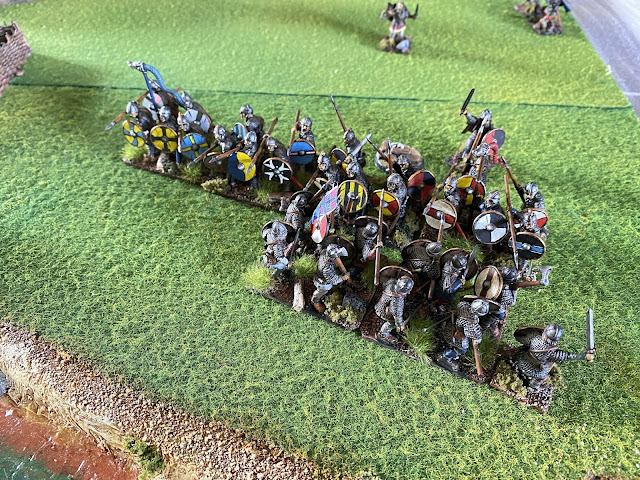


The Vikings win if they push the defending units out of the village and then hold it for two turns or if they destroy half of the Saxon force.
So how did the game run? Well a bit chaotically is the simple answer. In their initial set up the Saxons managed to get a unit of spearmen and one of bows to occupy the village. The Vikings got the most figures on the table first, but both sides struggled with motivation and neither were keen to engage.
Action started on the eastern side of the table with a unit of Hirdsmen boldly crossing the river. They were promptly attacked by a unit of Thegns and the Vikings were pushed back but not broken. The Hirdsmen came back and supported by a unit of spearmen pushed back disrupting two units of Thegns.


Meanwhile the bulk of the Vikings arrived on the southwestern quadrant (except for the unit of spearmen that moved to support the western Hirdsmen), but they struggled with motivation and the spearmen from the village, seeking to catch the Vikings before they could get organised, advanced to meet them, while the bowmen from the village came forward and rained arrows on the Vikings near the ford.

East of the village, the situation for the Saxons worsened and one of the units of Thegns was destroyed and other pushed back and disrupted.
Then suddenly the Vikings in the west moved rapidly and attacked the Saxon spearmen from the village. The spearmen fought bravely and threw back the first attack, but when a unit of Hirdsmen hit them in the front and a spear unit struck their flank, the Saxons were destroyed and the victorious Vikings fell on the rear of a unit of Saxon Thegns who promptly routed into the spears of another unit of Hirdsmen and were destroyed.


At last the much delayed northeastern Saxon wing, consisting of two units of Thegns and some bowmen, came forward. At first they pushed some Vikings back, but when the Vikings counterattacked, the Saxons came off the worst.


By now the village was vacant and more than half of the Saxon units had broken. The battle was ended and the Vikings looted the village.
The simplified rules worked OK, but needs a few tweaks.