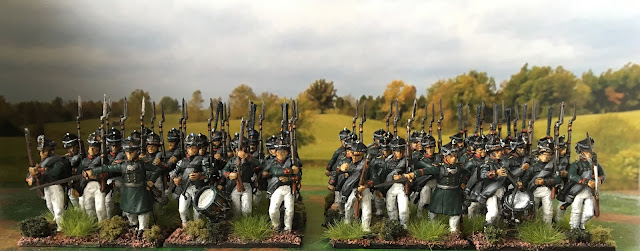
After dreadful night of wind and rain we met up for our first game for the year, the first outing for the Carlist War armies. We had a full turn out of eight players.
Taking the basis of the game from the Battle of Arquiljas (and a very loose basis I might add), the Carlists were defending a river only able to be crossed by three bridges, two of which carried roads to Bilboa, passing through two villages on the Carlist side.
The objective of the Carlists is to keep the Isabelino troops north of the river, while the Isabelinos need to gain control of the villages, an ultimately the roads to Bilboa, south of the river.
The Orders of Battle
Carlist forces
1st Brigade
Naverre Guides (Elite/shock troops)
1st Battalion Valencian Volunteers (Raw)
2nd Battalion Valencian Volunteers (Raw)
1st Battalion Zarragosa Infantry (Trained)
1 Mountain gun (Trained)
1 squadron Cavalry (Trained)
1 squadron Ontorio Hussars (Trained)
2nd Brigade
1st Battalion Girona Infantry (Trained)
2nd Battalion Guipúzcoa Infantry (Trained)
3rd Battalion Guipúzcoa Infantry Trained)
1st Battalion Álava Infantry (Raw)
2nd Battalion Álava Infantry (Raw)
1 squadron of cavalry (Raw)
3rd Brigade
4th Battalion Guipúzcoa Infantry (Trained)
5th Battalion Guipúzcoa Infantry Trained)
3rd Battalion Álava Infantry (Raw)
4th Battalion Álava Infantry (Raw) 1 field Gun (Raw)
1 Squadron of cavalry (Raw)
Isabelino Forces
1st Division
1st Brigade
1st Guard Infantry Battalion (Trained)
1 Light Infantry Battalion (Trained)
1st Battalion, 3rd Infantry Regiment (Raw)
2nd Battalion, 3rd Infantry Regiment (Raw)
Attached – Field Battery
2nd Brigade
1st National Militia Regiment (Raw)
2nd National Militia Regiment (Raw)
2nd Division
1st Brigade
2nd Guard Infantry Battalion (Trained)
1st Battalion, 5th Infantry Regiment (Trained)
1st Battalion, 7th Infantry Regiment (Raw)
2nd Battalion, 7th Infantry Regiment (Raw)
Attached – Mountain Gun
2nd Brigade
3rd Guard Infantry Battalion (Trained)
4th Guard Infantry Battalion (Trained) )
1st Battalion, 11th Infantry Regiment (Raw)
2nd Battalion, 11th Infantry Regiment (Raw)
Cavalry Brigade
1 squadron Line cavalry (Trained)
1 squadron Line cavalry (Raw)
1 squadron Line Cavalry (Raw)
Attached - Horse battery
British Auxilary Legion
Chichester's Brigade
1st English Battalion (Raw)
4th Queen's Own Fusiliers (Raw)
8th Highlanders Battalion (Raw)
Marines (Trained)
Two Spanish Battalions (Raw)
Rocket Battery (Trained)
The Carlists were able to deploy in front of the bridge on their right and as far as the first village, that stood about half way down the table. The Isabelinos could deploy as far as the second bridge. Neither force could be near the third bridge, on the extreme left of the table. On the Carlist side, between the second and third bridge was a significant hill, topped by a wood, and behind it stood the second village.
So the Carlist deployed the 1st Brigade on the left, ready to move further to the left, intending to occupy the left hand village and the hill. The 2nd Brigade was deployed in the other village, able to shift left or right as required. On the right was the 3rd Brigade covering the first bridge.
Above and below, the Carlist occupy the first village
The isabelinos deployed the British Auxilary Legion (BAL) opposite the first bridge. The 2nd Division was to cross the second, or middle bridge, while the cavalry and the 1st Division were to swing wide and flank the Carlists by way of the third bridge.
The flanking column sets off, above, and then crosses the third bridge, below, while below again the 2nd Division crosses at the middle bridge.
While the 1st and 2nd Divisions moved into positions the BAL moved up to the first bridge. Then in a moment of rashness the BAL lancer squadron dashed across the bridge. They rode into a crossfire of canister from the mountain gun and musketry from a battalion of infantry and was stopped dead. The troopers attempted to retrace their steps but another burst of fire sent them scurrying from the field.
Meanwhile the Carlist 1st Brigade took posession of the second village, occupying it with a battalion of Valencian Volunteers supported by the Ontorio Hussars, while the field battery was posted on the crest if the hill, supported by the Navarre Guides and a line battalion. The second Valencian battalion occupied the woods. At the same time the Isabelino 2nd Brigade, 2nd Division, formed line and prepared to take the crest.
On the hill the Isabelino troops struck first as the centre battalion, a raw unit, attacked the Carlist battery. Despite taking a burst of canister in the face the battalion closed on the battery. But the gunners were not prepared to give up their position and fought off the enemy, driving them back down the slope.
Before the Isabelino brigade had time to recover, Merino's lancers dashed over the hill and smashed into another of the raw battalions, routing them and then breaking through onto another battalion beside them. This battalion also routed and then the three broken battalions of 2nd Brigade, deciding that enough was enough, quit the field.
The Isabelino 1st Brigade, 2nd Division, quickly formed into a second line and faced up against the lancers. A solid volley of musketry drove the troopers off.
Meanwhile the Carlist 2nd Brigade were under no threat in the right hand village and marched to the aid of the 1st Brigade that was now threatened by the Isabelino 1st Division and cavalry brigade forming on their left.
The arrival of the Carlist 2nd Brigade allowed them to establish a solid line of defence across the hill. But when the battalions of the Carlist 2nd Brigade attempted to force the issue and charged forward, they failed to break the Isabelino battalion facing them and were eventually driven back.
To try to drive off the Isbelinos from the hill the Naverre Guides stormed forward. But they failed to break the two Isabelino guard units in front of them and a desperate melee ensued in which the guards eventually got the upper hand.
While all this was going on the flanking column was making good progress. The Isabelino cavalry swung around the village, while the squadron of Ontorio hussars formed in the streets to try and catch the enemy in the flank as they dashed past. But the hussars were caught in the rear by the Isabelino light cavalry and routed. The Isabelino line cavalry were now free to swarm through the village.
At the same time the Isabelino 1st Division formed for the attack. The first attempt of the brigade of National Militia to drive the Valencians from the village was unsuccessful, but eventually numbers took their toll and the Valencians made for the hills.
The division then moved past the village and fell on the flanks of the Carlists on the hill. Carlist resistance on the hill was failing. A charge by a unit of Carlist cavalry pushed back a squadron of Isabelino line cavalry, but it only gained a small amount of time and the Isabelino troops swarmed towards the second village.
With more than half of their army either destroyed or in retreat, the Carlists decided that the game was up. The 3rd Brigade, that had been holding the BAL off all day, began to withdraw. A Spanish battalion attached to the BAL now stormed across the bridge to push aside a single battalion rearguard, but was driven back.
The Carlists then abandoned the field and the game ended.
It was a fun game that kept eight of us busy for five or six hours on a blustery Auckland day. It was great to see the Carlist troops on the table.
A View of the Table at the End of the Game.