Thursday, 31 March 2016

Russian Church, part 11

 During the Easter break I took advantage of the fine weather and the free days to work outside on the long neglected base for the Russian church. I had cut the polystyrene for the base a couple of weeks ago, but it just sat there while the painting of figures took precedence.


The church is intended to be a significant feature in the game to be staged later this year. It was to be mounted on a rise, one edge of which will be steep as though dropping off into a ravine or gully, while the other sides are more gentle. A stone path leads up to the front steps of the church and an earthen track leads down through a small graveyard at the other end. 


It had been my intention to surround the crest of the hill by stone walls, in various states of repair. However, the thought if making a metre of stone walls from scratch was just too daunting, so I made wooden fences. This is probably more in keeping with the rural nature of the church. The fences are set far enough from the church itself to allow the troops to stand inside the base.


Saturday, 26 March 2016

More Napoleonics

Since yesterday was Good Friday and almost everything was closed here, I took advantage of the day to finish a couple of Napoleonic Russian items.

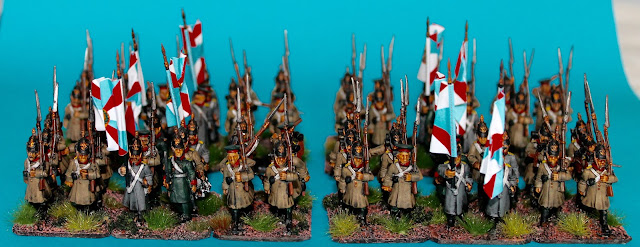
First up was the First Battalion, Narva Regiment. The figures for the second battalion should arrive next week.


Second  up was three mounted officers from Perry Miniatures. These are great little figures to work with.


Sunday, 20 March 2016

Fresh off the Painting Table

It has been a busy week on the painting table, with a number if items rolling off the "production line".

First completed was the Vladimir Infantry Regiment for the Russian Crimean War army. This was half finished last Sunday, and completely painted by Thursday night. Now it is based and ready for storage. This is the third of six regiments I need for the army.

The Vladimir Regiment painted and ready for basing

All four battlions based.

Second completed were the six Russian command figures, giving one base of two figures for a divisional command stand and four single figures for brigade commands.


Third is the second of my Russian Crimean artillery batteries - the second of five batteries.


Fourth is also in the Crimean vein, the Turkish command figures. Since I have struggled to find any such figures, I used the Egyptian command from the Perry Miniatures Sudan range. The two figures that will make up the senior commanders needed to be modified to suit. With a little Green Stuff I added shabraques, epaulettes and, on one figure, a bunch of gold lace on the front of the coat.


Finally was the  second battalion of the Smolensk Regiment for the Napoleonic Russians. I had actually finished painting this about two weeks ago, but only just finished the basing on Saturday.

The second battalion in line

Both battalions in column of divisions, first battalion on the left, the second on the right.


Wednesday, 16 March 2016

Making Things...Again

So I have been making things again.

First up is a small piece I made to fill in while I waited for more figures to arrive. The basic inspiration was the pump and water trough in this fragment of the painting of Rezonville by Ă‰douard Detaille.


I decided I didn't want to make such a tall pump and I wanted it to be a little less rustic that this one - more like something you might find in a town square. I made the trough and pump from various bits of plastic card and left over weapons from various plastic figure projects in the last year. The main part of the pump was made from a piece of plastic tubing. The cap was a literally the cap off the spare head of a War of the Roses figure. The spout and the handle were made of a left over medieval pike, bent as required. The base is two left over plastic bases with the pump and trough glued on. The whole base was then covered with Green Stuff and the flagstones were etched in. The water in the trough is the clear artists texture that I have mentioned in other posts. Here is the result.


Second, in the last year or so I have been a convert to basing with grass tufts. I have bought various types of these in the last year from Silflor, Heki, Noch, Faller, Busch and Gamer's Grass. They seem such an extravagence, but in truth they aren't all that expensive, adding only a dollar or two to the overall cost of a unit, but there is something about this hobby that challenges me to make things and when I went to my friend's place one day and saw him with a battery operate fly zapper, I remembered seeing an article on Eric's "Shed Wars" blog about how to make a grass tuft maker (http://shedwars.blogspot.co.nz/2015/05/a-fly-swat-sieve-and-soldering-iron.html) and I decided I had to have a go.
So I purchased all the components: a fly zapper for $7.00, a stainless steel sieve for $2.00, an alligator clip for $1.25, a set of ten connectors (although I only used two) for 5.75 and a bit of Emerkit epoxy putty at around $0.50, giving an all it cost of $15.50. Following Eric's instructions (actually I didn't follow the instructions to the letter because I made a couple of safety enhancements) I put the whole thing together in about an hour.

The Zapper in its original form...


In its cut down form...

The only other item I needed was a metal plate. Fortunately just as I started thinking about this little project, I had a software vender I deal with at work came to visit from Japan and brought with him a gift of some sweet shortbreads for the staff in the office. These came packed in a tin, the lid of which was a perfect size. When the tin was emptied - which didn't take long - it came home with me. 


And attached to thectin plate, ready for work.
My first attempts were not all that successful. The first thing I did wrong was use PVA glue. It proved to be too rigid. I soon corrected this by using some Woodlands Scenics "Foam Tack Glue" that is used to glue foliage to model trees, is latex based and much less rigid.
The second mistake was to use only the 3mm flock I had on hand. It was too short. I needed to use 6mm flock, but this proved a little more difficult. First I searched for a local supplier but to no avail. Then I found a UK supplier that sold 100g bags with two specific wargames colour mixes for mere £7.00 each. Two bags would make me many thousand tufts. Enthusiastically I added them to the shopping cart and whipped out the credit card...then whoa…what is that...£35.00 for freight! That is over $110 for two bags of flock! I quickly emptied my shopping cart. After I recovered from this shock I found US supplier of model railway supplies that sold bags that were a little smaller, but three bags and freight came to $50.00 and will still make several thousand (possibly tens of thousands) of tufts.

Some 3mm yellow/green tufts


Some dark green 3mm tufts


A single light green 6mm tuft
A selection of 6mm tufts of varying colours

So with those mistakes behind me I got started making tufts. All it takes is my fly zapper static charge dispenser, some grease proof paper (to apply the glue to) and the flock. Soon I had 3mm and 6mm tufts in several colours. I made small tufts, medium tufts, and large tufts. Tufts in “L” shapes, “S” shapes, “T” shapes and some truly odd shapes. I even made some mixed pieces - with 3mm and 6mm flock.
I have enough grass tufts now to base all my current projects, and enough raw materials to make tufts for projects for the next few years.

Sunday, 13 March 2016

Crimean Russian Infantry - the Vladimir Regiment Work in Progress

This week has seen work commence on the next Crimean War infantry Regiment, tha Vladimir Regiment.

The regiment is now exactly half complete. The target is to have the other half completed by next weekend.


We played an AWI game today. Four of us had a lot of fun in a marathon seven hour game.
Here are a few quick snaps.


Saturday, 5 March 2016

Crimean Russian Infantry - the Odessa Regiment

The last of the Odessa Regiment, the second of my Russian Crimean War infantry marched off the painting table today.

Here are a couple of quick shots. If I get any time tomorrow I will set up a proper session and take some better shots of the entire Russian force.


All of the Crimean infantry have been based six figure to a stand. The Allied troops have been based in two ranks on stands with a 50mm frontage and a depth of 35mm to represent the standard two deep line, while the Russians, to represent their preference for deeper columnular formations, have been mounted three deep on a base that has a 35mm frontage and 50mm depth.

Sunday, 28 February 2016

Wars of the Roses Game

Today we played our first game for the year - a Wars of the Roses game. The concept behind the game was originally posted here http://stracmark.blogspot.co.nz/2015/07/wars-of-roses-scenario-idea.html, but the actual rules for the game were as follows:

The Forces 
Henry VII of Lancaster: 
 • One command base
 • One messenger
 • One unit of three stands of mounted knights 
Richard III of York: 
 • One command base
 • One messenger
 • One unit of three stands of mounted knights
Four Noble Retinues (Fauconburg, Talbot, Grey de Codnor, Audley) each of:
 • One leader
 • One unit of three stands of foot knights
 • One unit of three stands of billmen
 • Two units of three stands of archers. 
Mercenaries (not assigned) 
 • Two units of three stands of Crossbowmen
 • Two units of three stands of Handgunners
 • One unit of three stands of Pikemen


The Terrain 
The table contains six specific domains, each of which contains a village, farm or keep as a home base and each is about 1500mm apart. Each domain is has a logical boundary (stream, river, road, hedge row etc). The terrain is rolling with many hedged fields and a few woods. 

Deployment
Before the game commences six black backed cards, each one representing Richard, Henry and the four nobles, are randomly placed face down, one each in one of the home bases. Seven mercenary cards (one for each of the units and two blanks) are placed face down on the table in their start locations. The mercenary cards must be placed at least 500mm away from any of the player cards. 

At the beginning of the game the each player will draw a card from a second,  blue backed, stack of  Noble cards to determine which force they will command. All the noble cards on the table are then turned over and the units belonging to that command are deployed in place. All units deploy within 150mm of the limits of their home base. 

Mercenary cards remain face down until a unit, leader or messenger comes within 200mm of the card, at which time the relevant unit is placed on the table. 


Initiative
At the commencement of each turn Henry, Richard and any noble who has not declared allegiance will draw a card to determine the order of play. Once a noble has joined a faction, they will move with that faction. 

Declaring Allegiance 
Once the rival standards are raised, i.e once Richard and Henry are deployed, the players declare their loyalty.

And so the game develops, until one side concedes defeat or if Richard or Henry are captured or killed. 

Mercenaries that are approached by a unit, a messenger or noble (within 200mm) will roll 1xD6 and a score of 4,5,6 will see them join the approaching noble or messenger, otherwise will remain neutral this turn. Mercenary units will not move or fight until they have joined a faction. If all nobles join one of the Royals, all of the mercenaries will immediately move to join the other Royal. 

Treachery
There is no requirement for players to remain aligned to one side for any length of time, and may change sides at will. Similarly no one needs to respect a noble's neutrality and neutral nobles can be attacked by any faction. Neutral mercenaries, however cannot be attacked. 

Home Base Defence 
Home bases will have an intrinsic defence value equivalent to one unit of peasants (3 stands). The peasants are free to move from building to building within the home base. They are armed with bows but fight at a lower rate than retinue troops.

So how did our game go?
Richard and Henry appeared at diagonally opposite ends of the table and only Grey stood with Henry. To make matters worse for Henry, of the three mercenary cards near him, two were blanks! Henry and Grey decided to try to defend the line of the river.


Richard, with Talbot on the right, Audley on the left and Fauconberg in the centre, gathered up the remaining four mercenary units and marched up the table.

Audley, finding no opposition in front of him (baring a large flock of sheep - that caused a fair amount of comment) crossed the river easily, but then found it difficult to manoeuvre around the woods on the opposite bank. Talbot secured the high hill above the river and then edged forward to engage Grey.


Henry, hoping he could break through and get at Richard, who kept his mounted knights behind the lines, charged at Fauconberg with his mounted knights, driving back two units of archers, but took such heavy losses that he could push no further. The knights withdrew across the river.


Talbot pushed across the river and drove back Grey with some accurate archery, while Henry called "Rally on me!" and led the mounted knights into Audley's leading unit of archers, routing them. But again Henry's knights ran out if steam. 


However, the shock of the attack of Henry's attack must have shaken Fauconberg's resolve because he changed sides, attacking Richard and Talbot. Richard's knights easily beat Fauconberg's mercenaries back and Talbot, having forced Grey back, turned back to face the new threat.


Fauconberg's treachery soon turned against him as his command was slowly taken apart by Talbot and a unit of German crossbowmen. After a couple of turns his command collapsed and fled the field.

Richard then turned his attention to Henry and Grey. The writing was on the wall, and although Grey checked Talbot, Audley was largely untouched and pressed forward, destroying Henry's only mercenary unit. 

A final fight between Henry and Richard, led to Henry's demise. For his treachery Fauconberg was found hanging from a tree, while Grey, bound to a chair, watched with alarm as Richard and Talbot heated pokers in the fire.