Sunday, 25 October 2020

A Welcome Retreat

Sometime between 0830 and 1400 hours on Tuesday 27 October (NZDST) and again between 1400 and 1800 hours on Sunday 1 November two strange events will affect our world (although many may be thinking just how much stranger things can get in the world at the moment). This strangeness might manifest itself as simply as a picture frame tilting on a wall, the weather might abruptly change, water in fish tanks and swimming pools may slosh about, and shelves may tip or sway - it might be wise to secure delicate and valuable objects.

And what, you ask, is this phenomenon? The answer is simply that the centre of gravity of the earth is about to shift. It has happened every year over the last 36 years, although never on the same day, and in extreme cases tsunamis may result, crops may fail, governments have been known to change and global warming can weaken or intensify.

The root cause of all of this is a group of wargamers making their annual pilgrimage to Lake Tarawera for a wargames retreat. This sudden movement of several thousand metal figures, buildings, model trees, bottles of wine, beer, aperitifs and food causes the earth to tilt on its axis.

Given the tumultuous times we live in I am not sure that any of us really believed that this event, that we eagerly await every year, would happen this year.

We are fortunate in that we live in a country we have managed to keep COVID pretty much under control, thanks to our small population and that as an island nation separated from our nearest neighbour by more than 1000 km we are able to secure our borders. It is hard for me to imagine just how difficult things are for readers in countries facing the second wave.

Still we are not immune to the economic impact of the pandemic with tourism, one of our largest industries, decimated. My employer, heavily dependent on tourism, has layed off 4,500 of its 12,000 staff and many more of us have voluntarily reduced hours. The impact of all of this on mental health by way of stress and anxiety cannot be underestimated and is plainly obvious on the faces and in the actions of work colleagues. 

I must admit that when last week it looked like a new cluster of infection was developing and another lockdown seemed possible, my heart sank. But now as that possibility begins to fade I am incredibly  grateful to our host for making possible five days of gaming in the company of good friends.

So be ready for that gravitational shift and if you listen carefully you may just hear that ”YAHOOOOOO” that will be emanating from my car as I get under way.

Saturday, 24 October 2020

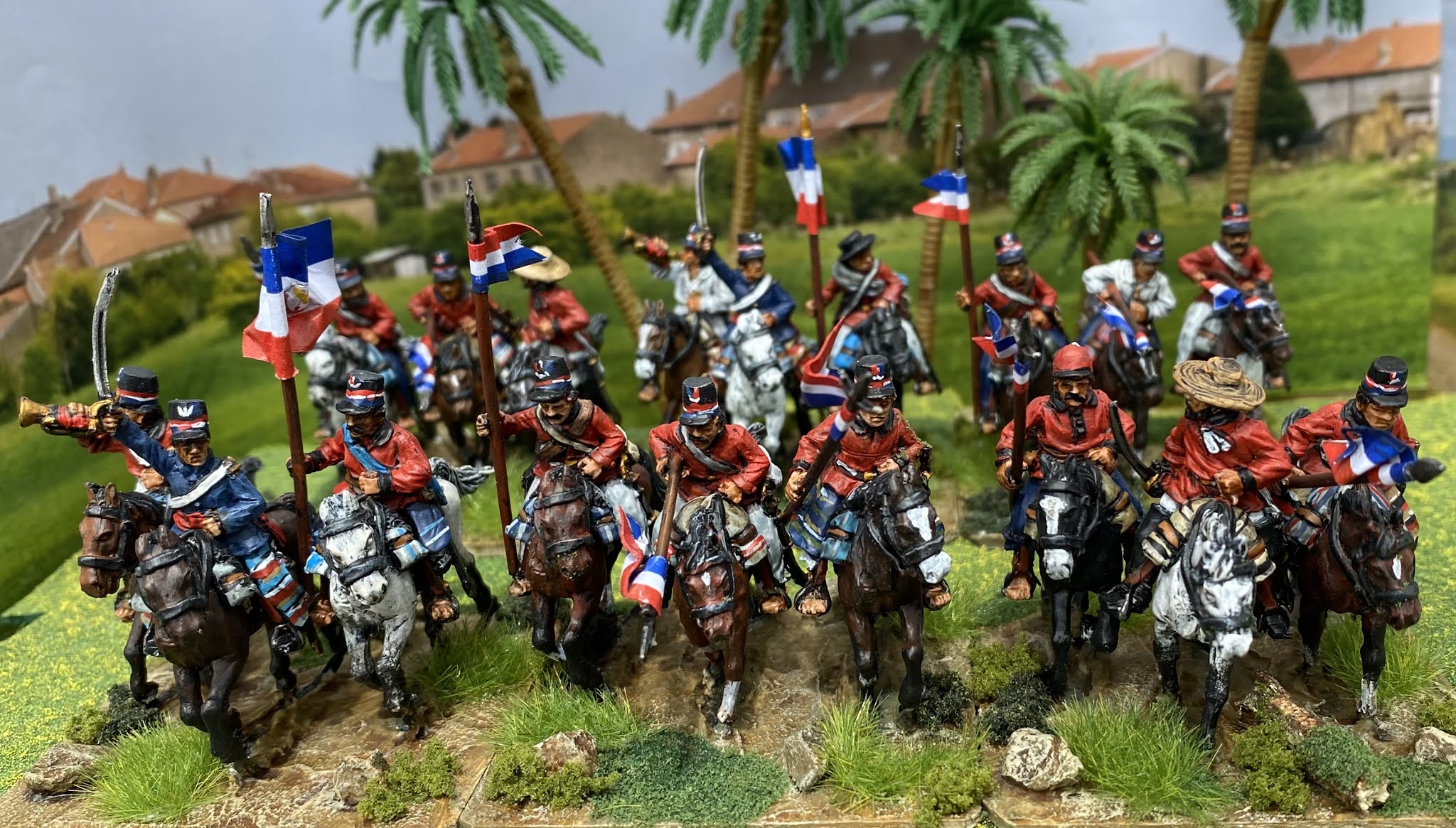
Two more Paraguayan Line Cavalry Units

Started sometime last week, today’s post features the second and third, and possibly the last, of the Paraguayan line cavalry. It won’t be the last of Paraguayan cavalry though because two units of militia cavalry are lurking in little boxes in my study.


In one of the units have added a few figures in captured blue trousers and white shirts instead if red, just to get a little variety.


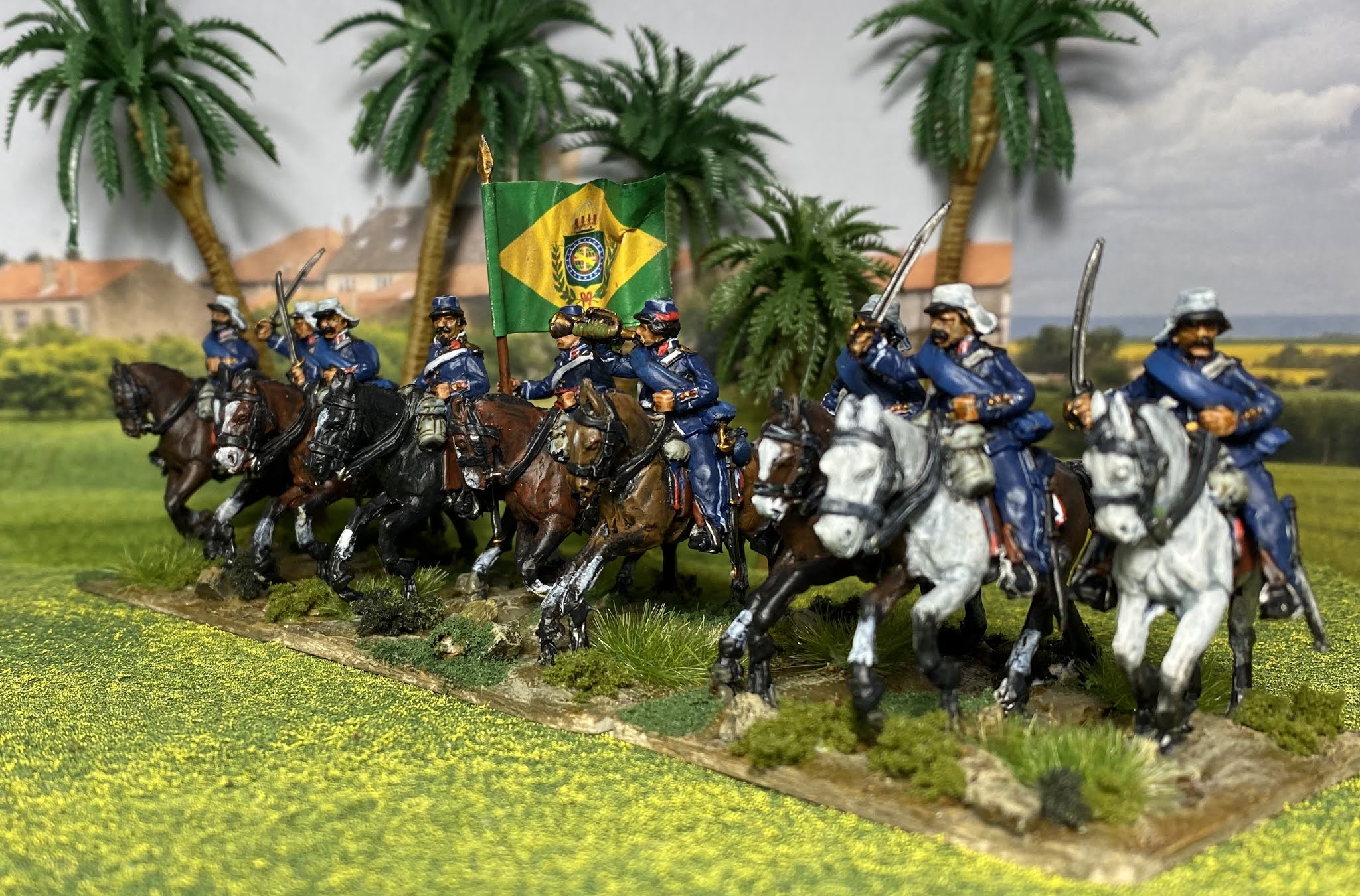
Next in the painting queue is a unit of Brazilian lancers.


Sunday, 18 October 2020

First Carlist War Game

Today we played our first games as a Group since 9 August. It was great to get together again.

The choice of period was the First Carlist War which I set up with a Carlist force of 21 battalions, six cavalry units plus two field guns and two mountain guns defending a small town in front of which ran a stream. All of the Carlist infantry, except for two small units, were classed as a raw, while the cavalry and artillery were rated trained. Opposing them was a Royalist force of 5 battalions of Royal Guards, 11 of line infantry, 4 battalions of British Legion, 4 battalions of the French Foreign Legion, five cavalry units 2 field guns, 2 mountain guns and two rockets. Of the Royalist force, the guard and French infantry, all the cavalry and artillery were rated trained, while all other troops were rated raw.

The Carlist sought to turn the Royalist right with the cavalry and infantry brigade (my command), while the Royalists decided to hold their right and attack with  the center and left against the Carlist position. 

So what actually happened? Well the Carlist cavalry did gain the Royalist right with some ease, but it took time. Eventually, supported by a brigade of  Carlist infantry, they succeeded in  breaking the French and then were poised to sweep into the Royalist rear. Royalist center tried to take the Carlist centre and made some headway but in then end failed because the collapse of the French freed up units to flank the centre Only on the Royalist left did the Royalist make headway, but the collapse of the troops to their right ended  the battle for them.

I am sure my friend Keith will post a view of the game from his side of the table.

So to my photos:

The Carlist cavalry commence their turning movement 
A brigade of Carlist infantry moves in support
The Royalist centre, the British in the lead, followed by the Royal Guard, advance
The Carlists put pressure on the French
The Carlist artillery in action
The Carlist cavalry sweep around the Royalist flank
The action on the Royalist left (Carlist right)
The Carlist cavalry engages the French...this shot was tajen just after the Polish Lancers were destroyed
The action on the Royalist left continues...complete with a rare “six” rolled by the Royalist player
The French collapsed leaving the centre exposed.
The Royalist on the left put pressure on the Carlists 
The Carlists in the centre press across the stream to engage the weakened Royalists 
My glorious Carlist cavalry
Another shot of my glorious cavalry 
More action on the Royalist Left
The Royalist heavy cavalry advance
The end of the game, only the Royalists on the left remain in action...the rest have quit the field


J

Friday, 16 October 2020

Paraguayan Line Cavalry

 Yesterday saw the completion of the first of three Paraguayan line cavalry units.

There is a good variety of figures for the Paraguayan troopers with a command set of three figures and then three separate sets - couched lance, lance upright and then lance sort of in between - and each set has three different figures. This combined with three different horse types means that no one figure is repeated in the unit.


The bright red coats really make these guys pop. The other regiments may be given a little more variety with the occasional white shirt and different coloured trousers.

Wednesday, 7 October 2020

Brazilian Cavalry

Today saw the completion of the first of the Great Paraguayan War Cavalry.

This one is a regiment of Brazilian line cavalry.


A second line regiment and a regiment of lancers will join them before the project is completed.

Next on the production line is the first of five Paraguayan cavalry units.

Saturday, 3 October 2020

Dark Ages Game

Yesterday I played another solo game and again I wanted to use armies that had not seen the table for a while. In this instance I chose to use troops that have never been on the table, the Dark Ages Saxons and Vikings that I had painted some years ago. I had even written a simplified set of rules, based around my standard rules concepts.

I decided to play a small game with the Vikings attacking a Saxon village. I set up a small 1200mm x 1200mm table with a village in the centre of table. 

The Saxons could have up to three units in the village at the start of the game. First they roll 1xD6 and if the score is “6” then there will be three units, otherwise there will be just two. Once the number of units is determined they will roll 1xD6 for each unit and a 1,2 or 3 will mean the unit is spearmen, while a 4,5 or 6 will mean it is bowmen (only two units can be of the same type). All other troops arrive by dice roll to arrive on the table.

The Vikings will arrive at positions V1-6 and each turn will require a score of 4+ to bring on each of the following: 2 leaders, 2 musicians, 4 units of Hirdsmen, 2 of spearmen and one of bowmen. Once arrival is determined the units will roll again to determine which of the arrival points they appear at. 

The Saxons will arrive at positions S1-6 and each turn will require a score of 4+ to bring on each of the following: 2 leaders, 2 musicians, 4 units of Thegns,  1 or 2 of spearmen and one of bowmen. Once arrival is determined the units will roll again to determine which of the arrival points they appear at. 

The Vikings win if they push the defending units out of the village and then hold it for two turns or if they destroy half of the Saxon force.

So how did the game run? Well a bit chaotically is the simple answer. In their initial set up the Saxons managed to get a unit of spearmen and one of bows to occupy the village. The Vikings got the most figures on the table first, but both sides struggled with motivation and neither were keen to engage. 

Action started on the eastern side of the table with a unit of Hirdsmen boldly crossing the river. They were promptly attacked by a unit of Thegns and the Vikings were pushed back but not broken. The Hirdsmen came back and supported by a unit of spearmen pushed back disrupting two units of Thegns.


Meanwhile the bulk of the Vikings arrived on the southwestern quadrant (except for the unit of spearmen that moved to support the western Hirdsmen), but they struggled with motivation and the spearmen from the village, seeking to catch the Vikings before they could get organised, advanced to meet them, while the bowmen from the village came forward and rained arrows on the Vikings near the ford.


East of the village, the situation for the Saxons worsened and one of the units of Thegns was destroyed and other pushed back and disrupted.

Then suddenly the Vikings in the west moved rapidly and attacked the Saxon spearmen from the village. The spearmen fought bravely and threw back the first attack, but when a unit of Hirdsmen hit them in the front and a spear unit struck their flank, the Saxons were destroyed and the victorious Vikings fell on the rear of a unit of Saxon Thegns who promptly routed into the spears of another unit of Hirdsmen and were destroyed.


At last the much delayed northeastern Saxon wing, consisting of two units of Thegns and some bowmen, came forward. At first they pushed some Vikings back, but when the Vikings counterattacked, the Saxons came off the worst.


By now the village was vacant and more than half of the Saxon units had broken. The battle was ended and the Vikings looted the village.

The simplified rules worked OK, but needs a few tweaks.


Friday, 2 October 2020

A Little Parade.

 Last night saw the completion of the sixth battalion of Paraguayan infantry. This is the last infantry unit in the lead pile for a while.


And now for a parade of the Great Paraguayan War armies so far.

Six battalions of Paraguayan infantry.

Eight battalions of Argentine infantry

Two Brazilian battalions


Next up is the first of the cavalry for the Paraguayan War.