Sunday, 15 April 2018

The 11th Light Dragoons

For some time now I have been using three stands as the standard for my units. I started this with the Austro-Prussian War armies and have continued it through the Russo-Japanese War, WWI, Crimean War, Carlist War and Wars of the Roses collections. The number of figures on a base varies only slightly – I use three figures on the early 20th Century stands, where the formations are more open, but for the other periods I use six figures for infantry and three for cavalry. For the six and three mix works out well because all the ranges I have bought recently have been from manufacturers who sell their figures in packs of six infantry or three cavalry.


The physical size of the stands can differ with the period. Most have 50mm frontage and 40mm depth (although the Russian Crimean War stands are 40mm x 50mm to represent the fact that the Russians generally used narrow, deep formations). The Napoleonic armies (Prussians, Russians, French and United States) are on slightly narrower bases, 45mm x 40mm to match with others in the group. The Napoleonic ranges also vary in unit size, being of four stands, not three, again to fit in with the long standing standard unit size we have chosen for play within the group.


Left to right above a stand each of Austrians from 1866, WSS Bavarians, Carlists, British Crimean, Russian Crimean, French Napoleonic.


When I started the Egyptian project I thought long and hard about unit size. Since no one else in the group is collecting these armies I can use the three stand approach.


Looking at the various historical sources the “fit for service” strengths for infantry units on both sides varied radically from 700 men through to less than 100. The cavalry strengths were equally varied, with the British suffering from a severe shortage of horses – so  much that in the first month of the campaign less than one-third of their cavalry had mounts (of the 1,101 light dragoons listed in the returns of 8 March 1801, there were only 320 horses). The bulk of the British cavalry fought dismounted.


So my question for the Egyptian campaign was whether to  try to capture the varied strength of units. And the answer is on the whole no. The exception is the British cavalry. Here I will create three mounted units and two dismounted units, each of two stands. Which leads to the point of this post

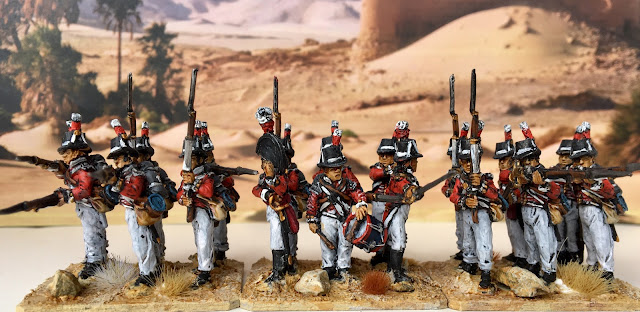
with the first unit of British in Egypt cavalry – the 11th Light Dragoons - passing in review:


Mounted (using the Perry plastic Light Dragoon set)


Dismounted, and armed with muskets rather than carbines, using the metal figures.


The other units that will follow will be the 8th and 26th Regiments, but I still need some more figures to complete these units so it may be a while before they shuffle onto the parade ground.

Saturday, 14 April 2018

The 13th (1st Somersetshire) Regiment of Foot

It has been a bit of trying week. A significant storm hit us on Tuesday night taking out electricity twice in three days (limiting painting time as a result), causing some minor damage to my roof, but major disruption to my days trying to get a reliable tradesman to come and fix it before a fresh storm hit us last night. But it is all resolved now and the painting schedule is back on track with the completion of the 13th Regiment of Foot.


With a history dating back to 1685, this regiment served in the first Jacobite uprisings in Scotland, Ireland, the War of Spanish Succession, the Anglo-Spanish War, the War of Austrian Succession, the “Forty-Five”, in the Carribean during the American Revolution and the early stages of the French Revolution, before being sent to Egypt in 1801, where it served first in Craddock's Brigade then later in Doyle's Brigade.


Shako Plate of 13th Regiment in 1812, with the Egypt honour at the top.


Again I have done this unit is round hats.


This is the ninth infantry unit of this British in Egypt collection and is the last of the infantry units in this batch of figures. Another six units will be ordered towards the end of this month to complete the infantry contingent.

Sunday, 8 April 2018

War of Spanish Succession Game

Today's regular Sunday game was a War of Spanish Succession extravaganza in which an Anglo/Dutch/Austrian force took on a Franco/Spanish/Bavarian force. The scenario was a simple one both sides were to annihilate the opposition.

The opposing commanders had to plan thier battle and issued orders to thier subordinates, who could not vary from these orders unless they received instructions from the CinC. By chance each commander deployed completely opposite to the other, each deploying their cavalry on their left and infantry to the right.

The Bavarians and Spanish deployment 

The English lines

The French artillery

The Austrian and Dutch deployment 

The Franco/Spanish cavalry deployment

The French started the game, advancing a brigade against the Austrians.


The Austrians moved to counter the French advance.


While the Bavarian and Spanish moved to control the right flank


The Franco/Spanish cavalry waited an opportunity to advance.


The English lines advanced unopposed at a very leisurely pace.


The English guns deployed


The Austrians and French drew closer...


...then clashed 


The French infantry stumbled...


...and two battalions on the left of the line were driven off and disoersed.

The English, Dutch and Austrian cavalry arrived opposite the Bavarians. 


They attacked the Bavarians...


...breaking one of the Bavarian battalions, but were halted by the Bavarian second line.


The English cavalry then attacked the second French brigade, but were beaten off.


But a gap opened in the Franco/Bavarian line that the Austrian cavalry rode through eventually dispersing the French artillery.


Meanwhile the Bavarians and Spanish drove off the rest of the English cavalry and took control of that flank.


In the centre the remnants of the French cavalry pushed back the Austrians, but could not break them.


Soon the remaining Austrians destroyed the last of the French troopers.


Belatedly the English formed up on the French left and advanced.


On the Franco/Bavarian right the Bavarian and Spanish, now free of the English cavalry formed up to face the distant English line.


Here the game ended with both armies having turned each other's right flank. The French, Austrian and Dutch commands and all the cavalry were all but destroyed.

Here the game ended. Neither force managed to destroy the other.

Below are the final positions.


Saturday, 7 April 2018

More Marines

The week has seen the completion of the second battalion of Marines.


Next on the painting table is the 13th Regiment of Foot.

Wednesday, 4 April 2018

The Guards...and a Goat

The Easter break has seen the completion of the Guards Brigade for the British in Egypt...and a goat. 

The brigade comprises of two battalions: the 1/Coldstream Regiment of Foot Guards and 1/3rd Regiment of Foot Guards. I have done these with stovepipe shako.

First is the Coldstreams


And then the 3rd Regiment of Foot Guards


And why the goat? 


Well after Lawrence's and Iain's comments about the gaot that is the mascot of the 23rd Foot I felt obligated to make the effort. This piece was on a sprue of farm animals I bought to fill out a recent Warlord Games order and was just crying out to be the 23rd's mascot. There was a temptation to have a before and after model, but I couldn't find the time to make a goat roasting over a fire on a spit.